


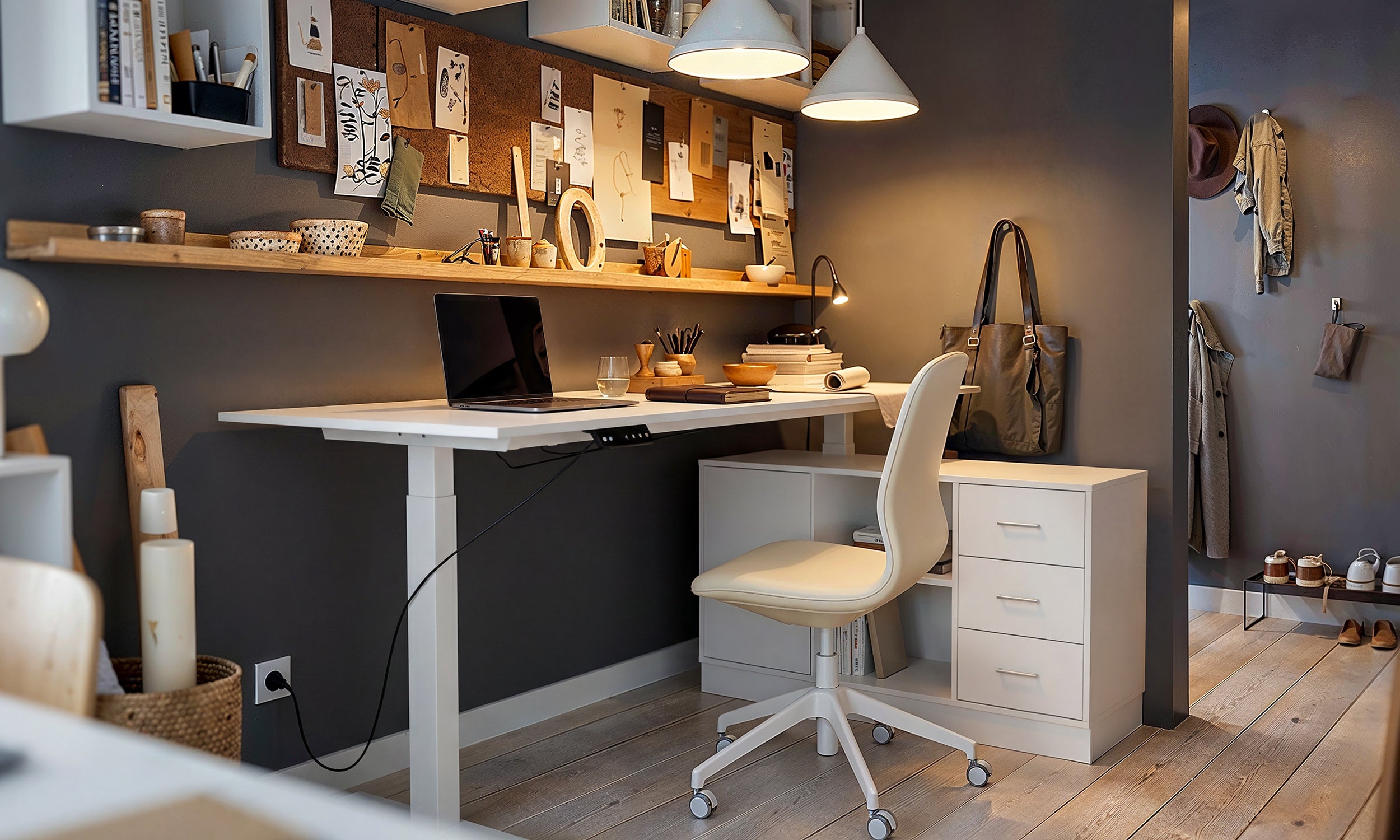
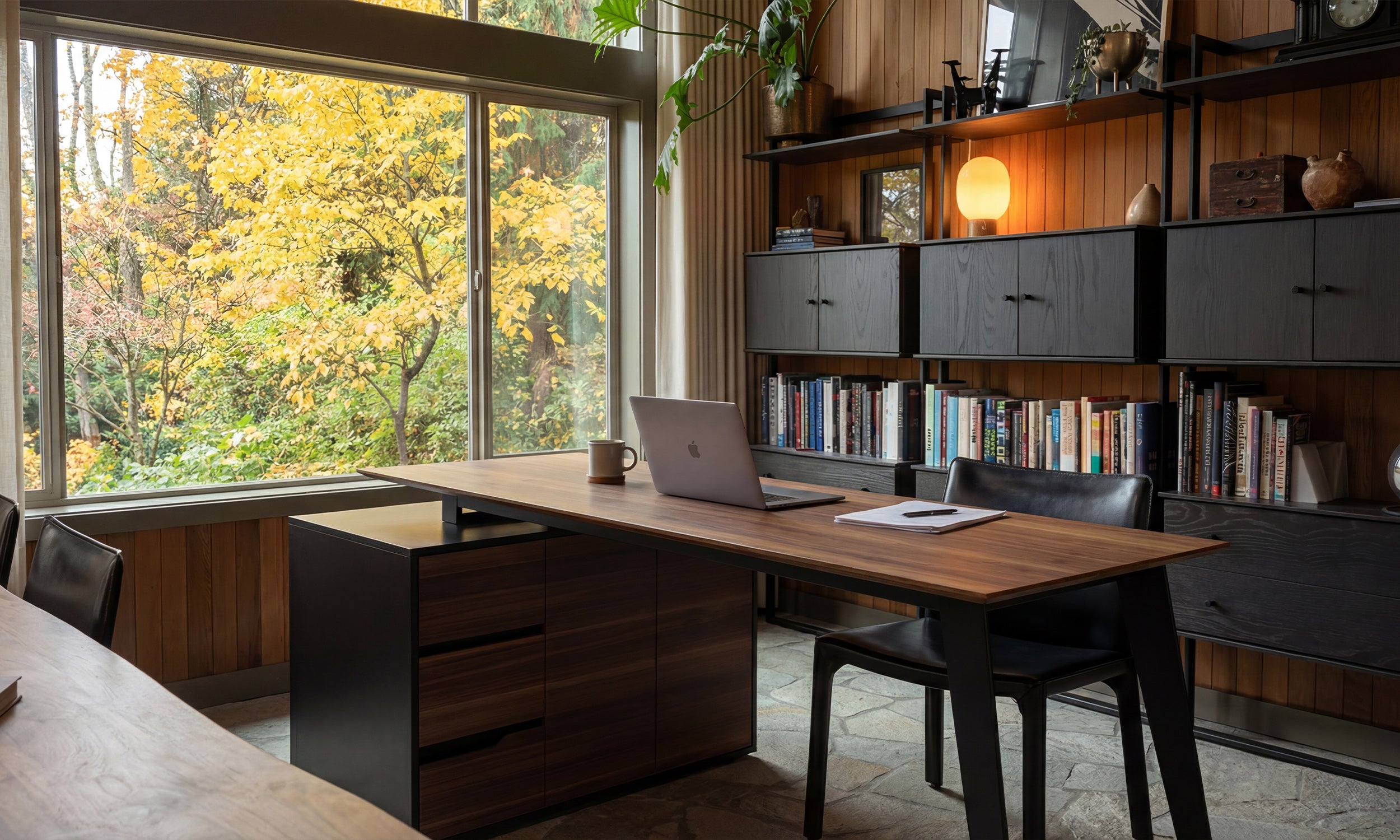



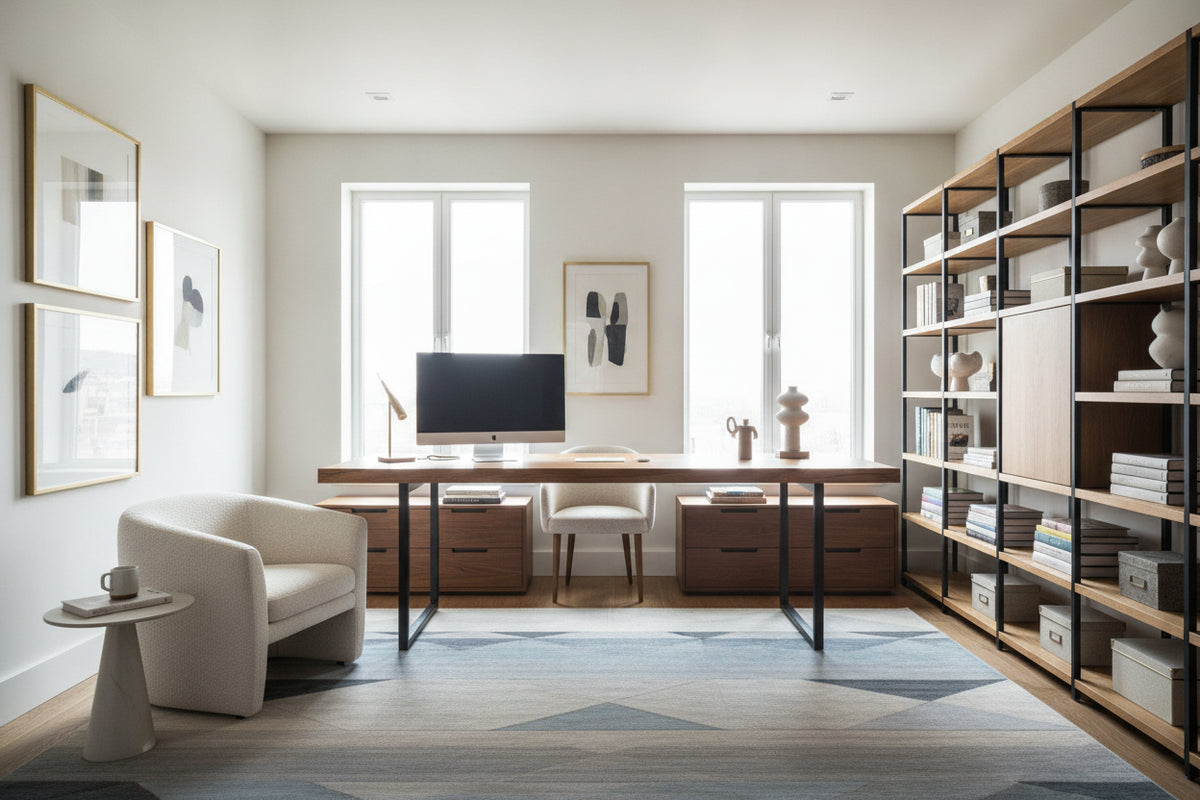
A 100 inch desk is 8 feet 4 inches long: enough for two people side by side, or one long workstation for gaming, drawing or a whole wall of storage. Few freestanding desks come that long, since planning guides put a one-person desk at 48 to 72 inches wide, so most people get there one of three ways: a long desk of about 90 to 95 inches, a long reception or conference-style piece, or two desks side by side, such as two 51.2-inch desks for 102.4 inches.
Below: room size, elbow room, support, cords and moving it in, then six long options from the FUFU&GAGA writing and computer desk collection with sizes from each listing.
Key takeaways
- Wall: a true 100-inch desk does not fit an 8-foot (96-inch) wall. A 9-foot wall leaves 8 inches; a 94.5-inch desk fits an 8-foot wall with 1.5 inches to spare.
- Room depth: desk depth + a 42-inch chair zone + a 30-inch walkway, about 96 to 102 inches for a 24 to 30 inch deep desk.
- Two people: 100 inches gives each person 50, inside the 48 to 60 inch range planning guides give for one desk.
- Support: sag grows with the fourth power of the span, so a long top needs a middle leg, drawer stack or panel, or two separate desks.
How long is a 100 inch desk, and who needs one?
100 inches divided by 12 is 8.33 feet, or 8 feet 4 inches. The workstation clearances on Dimensions.com list desks at 48 to 72 inches wide, 24 to 30 inches deep and 28 to 30 inches high, and the home office size guide from Plan7Architect calls 48 to 60 inches standard. A 100 inch long desk is beyond both, which is why stores rarely stock one.
It earns its wall when you need zones: two workstations with a shared printer between them, a gaming setup with three monitors, or a computer at one end and a drawing mat or sewing machine at the other. Otherwise a 60 to 72 inch desk is easier to place and support.
How much room does a 100 inch desk need?
Measure the wall and the depth from it into the room. Planning figures from Plan7Architect and Dimensions.com:
| Measurement | Planning figure | Source |
|---|---|---|
| Desk depth | 24 to 30 in | Both |
| Chair zone behind the desk | 36 in minimum, 42 to 48 better; 36 to 42 for a rolling chair | Plan7Architect; Dimensions.com |
| Walkway past a desk or chair | 30 to 36 in | Plan7Architect |
| Office for two people | 150 to 200 sq ft | Plan7Architect |
The wall. A 100-inch desk needs at least 100 inches of clear wall, so it will not fit an 8-foot (96-inch) wall. A 9-foot (108-inch) wall leaves 8 inches; a 12-foot (144-inch) wall leaves 44, enough for a 30 to 36 inch path to a door at one end.
The depth. Add desk depth, a 42-inch chair zone and a 30-inch walkway: 24 + 42 + 30 = 96 inches for a 24-inch-deep desk, 30 + 42 + 30 = 102 inches for a 30-inch one. So plan on a room about 8 to 8.5 feet deep before any furniture on the opposite wall.
The room. Plan7Architect suggests at least 150 square feet for two desks in one room, about 10 x 15 feet. A 12x12 room (144 square feet) comes close: the desk leaves 44 inches beside it and 144 - 96 = 48 inches behind the walkway for shelves. See our 12x12 office layout guide. A long desk rarely suits a small bedroom; see our guide to a desk in a small bedroom.
Can two people share a 100 inch desk?
Yes. 100 / 2 = 50 inches per person, inside Plan7Architect's 48 to 60 inch range for one desk. Shorter desks give less: a 94-inch desktop gives 47 inches each, a 90.6-inch one 45.3. Screens decide whether that is enough. A 16:9 monitor is about 0.872 times its diagonal wide:
| Monitors per person | Width before stands | Fits 50 in each? | Fits 47 in each? |
|---|---|---|---|
| One 27 in | About 23.5 in | Yes, with room for papers | Yes |
| One 32 in | About 27.9 in | Yes | Yes |
| Two 24 in | About 41.8 in | Yes | Yes, just |
| Two 27 in | About 47 in | Just | No room to spare |
Depth matters too. OSHA's guidance on computer desks says the surface should let you place the monitor directly in front of you, at least 20 inches away. On a 23.6-inch-deep top that puts the screen near the back edge; a 40-inch or deeper table leaves room to spare.
Two people on one top also share every bump. If you each want your own height, two desks are more flexible; our his and hers desk guide compares five two-desk layouts.
Does a long desk need a middle leg?
Usually, yes. For a top supported only at its ends and loaded evenly, maximum deflection is 5qL⁴ / 384EI, per the Engineering ToolBox beam formulas, where L is the span. Because sag rises with the fourth power of the span, a 100-inch span of the same top sags about (100 / 60)⁴ = 7.7 times as much as a 60-inch span under the same load per inch. A support in the middle halves the span, and by the same formula each half sags about (1/2)⁴ = 1/16 as much.
So look in the photos and diagram for a drawer stack, middle leg or panel; two separate desks avoid the problem, since each span stays short. Keep the knee space clear: OSHA says leg clearance should generally be 20 to 28 inches high and free of files, CPUs, books and storage, so set a tower beside your knees, not in front of them.
Cable management on a long desk
A monitor at one end of a 100-inch desk can be 8 feet from the outlet, so plan power first. Give each workstation its own power strip: the U.S. Fire Administration advises strips with internal overload protection and warns against overloading outlets or strips. Mount strips under the top or in a cable tray so cords drop at one or two points, and run them along the wall, not across the floor; the USFA also warns against cords where they can be pinched, such as under a rug.
Getting a long desk into the room
Our long desks arrive flat-packed for assembly, so build yours in the room where it will stay: a finished 90-plus-inch desk is hard to turn through a doorway. Our guide to assembling flat-pack furniture covers the steps.
- Weight: the long desks with hutches below weigh 264 and 266 lb; the reception desk, conference table and 83.8-inch desk weigh 132 to 137 lb. Use two people for any long top.
- Ceiling: an 86.6-inch hutch 23.6 inches deep, built lying down, has a diagonal of about 89.8 inches (the square root of 86.6² + 23.6²) as you stand it up, so it clears an 8-foot (96-inch) ceiling.
- Anchoring: the CPSC's Anchor It campaign says anchoring furniture with drawers, doors and shelves to the wall prevents tip-over injuries and deaths. Both desks with hutches include hardware to attach them to the wall: use it, as in our guide on how to anchor a bookcase to the wall.
Our picks: long desks and a matching pair
No desk in our range is exactly 100 inches long. These six come closest. Sizes are W x D x H from each listing.
94.5" Modern White Desk with Hinged Doors and Pull-out Drawers
Our closest single desk to 100 inches: 94.5" W x 23.6" D x 86.6" H overall, with a 94" x 23.6" desktop at 29.5 inches. The listing describes the desktop as two workstations side by side, and the photos show a drawer stack in the middle that also supports the top. Above is a hutch of open shelves and hinged-door cabinets with 8 interior shelves; there are six drawers in all. White solid and manufactured wood (MDF), 264 lb, with hardware to attach the desk and cabinets to the wall.
Best for: two people on one wall of 8 feet or more who want a built-in look and shared storage.
Skip it if: you have under 86.6 inches of clear wall height, each person runs two large monitors (see the table above), you need hanging files (the drawer interior is listed at 3.3" H x 13.8" D), or one of you wants to stand.

90.6" Transitional Black Computer Desk With Light And Glass Hinged Doors
A long black desk at 90.6" W x 23.6" D x 82.7" H, with the desktop at 29.5 inches. The hutch has five glass-door cabinets and five small open shelves lit by three-color LED lights, and the photos show cabinets under both ends and a center leg between the two knee spaces. Four drawers hold 15 lb each, the spec lists a USB port, and wall-attachment hardware is included. 266 lb.
Best for: a long display wall, or two people with one monitor each.
Skip it if: you need a file drawer for hanging folders (the listed drawer interior is 2.4" H x 14.4" D, too shallow), your wall is under 90.6 inches, or you have less than 82.7 inches of clear height.
86.6" Contemporary White Reception Desk With Solid And Manufactured Wood
A long reception desk that works as a home office desk facing into the room: 86.6" W x 23.6" D x 39.3" H, with the work surface at 31 inches behind a raised front panel. The back is finished, so it can stand away from a wall, and the photos show a center panel under the work surface. Solid and manufactured wood top with a scratch-, heat- and UV-resistant white finish, open shelves, 136 lb; the listing says one person can assemble it.
Best for: a home business or studio where clients come in, or a long desk set in the middle of a room.
Skip it if: you want drawers or closed storage, which the listing does not show, or you are short: 31 inches is above the desk height range on Dimensions.com, and OSHA's fix is to raise the chair and add a footrest.

86.8" Modern Black/Wood Conference Table for Meetings, Gaming and Dining
A table-style desk at 86.8" W x 47.2" D x 29.4" H, in walnut or black. The depth lets two people sit facing each other, each with the full length, instead of splitting it side by side. The listing calls it a large desk that doubles as a conference, gaming or dining table. MDF top on a solid and manufactured wood and stainless steel base, water- and scratch-resistant, 132 lb; the diagram shows a leg frame at each end and no middle leg.
Best for: a partner desk in the middle of a room, or a multi-monitor gaming or editing setup that needs depth.
Skip it if: you need drawers or shelves (it has none), the room can't take a chair zone on both sides (see the comparison below), or you plan heavy equipment, since the listing copy does not confirm a weight rating.
83.8" Modern Dark Brown Writing Desk with Cable Management
A deep solid pine desk at 83.8" W x 40.1" D x 31.1" H in dark brown wood grain. Panel legs form a double pedestal base at the ends, and a 0.79" gap down the center of the plank-style top lets cords pass through. The listing gives a 330 lb weight capacity and says it also works as a meeting or dining table. 137 lb; a screwdriver is needed to assemble it.
Best for: one person who spreads out papers or drawings, or two people facing each other for shared work.
Skip it if: you want storage (none is listed) or you are short: at 31.1 inches it is taller than the usual desk height range, so plan a higher chair and a footrest.
Two 51.2" Minimalist Solid Wood Writing Desks, side by side
The matching-pair route. Each desk is 51.2" W x 27.6" D x 28.7" H in solid rubberwood with a brown finish, rounded corners and a trestle-style base; two side by side run just past 100 inches. Each holds 80 lb and weighs 60 lb, so each span stays short and easy to move. The listing does not say the desks connect, so set them edge to edge or with a small gap.
Best for: two people who want the look of one long desk with separate tops, so one person's typing doesn't shake the other's screen.
Skip it if: your wall is too short for two (see the comparison below), you need drawers (there are none), or your equipment is heavy for an 80 lb rating.

Compare the picks
| Pick | W x D x H | Work surface height | Support shown | Room depth needed |
|---|---|---|---|---|
| 94.5" desk with hutch | 94.5 x 23.6 x 86.6 in | 29.5 in | Center drawer stack | 95.6 in |
| 90.6" black computer desk | 90.6 x 23.6 x 82.7 in | 29.5 in | End cabinets, center leg | 95.6 in |
| 86.6" reception desk | 86.6 x 23.6 x 39.3 in | 31 in | Center panel | 95.6 in |
| 86.8" conference table | 86.8 x 47.2 x 29.4 in | 29.4 in | End frames only | 131.2 in for two facing chairs |
| 83.8" writing desk | 83.8 x 40.1 x 31.1 in | 31.1 in | End panel legs | 112.1 in |
| Two 51.2" desks | 102.4 x 27.6 x 28.7 in | 28.7 in | Two separate desks | 99.6 in |
Room depth = desk depth + 42-inch chair zone + 30-inch walkway (23.6 + 42 + 30 = 95.6). For the conference table, a chair zone on each side: 42 + 47.2 + 42 = 131.2 inches, about 11 feet.
Two desks side by side or one long desk?
Two desks are often the easier route to 100 inches. Beside the pair above, two of our 47.2-inch wooden minimalist study desks make 47.2 + 47.2 = 94.4 inches, which fits an 8-foot wall. Buy two of the same model: different desks rarely share a height, and a step between tops catches papers. One long desk wins on a built-in look and shared storage; two win on short spans and lighter pieces.
100 inch desk checklist
- Wall: at least 100 inches clear for a true 100-inch desk, 94.5 for our longest single desk.
- Depth: desk + 42-inch chair zone + 30-inch walkway, about 96 to 102 inches.
- Two people: 48 inches or more each; two 27-inch monitors alone take about 47.
- Support: find the middle leg, panel or drawer stack in the photos or diagram.
- Knees: 20 to 28 inches of clear leg height, with no tower in front of them.
- Power: one overload-protected strip per person, cords along the wall.
- Hutch: check clear wall height and anchor it.
FAQ
How long is a 100 inch desk in feet?
8.33 feet, or 8 feet 4 inches, so it needs a wall longer than 8 feet. A 9-foot wall leaves 8 inches to spare.
Is a 100 inch desk big enough for two people?
Yes. Each person gets 50 inches, inside the 48 to 60 inches planning guides give for one desk: enough for two 24-inch monitors each, with little to spare for two 27-inch ones.
How deep should a 100 inch desk be?
Planning guides give 24 to 30 inches, and OSHA says the monitor should be at least 20 inches away. A 40 to 47 inch conference-style top lets two people face each other.
Can I put two desks together to make a long desk?
Yes, side by side: two matching 51.2-inch desks make 102.4 inches, two 47.2-inch desks 94.4. Unless a listing says they connect, set them edge to edge, and buy the same model so the tops match.
Compare lengths, depths and heights against your wall in the FUFU&GAGA writing and computer desk collection.

Leave a comment
This site is protected by hCaptcha and the hCaptcha Privacy Policy and Terms of Service apply.