










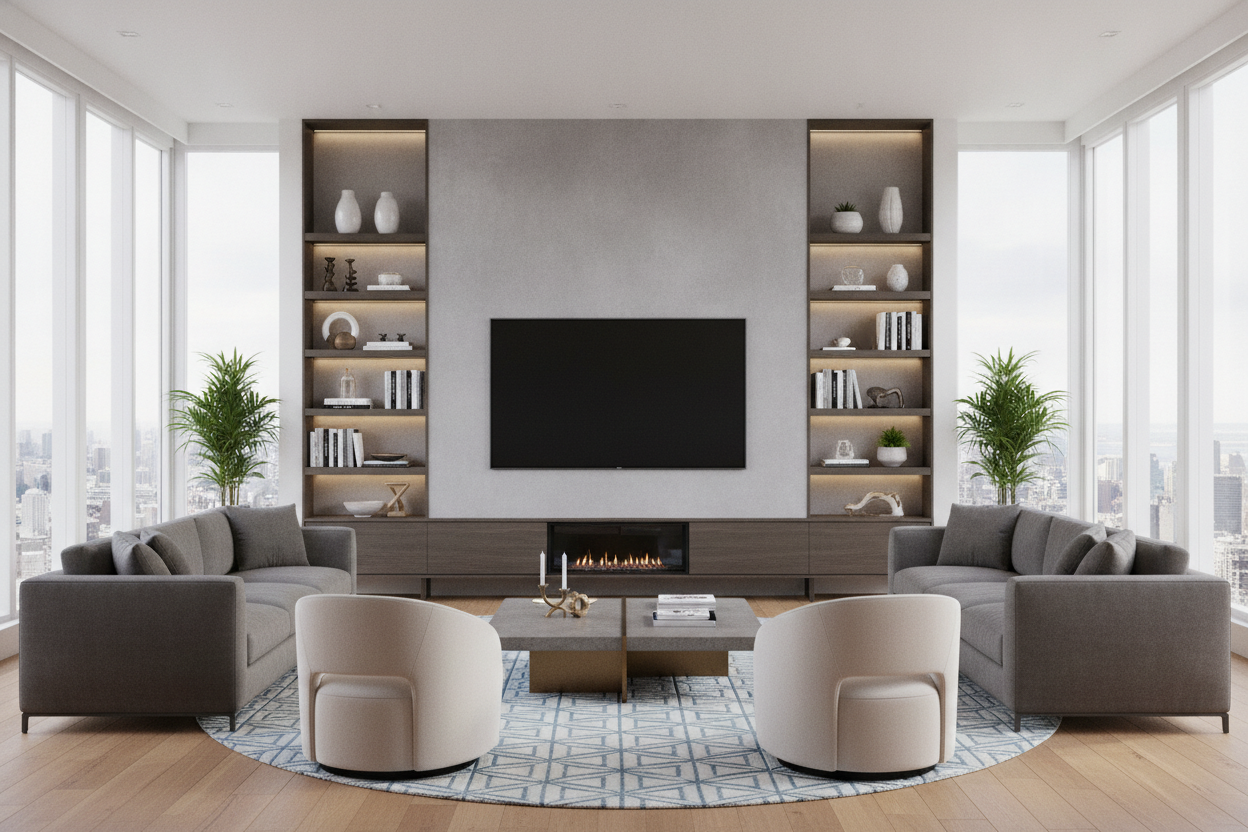
I remember the day my 85-inch screen arrived. I had measured the wall, sure, but I hadn't measured my sanity. Trying to find 80 inch tv stands that don't look like a coffin in the middle of the room is a unique kind of interior design hell. If you aren't careful, you end up with a piece of furniture that has the same footprint as a Honda Civic parked in your living room.
- Scale is everything: An 80-inch stand is roughly the length of a full-sized sofa.
- Traffic flow requires at least 30-36 inches of clearance around the unit.
- Light colors and 'floating' designs help mitigate the visual weight of large pieces.
- In open concepts, the console can serve as a functional room divider if it has a finished back.
The Seven-Foot Elephant in the Room
Let's talk about the sheer physics of an 80 in media console. We are talking about a piece of furniture that is nearly seven feet long. To put that in perspective, a standard three-person sofa usually clocks in between 84 and 90 inches. When you buy a tv stand 80 inches wide, you are effectively adding another sofa-sized object to your floor plan.
I’ve seen people buy a massive entertainment center 80 inches long and realize it blocks the entrance to their hallway or overlaps with a window frame. Before you commit, tape out the dimensions on your floor with blue painter's tape. It’s a 10-minute task that prevents a 200-pound mistake. Most 80 inch tv media console units also have a depth of 18 to 22 inches, which can eat up a surprising amount of square footage in a narrow room.
Floating Walls vs. Perimeter Walls
In most modern homes, you have two choices: shove it against the wall or use it to define a space. Most people browse standard tv stands and naturally assume they belong against the longest uninterrupted wall. But in an open layout, that can leave your seating area feeling miles away from the screen, or worse, create a 'bowling alley' effect where all the furniture is pushed to the edges.
If you have a massive open-concept area, consider a floating wall approach. You can place a tv console 80 inch wide perpendicular to a wall to create a 'media zone.' This works best with a lower-profile tv stand 80 inch model so you don't block the line of sight across the room. Just make sure you’ve figured out the cable management, because nothing ruins a floating layout faster than a rat's nest of black wires dangling off the back.
The Visual Weight Problem (And How to Cheat It)
A black media console 80 inch long can feel like a black hole that sucks all the light out of a room. It’s a lot of dark surface area. When I was shopping for my own place, white tv stand for 80 inch tv options were high on my list because they blend into the wall, making the piece feel significantly less intrusive. A gray tv stand 80 inch model is another great middle ground that offers a modern look without the heaviness of espresso or black finishes.
If you really want to cheat the system, look for a wall mounted media console. By lifting the unit off the floor, you expose more of the flooring, which tricks the human eye into thinking the room is larger than it is. It turns a bulky 80 inch wide tv console into a sleek architectural feature. Just ensure you’re hitting at least three or four studs; an 80-inch unit plus a massive TV is a lot of weight for drywall to handle alone.
Creating 'Zones' with Your Media Console
In a big, echoey open floor plan, an 80 inch tv credenza can act as a low-profile partition. I’ve used a solid wood 80-inch tv stand to separate a dining area from a lounge area with great success. The key is finding a piece that doesn't have an ugly, unfinished particle-board back. Many modern units are designed to be seen from 360 degrees.
I actually spent months vintage mid century modern tv stand hunting for this exact reason. Older pieces were often finished on all sides because they weren't always meant to be pushed against a wall. If you find a modern 80 media console modern style with a finished back, it becomes a piece of architecture rather than just a place to put your Xbox.
Don't Forget the Walking Clearance
The biggest mistake I see? Bruised shins. You need a minimum of 30 inches—ideally 36—of walking space between your tv stand 80 long and the edge of your coffee table or sofa. If you have a 70 80 inch tv stand in a room that is only 12 feet wide, and you add a deep sofa and a coffee table, you’re going to be side-shuffling like a crab every time you want to get a snack.
Check the depth of the unit. A 15-inch deep tv unit 80 inch model is a godsend for tight layouts compared to the standard 20-inch depths. Those five inches don't sound like much until you're trying to navigate a vacuum cleaner around the corner of the stand at 9 PM on a Sunday.
FAQ
What size tv stand for 80 inch tv?
You want a stand that is at least 70 to 80 inches wide. Ideally, the stand should be a few inches wider than the TV itself to prevent it from looking top-heavy or like it's about to tip over. An 80 inch wide tv console is the perfect match for a 75 or 85-inch screen.
Can I use a corner tv stand for 80 inch tv?
Technically, yes, but an 80 inch corner tv stand is a massive piece of furniture. It will eat up a huge amount of floor space and create a weird 'dead zone' behind the TV. It's usually better to go with a flat wall placement or a floating mount.
Is an 80-inch solid wood tv stand worth the money?
If you plan on keeping it for a decade, yes. Large units made of MDF or particle board tend to sag in the middle over time under the weight of a huge TV. Solid wood or a high-quality 80 20 tv stand with a metal frame will actually stay level.

Leave a comment
This site is protected by hCaptcha and the hCaptcha Privacy Policy and Terms of Service apply.