










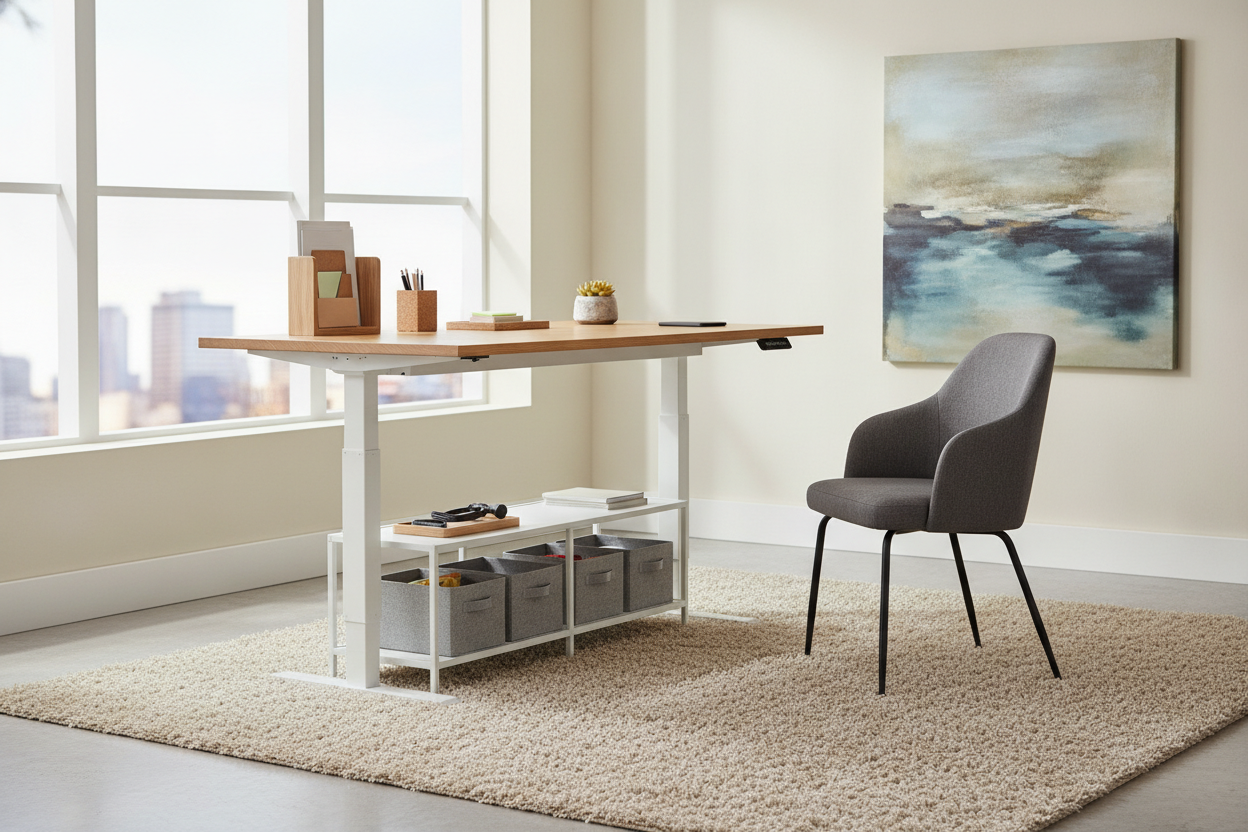
I remember the exact moment I realized my office setup was a disaster. I had just finished cable-managing my 72-inch butcher block top, feeling like a productivity god, and hit the 'up' button on my handset. As the motor whirred, my external hard drive—which I’d cleverly tucked onto a fixed wall shelf—was ripped off its mount because the cord didn't have enough slack. My pen cup tipped over, and I spent the next ten minutes chasing paperclips across the hardwood. That is the reality of storage for standing desk setups: gravity and movement are usually working against you.
The Problem With Moving Furniture (And Gravity)
Organizing a desk that moves is a completely different beast than styling a stationary writing computer desk. When your workspace stays at a fixed 29 inches, you can stack books, lean art, and place heavy filing cabinets wherever you want. But the second you introduce a motor, you have to account for the 'travel zone.' Everything needs to either move with the desk or be low enough that the desk doesn't crush it on the way down.
I’ve seen people try to use tall bookshelves right next to their sit stand desk storage, only to have the desktop clip the corner of a shelf on its way up. It’s not just about the furniture; it’s about the physics of the cords. If your storage isn't integrated or mobile, your cables become tripwires. You need a setup that respects the fact that your desk is basically an elevator for your coffee and laptop.
Quick Takeaways
- Avoid fixed drawers that exceed 4 inches in depth if you value your kneecaps.
- Mobile pedestals are superior to fixed cabinets because they can be repositioned as you change posture.
- Always measure the distance between your desk's legs before buying under-desk units.
- Cable slack is the most overlooked part of any standing desk organization ideas.
The 'Knee Smasher' Trap of Add-On Drawers
We’ve all seen those 'universal' under-desk drawers on Amazon. They look great in the renders—slim, white, and holding a neat pair of AirPods. In reality, these are often a nightmare for adjustable desk storage. Most sit-stand frames have a massive steel crossbar or a motor housing running right down the center. When you try to screw an aftermarket drawer in, you either hit the metal frame or you’re forced to mount it so far forward that it hits your thighs every time you sit down.
I once installed a 'slim' 3-inch metal drawer that seemed perfect. Within two days, I had a permanent bruise on my right knee. Because the drawer sat right where I naturally crossed my legs, I couldn't sit ergonomically. Plus, if you have a 1-inch thick desktop, adding a 4-inch drawer means you’ve just lost 5 inches of vertical legroom. For anyone over 5'10", that’s a dealbreaker. Before you buy any under standing desk storage, crawl under your desk with a measuring tape and check where the motor brackets actually live.
Standing Desk Storage Ideas That Actually Make Sense
The trick to standing desk storage ideas is to stop thinking about the desk as a storage unit and start thinking of it as a workstation. You want the surface to be clear, which means the heavy lifting needs to happen elsewhere. The best setups I've tested use a 'satellite' approach: keep the essentials on the moving surface and the bulk in independent, low-profile units.
Rolling Cabinets That Don't Trap You
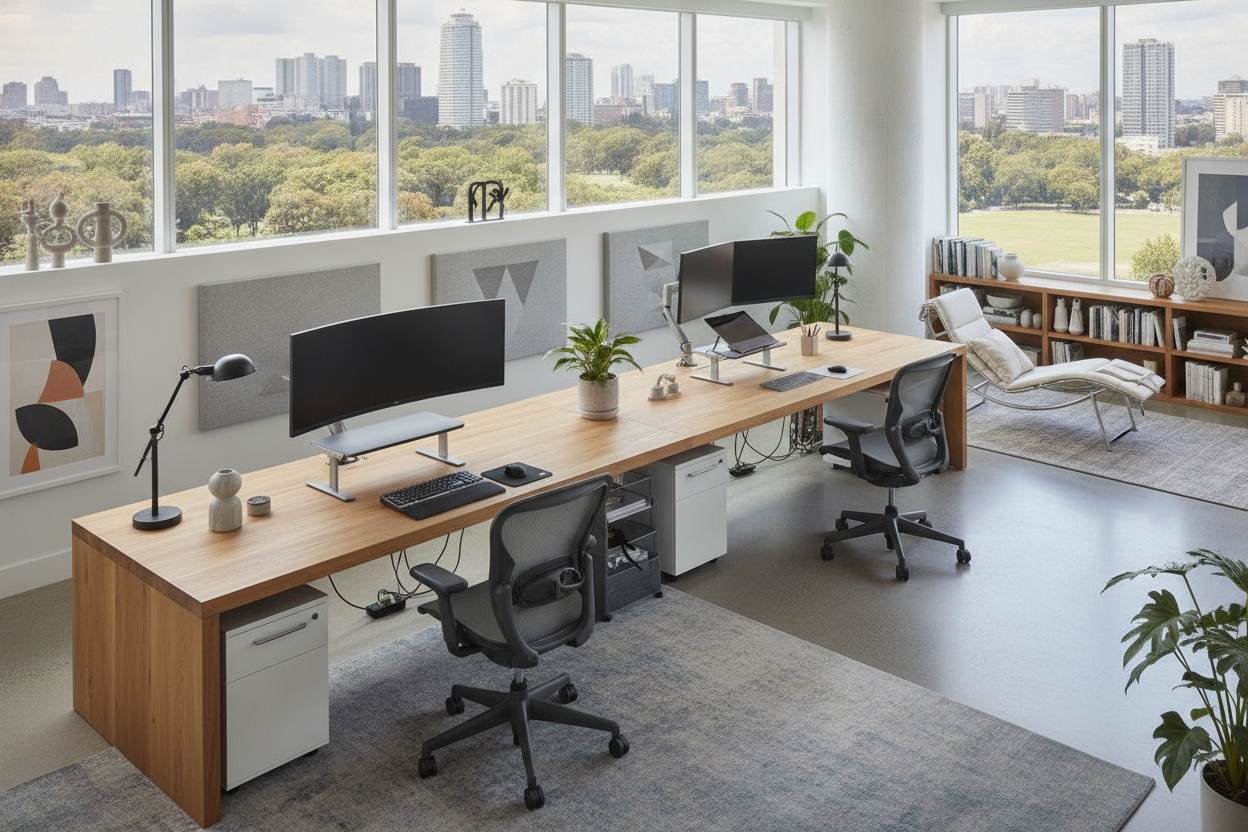
If you need more than a pencil tray, a mobile pedestal is the only way to go. I prefer the low-profile versions that sit around 20 to 22 inches high. This height is crucial because it allows the desk to lower to its minimum height without bottoming out on the cabinet. It also gives you the flexibility to roll the storage under standing desk to the left or right depending on how you're standing.
When shopping, look for units with five wheels (the fifth one on the bottom drawer prevents it from tipping over when full). This guide to under desk storage units breaks down the specific weight capacities you should look for, especially if you’re planning to store heavy reams of paper or tech gear. I personally use a steel 3-drawer unit that I can tuck away when I’m in 'standing mode' and want more floor space for my anti-fatigue mat.
Slim Trays for the Absolute Bare Minimum
For those who hate the look of a bulky cabinet, standing desk under desk storage should be limited to felt or plastic 'pencil trays.' These are usually less than 2 inches deep. They won't hold your MacBook, but they’ll hold your Apple Pencil, a notepad, and your Chapstick. The key is to mount them off-center. I put mine on the far left side, away from my lead leg, so I never hit it when I pivot in my chair.
Should You Just Buy a Desk With Built-in Drawers?
I get asked this a lot: is it better to hack a storage-less desk or just buy one that has it built-in? Honestly, if you haven't bought your desk yet, go for the integrated route. Manufacturers who design an adjustable desk with dual storage modules have already done the math. They’ve recessed the motor and reinforced the frame so the drawers don't compromise the stability of the desk when it's at full height.
The downside of built-in stand up desk storage is usually the price and the weight. These desks are heavy—often over 150 lbs—which makes assembly a two-person job. But compared to the frustration of trying to DIY a drawer onto a frame that wasn't meant for it, the extra cost is usually worth the lack of a headache (and the lack of bruised knees).
My Final Verdict on Keeping a Clean Sit-Stand Workspace
At the end of the day, tall desk storage is all about compromise. You can't have a massive executive-style mahogany drawer set and a desk that zips up and down 20 inches. My golden rule? Keep the desk surface for your 'active' items and use a rolling cart for your 'passive' storage. If you haven't touched it in three days, it shouldn't be attached to your moving desk. Keep your legroom sacred, keep your cables long, and stop trying to make your standing desk do the job of a closet.
FAQ
Can I use a standard filing cabinet under my standing desk?
Only if it is shorter than your desk's lowest setting. Most standard cabinets are 27-29 inches, which is exactly where most people set their sitting height. This means your desk will bottom out on the cabinet. Look for 'low-profile' units under 23 inches.
How do I stop my cables from pulling when the desk goes up?
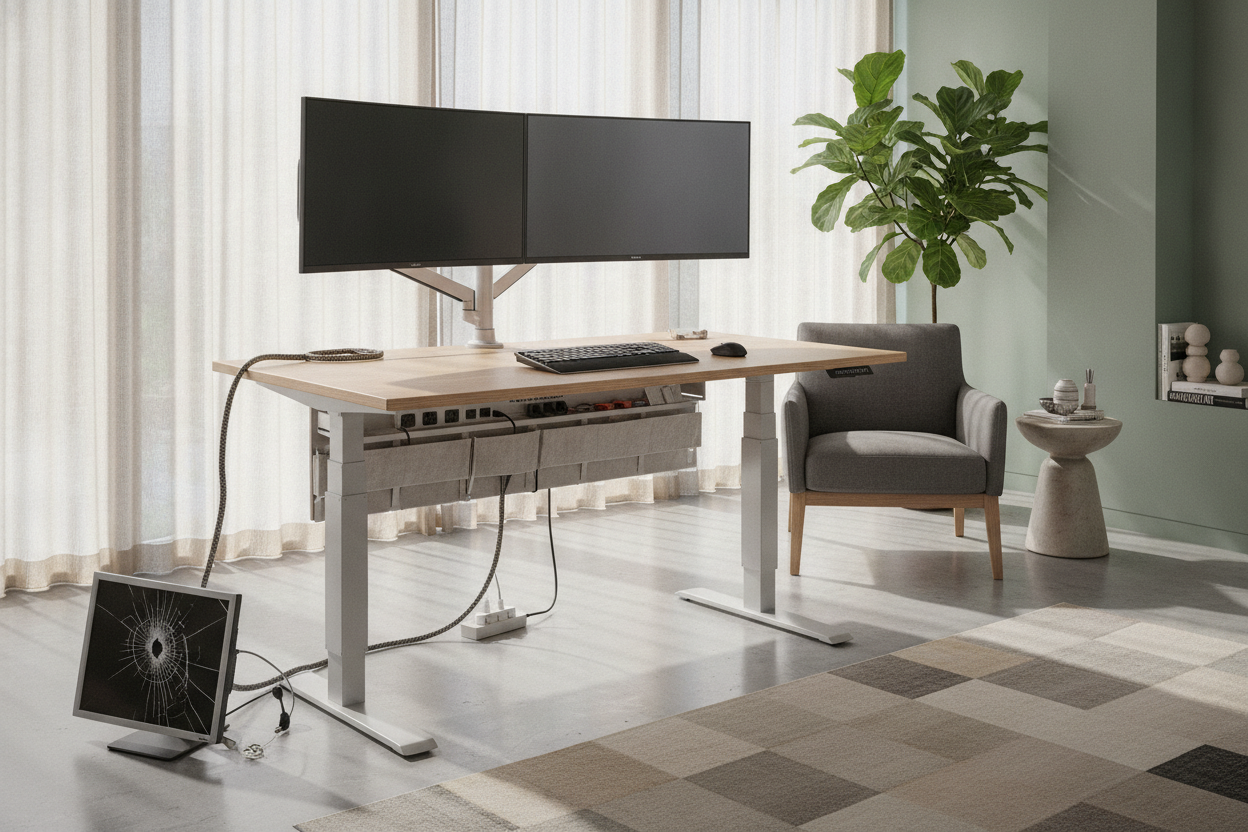
You need a cable spine or a tray attached to the underside of the desk. Every cord—monitor, power, and peripherals—should meet at a single power strip mounted to the desk. Only one 'umbilical' cord should go from the desk to the wall outlet, with plenty of slack.
Are felt drawers better than metal ones for under-desk storage?
Felt is much more forgiving. If you do happen to bump your knee against a felt storage for under standing desk, it doesn't hurt. Metal drawers are more durable but can be loud and have sharp edges that aren't great for your ergonomic flow.

Leave a comment
This site is protected by hCaptcha and the hCaptcha Privacy Policy and Terms of Service apply.