










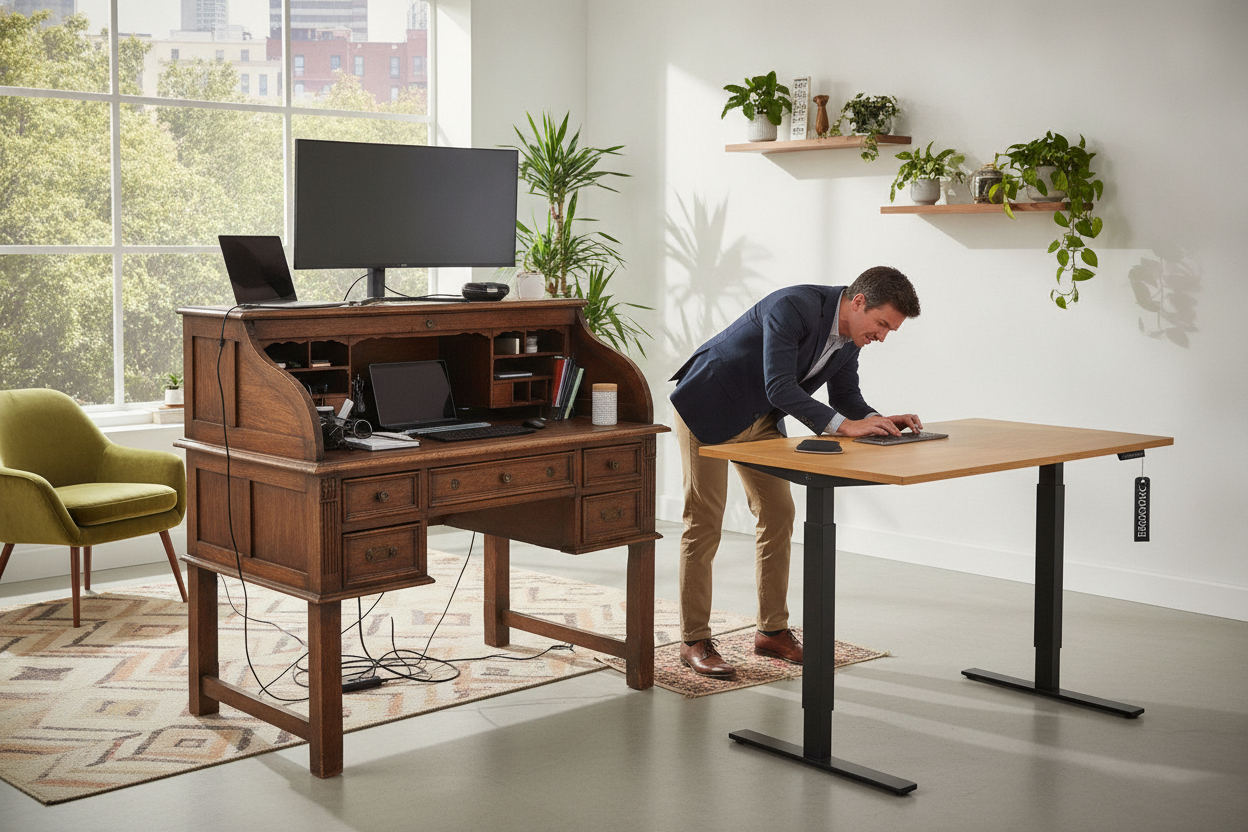
I spent three weeks stalking a mahogany clerk's desk on eBay. I imagined myself looking very dignified, perhaps sipping a dry sherry while drafting emails. Then I realized I’d be hunched over like a gargoyle because 19th-century people were, on average, several inches shorter than us. Buying a real antique standing desk is one of those design choices that looks incredible on Instagram but feels like a torture device in practice.
We've all been there—trying to force an aesthetic because we're tired of the 'corporate office' look. But your lumbar spine doesn't care about your Pinterest board. If you're serious about working on your feet, you need to ditch the flea market finds and get creative.
- Authentic antiques are fixed-height and usually too low for modern ergonomics.
- Slanted surfaces are meant for paper and quills, not laptops and lattes.
- Vintage wood is beautiful; vintage mechanics are usually broken or non-existent.
- The best move is a 'mullet' desk: 1880s on top, 2024 on the bottom.
The Romantic Fantasy vs. The Ergonomic Reality
There’s a specific romantic fantasy that comes with a standing desk vintage setup. You imagine yourself as a Victorian clerk or Charles Dickens, standing tall while penning the next great American novel. It feels sophisticated, intentional, and decidedly un-corporate. It’s a far cry from the sterile, white-laminate writing computer desk you see in every big-box store.
The reality is much less poetic. Those historical desks were designed for a world where people spent their days writing with nibs and ink, not staring at dual monitors for eight hours. When you’re locked into a fixed-height surface that was built for someone five-foot-five, your neck and shoulders pay the price. You can’t just 'power through' bad ergonomics; eventually, the desk wins, and you’re back on the couch with a heating pad.
Why Your Spine Hates Authentic 19th-Century Furniture
The biggest issue with an antique stand up desk is the lack of adjustability. Modern standing desks exist because our bodies aren't meant to stay in one position forever. An authentic 19th-century piece is a static object. If the height doesn't perfectly align with your elbows, you're either shrugging your shoulders or leaning over, both of which lead to chronic strain.
Furthermore, monitor height is a total afterthought in the vintage world. To get your screen at eye level on a vintage standing desk, you’d have to stack it on top of a pile of old books, which completely ruins the look you were going for. You end up with a beautiful piece of furniture that makes your body feel eighty years older than it actually is.
The Slanted Top Problem (Great for Quills, Bad for Mice)
Most retro standing desk designs from the 1800s feature a slanted top. This was brilliant for drafting or calligraphy because it brought the paper closer to the eyes and reduced neck tilt. It is, however, a total disaster for a modern tech setup.
Try placing a laptop on a 15-degree incline. It slowly migrates toward your belt buckle. Try using an optical mouse; it won't track properly, and it’ll slide off the edge the second you let go. And don't even get me started on trying to keep a cup of coffee stable on a slanted 100-year-old oak board. It’s a recipe for a ruined keyboard and a very bad Tuesday.
How to Build a Vintage Looking Standing Desk That Actually Works
If you absolutely must have that old-world vibe, stop looking for a complete unit. Instead, look for a vintage looking standing desk hack. The smartest way to do this is to buy a high-quality, modern adjustable height standing desk with electric lift system and swap out the generic top.
I’ve seen people use reclaimed barn wood, old fire doors, or even the top of a ruined 1920s dining table. You get the heavy, character-filled wood that smells like history, but you mount it onto a frame that can actually move. This gives you the best of both worlds: the soul of an antique and the motor of a modern workstation. You can set your memory presets for the exact height you need, saving your back while keeping your office looking like a library at Oxford.
Styling Your Hybrid Setup So It Doesn't Look Like a Sci-Fi Prop
The main challenge with a DIY setup is the 'cyborg' look—beautiful wood on top, cold industrial metal on the bottom. To make it blend in, you have to get aggressive with cable management. Use leather cord organizers or brass cable snakes to hide the wires. If the black or grey legs of the motor frame feel too modern, consider painting them with a matte 'iron' finish or a dark bronze to mimic old cast iron.
Placement is also key. Don't just shove it against a white wall. Surround the desk with other traditional elements like a heavy wool rug or an old brass lamp. You can find plenty of designer ideas for standing desk layouts that show how to integrate modern tech into a classic room without it looking like a mistake. The goal is for the desk to look like a piece of salvaged machinery, not a piece of office equipment.
My Personal Desk Disaster
I once hauled a 1920s drafting table up three flights of stairs. It had that perfect, ink-stained patina. Within forty-eight hours, I had a tension headache that felt like a localized earthquake. The top was slanted at a permanent angle, meaning my mouse kept sliding into my lap. I eventually sold it for $50 less than I paid just to get my floor space back. Now, I use a motorized frame with a 2-inch thick slab of reclaimed walnut. It is better in every possible way.
FAQ
Can I use a laptop stand on an antique desk?
You can, but it usually looks terrible and doesn't solve the height issue for your arms. You're better off modifying the desk or using a hybrid setup.
Are there any 'flat' antique standing desks?
They exist, often called 'teller desks,' but they are rare and usually very expensive. Most were built for specific heights, so the odds of finding one that fits your ergonomics are slim.
How do I hide the motor on a modern standing desk frame?
Try using a 'modesty panel' made of matching old wood or even a heavy fabric like velvet. It hides the electronics and the motor while adding to the vintage aesthetic.


Leave a comment
This site is protected by hCaptcha and the hCaptcha Privacy Policy and Terms of Service apply.