










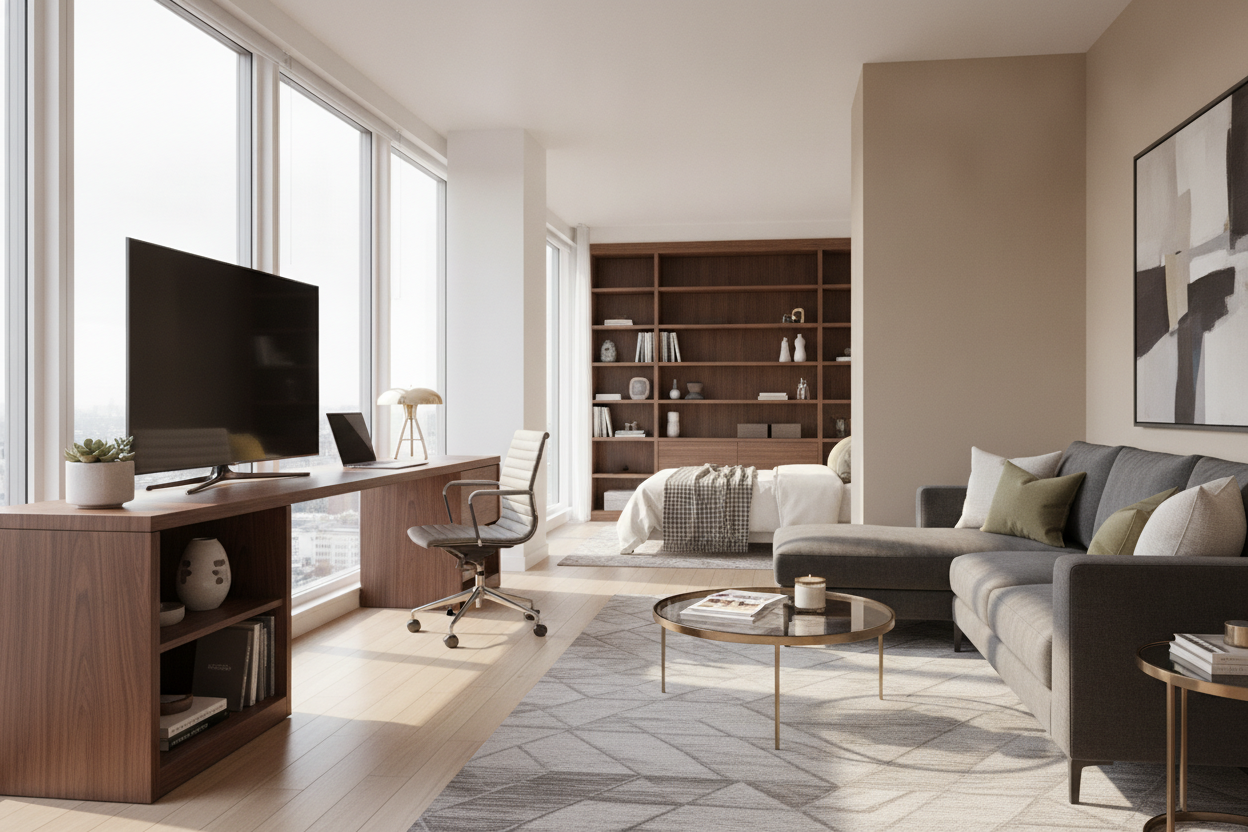
I remember my first studio apartment in Brooklyn. I had a thrifted desk from the 90s and a TV stand I found on a sidewalk. They didn't match, they were different heights, and they took up so much floor space that I spent every night dodging sharp corners like a contestant on American Ninja Warrior. Trying to fit a tv stand with desk into a 400-square-foot box is the ultimate Tetris challenge, and most of us are losing.
- Combining units saves roughly 15-20 square feet of floor space.
- Unified furniture reduces 'visual clutter' that makes small rooms feel smaller.
- Cable management is 10x easier when all your tech is on one wall.
- Modern designs look like high-end cabinetry, not a college dorm.
The 'Two-Table' Trap in Small Apartments
Most of us fall into the same trap. We buy a media console because we need a place for the 55-inch screen, then we realize we can't actually work from the sofa without destroying our backs. So, we buy a separate desk. Suddenly, you have two 18-inch deep blocks of wood eating up your walking path, and your room feels like a furniture showroom that's gone out of business.
I finally realized that the 'two-table' approach was the reason I felt claustrophobic. I swapped my bulky furniture for a single, integrated unit, and it was like my room finally exhaled. When you have two separate pieces, you have two sets of legs, two sets of cable nests, and a weird dead space in between them that just collects dust bunnies and lost socks.
What Exactly Is a TV Stand Desk Combination?
A tv stand and desk combo isn't just two things pushed together; it's a piece of furniture designed with a single, continuous silhouette. Usually, it features a lower section for the television and a slightly higher or extended surface for your laptop. Some are modular, while others are built as one solid 72-inch or 84-inch unit.
The beauty of a tv stand desk combination is the visual trickery. Instead of your eyes jumping between a media console and a dedicated writing computer desk, they glide across one long, horizontal line. This makes the wall look wider and the floor look less crowded. It turns a chaotic 'office-meets-bedroom' vibe into a streamlined suite.
L-Shape vs. The Long Console
If you're working with a corner, a desk entertainment center combo in an L-shape is your best friend. It tucks the 'work' part away from your line of sight when you're laying in bed. However, if you have a long, flat wall, a linear modern tv stand with desk is the way to go. It looks like custom built-ins without the $5,000 price tag of a contractor.
How to Hide the 'Work' When It's Movie Time
The biggest downside of a desk for tv and computer setups is the 'spreadsheet anxiety' factor. You don't want to be halfway through a movie and see your work monitor glowing in the corner of your eye. The secret is cable management and lighting. I use 2-inch wide cable sleeves to group my HDMI and power cords together so they don't look like a plate of black spaghetti.
If you're using a desk as a tv stand, try an offset monitor arm. This lets you swing your work screen out of the way or even turn it toward the bed for a secondary viewing angle. Using a desk as a tv stand only works if the desk is rated for the weight; most 1-inch thick MDF desks can handle a modern LED TV, but don't try it with an old-school plasma beast that weighs 80 pounds.
Is This Just for Gamers? (Definitely Not)
There's a common myth that a computer and tv desk is only for teenagers or people who live on Twitch. Sure, you can find a gaming desk with LED lights that looks like a spaceship, but that's not the only option. I'm a fan of the mid-century modern look—think tapered legs and warm walnut finishes.
A well-designed tv console with desk can look incredibly grown-up. Look for materials like kiln-dried oak or powder-coated steel. Avoid the cheap 1.5 lb density particle board if you can; it'll sag under the weight of a TV within six months. Spend the extra $100 for something with a solid core or a metal support frame.
Personal Experience: My 'Frankenstein' Mistake
I once tried to DIY my own desk tv unit by buying two different pieces from the same 'collection' online. Big mistake. The wood grains didn't match because they were from different batches, and the desk was half an inch taller than the TV stand. It looked cheap and accidental. If you're going for this look, buy a single, engineered tv stand and computer desk combo. It’s the only way to ensure the heights and finishes actually align.
FAQ
Can I use a regular desk as a TV stand?
Yes, but check the height. A standard desk is 29-30 inches tall, which might be too high for comfortable TV viewing if you're sitting on a low sofa. Your neck will thank you for checking the ergonomics first.
Is a tv stand with desk attached sturdy?
If it’s a single unit, yes. These are designed to counter-balance the weight. Just make sure you anchor it to the wall if you have kids or a cat that likes to jump on things.
What is the best length for a combo unit?
For a 50-inch TV and a laptop setup, you want at least 72 inches of total width. Anything smaller and you'll feel like your mouse pad is fighting the TV base for territory.

Leave a comment
This site is protected by hCaptcha and the hCaptcha Privacy Policy and Terms of Service apply.