










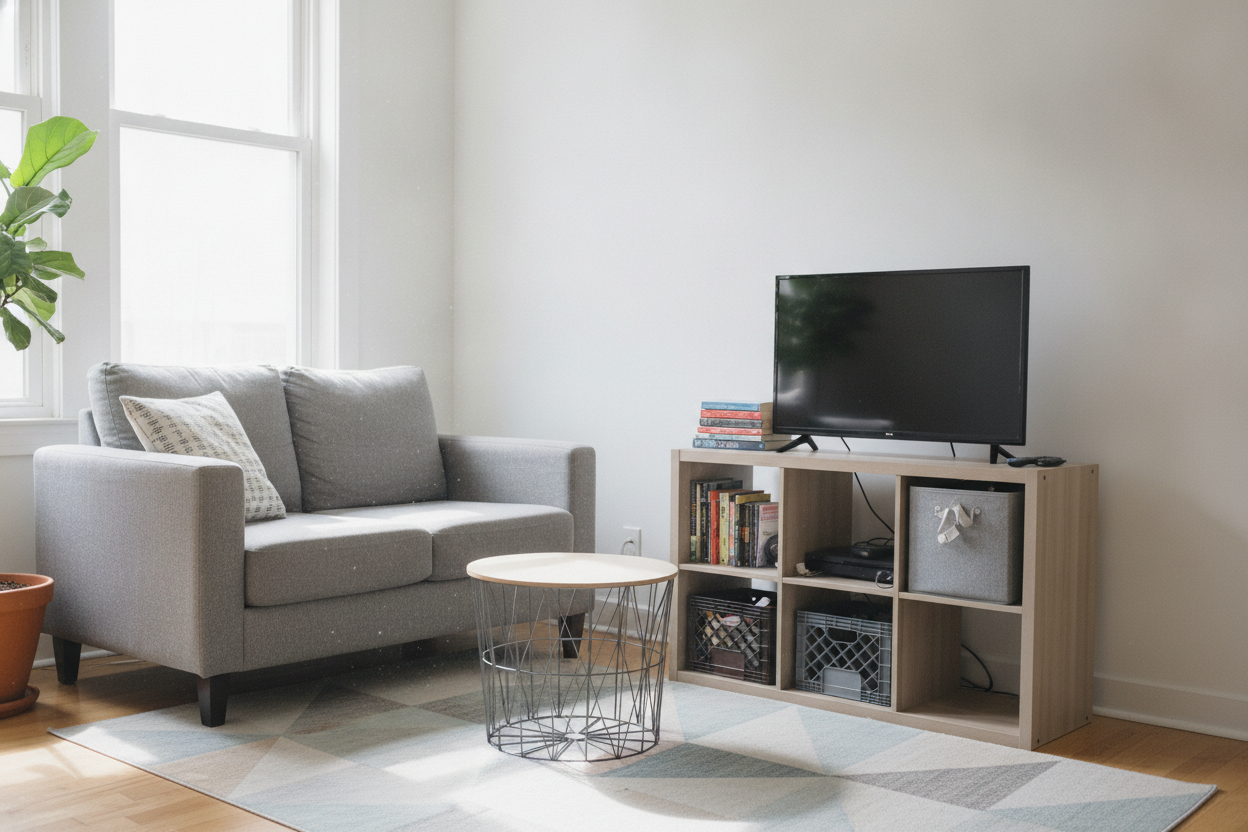
I remember my first 'adult' apartment. I bought a tiny 40-inch TV stand because the room was narrow, and I thought I was being smart. Instead, it looked like a postage stamp on a billboard. If you have ever felt like your small media console looks like it belongs in a freshman dorm rather than a curated home, you are not alone. We have all been there, staring at a screen that feels like it is hovering in a void.
- Scale is everything; a tiny unit on a big wall looks like an accident.
- Doors beat open shelving for hiding the 'spaghetti' of cables and routers.
- Legs create the illusion of space by showing the floor underneath.
- Asymmetry is your friend—don't just center it and call it a day.
The 'Floating Box' Effect (And Why It Ruins Your Wall)
People often buy a small media console table thinking it saves space. Technically, it does, but visually it is a disaster if you stick it in the middle of a 12-foot wall. It creates this awkward 'floating box' effect where the furniture looks orphaned. It is not just about the floor space; it is about the visual weight on the wall.
If you have a 50-inch TV on a 42-inch stand, the overhang makes the whole setup look top-heavy and cheap. You want at least 3-6 inches of breathing room on either side of the TV base. Without it, the scale is just wrong. I have seen 80-inch TVs perched on tiny stands that look like they are about to snap, and it ruins the vibe of the entire room.
Stop Centering Your Mini Media Console
The instinct is to find the dead center of the wall and park your mini media console right there. Stop doing that. In a small room, centering a tiny piece of furniture highlights how much empty space you have left over. It makes the wall look unfinished rather than minimalist.
It is much better to tuck that small media table into a corner or align it with a window frame or an alcove. By creating a 'vignette'—maybe adding a floor lamp or a tall olive tree next to it—the console feels like part of a larger, intentional grouping. I once moved my console three feet to the left to sit under a gallery wall, and suddenly the room felt finished. It stopped being a 'TV area' and started being a living room.
You Need Doors, Not Open Shelves
Open shelving is a trap. Unless you have a collection of vintage Leica cameras or perfectly bound art books, that small media console cabinet needs doors. Most people just have a tangled mess of HDMI cables, a dusty router, and a PlayStation controller that hasn't been cleaned in months.
Closed storage instantly makes a piece look more expensive. It hides the visual noise that clutters up a small apartment. I have tested those $80 wire-frame stands, and they always look like temporary furniture. Spend the extra money for a solid-door unit; your brain will thank you for the lack of cord-chaos. If you can't see the wires, the space feels ten times more organized.
Why the Best Small Modern TV Consoles Have Legs
The heaviest-looking furniture sits flat on the floor. In a cramped bedroom or a 200-square-foot studio, you want to see as much floor as possible. The best small modern tv consoles have tapered legs or a slender metal base that tricks the eye into thinking the room is larger because the sightline isn't interrupted at the baseboard.
If you are dealing with a truly microscopic floor plan where even legs feel bulky, skipping the floor entirely with a wall mount console is a great alternative for both living rooms and tight foyers. It keeps the footprint at zero and the vibe high-end. I have used wall-mounts in three different apartments, and they are the only way to make a hallway feel like a real room.
Maybe Your Room Actually Is Too Big?
Sometimes, the issue isn't your styling—it is your math. If you are trying to make a 36-inch stand work in a massive open-concept living room, no amount of plants will save you. You are fighting a losing battle against physics. A tiny stand in a big room looks like you ran out of money halfway through furnishing.
If you find yourself constantly trying to 'fill the gaps' around a tiny unit, it might be time to admit defeat. You might need to upgrade to a 60 media cabinet to actually anchor the space. It is better to have one piece that fits the wall than three small pieces trying to do the same job. I once spent three hours assembling a 'mid-century' console I found on sale. It was made of that crumbly particle board that strips the second you turn a screw too hard. It looked okay from across the room, but the doors never quite aligned. I eventually gave it away and bought a solid wood piece with actual weight. If it weighs less than your TV, it is probably not going to last the year.
How much wider should a console be than the TV?
Ideally, your console should be at least 6 to 10 inches wider than your TV. This prevents the 'top-heavy' look and gives you space for a small lamp or a decorative object.
Can I use a dresser as a media console?
Absolutely. Dressers are often built better than cheap media stands and offer much better storage for things that aren't electronics, like extra blankets or board games.
Should the TV be centered on the wall or the console?
Always center the TV on the console. If the console itself is off-center on the wall to accommodate a window or a chair, that is fine—the TV and the stand should always move as a single unit.

Leave a comment
This site is protected by hCaptcha and the hCaptcha Privacy Policy and Terms of Service apply.