










I have spent more time staring at my reflection in a turned-off monitor than I care to admit, usually while rubbing a knot in my shoulder that feels like a buried walnut. For years, I told myself I didn't need a motor to stay healthy. I figured a bit of willpower and a cheap riser would do the trick, but I was wrong. Buying a stand up desk automatic isn't about being fancy; it's about acknowledging that I am fundamentally lazy when the 2:00 PM slump hits.
- Manual desks are a motivation killer; if it takes effort to move, you won't do it.
- Memory presets are the only feature that guarantees you will actually change positions.
- Motor noise is a real factor if you share an office or spend all day on calls.
- Cable management becomes 10x harder when your desk moves 20 inches up and down.
The 'I'll Just Use a Manual Crank' Delusion
I once bought a manual standing desk because I thought the extra $150 for a motor was a 'luxury tax.' I told myself the 30 seconds of cranking would be a nice little 'mini-workout' for my arms. That lasted exactly four days. By day five, I was too deep in a spreadsheet to spend a full minute spinning a handle like I was starting an old-timey car.
Within two weeks, that desk became a permanent fixture at 29 inches high. It was no longer a piece of ergonomic equipment; it was just a standard writing computer desk with a weird handle sticking out the side. If there is even a tiny bit of friction between you and a healthy habit, the habit loses every single time. My back still hurt, and I was out $300 for a feature I never used.
The 30-Day Sit Stand Automatic Desk Experiment
To see if a motor actually fixed my laziness, I swapped the manual beast for a sit stand automatic desk and installed a posture-tracking app on my phone. The app would ping me every 45 minutes to check my status. I wanted to see if the ease of a button-press actually translated to more vertical time, or if I’d just find a new excuse to stay parked in my chair.
During the first week, I was obsessive. I stood for four hours a day, mostly because the novelty of the quiet whirring motor was satisfying. But the real test came in weeks three and four, when the 'new toy' feeling wore off and I was just trying to survive a heavy deadline week. That is where the automation either proves its worth or becomes a very expensive paperweight.
Why the Memory Preset Button Is the Real Hero Here
The difference between a basic motor and a computer desk automatic with memory settings is massive. If you have to hold the 'up' button for 20 seconds while watching the little digital display climb, you’re still doing work. It sounds petty, but that 20 seconds is enough time for your brain to say, 'Eh, I’ll just stay sitting.'
Using a sit stand up desk with memory preset controller changed the psychology of the whole thing. I programmed '1' for my sitting height and '2' for my standing height. Now, when the app pings me, I just tap a button and walk away to grab water. By the time I’m back, the desk is at the perfect level. No fine-tuning, no wobbling, and no second-guessing if I’m at the right ergonomic height for my elbows.
The Annoying Part: Where Do You Put Your Stuff?
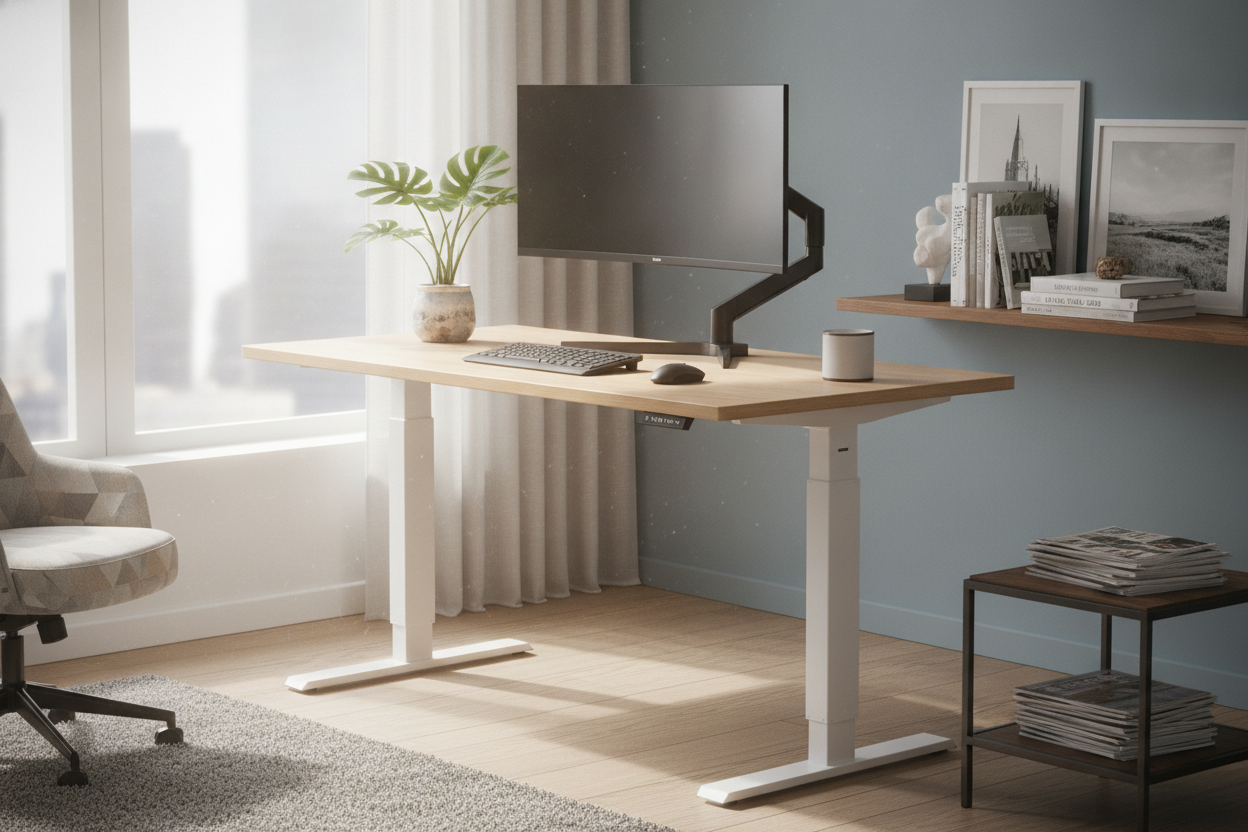
Here is the honest truth no one tells you: these desks are basically just a slab of wood on robotic legs. Because the motor housing and the crossbars take up so much space under the desktop, you almost never get drawers. I went from a traditional desk with three drawers to a motorized one with zero, and suddenly my stapler, pens, and extra hard drives were just... everywhere.
You also have to deal with the 'octopus' problem—cables hanging like vines. If you don't secure them, they’ll snag on your chair or pull your monitor off the desk when it rises. I ended up adding a sit stand desk with file cabinet next to my setup just to regain some sanity. It’s an extra expense, but unless you’re a total minimalist, you’re going to need a place to hide your clutter.
The Final Verdict: Did It Actually Change My Habits?
The data from the app didn't lie. My standing time went from a pathetic 12 minutes a day on the manual desk to an average of 2 hours and 40 minutes on the motorized one. My lower back pain didn't magically vanish overnight, but the 'stiff' feeling I used to have at 5:00 PM is almost entirely gone. It turns out I didn't have a willpower problem; I had a friction problem. When it’s as easy as pressing a button, you actually do the thing.
How loud is the motor?
Most decent dual-motor desks sound like a quiet electric toothbrush. It’s not loud enough to disrupt a phone call, though your mic might pick up a slight hum if it’s sitting directly on the desk surface.
Do these desks wobble when they are high up?
If you buy a cheap, single-motor frame, yes. It’ll feel like a bridge in a windstorm. If you get a heavy-duty frame with T-style legs, it’s rock solid even at 45 inches.
Can I turn my existing desk into an automatic one?
You can buy just the motorized legs and DIY your own top. It’s a great way to save money if you already have a high-quality wood slab you love.

Dejar un comentario
Este sitio está protegido por hCaptcha y se aplican la Política de privacidad de hCaptcha y los Términos del servicio.