










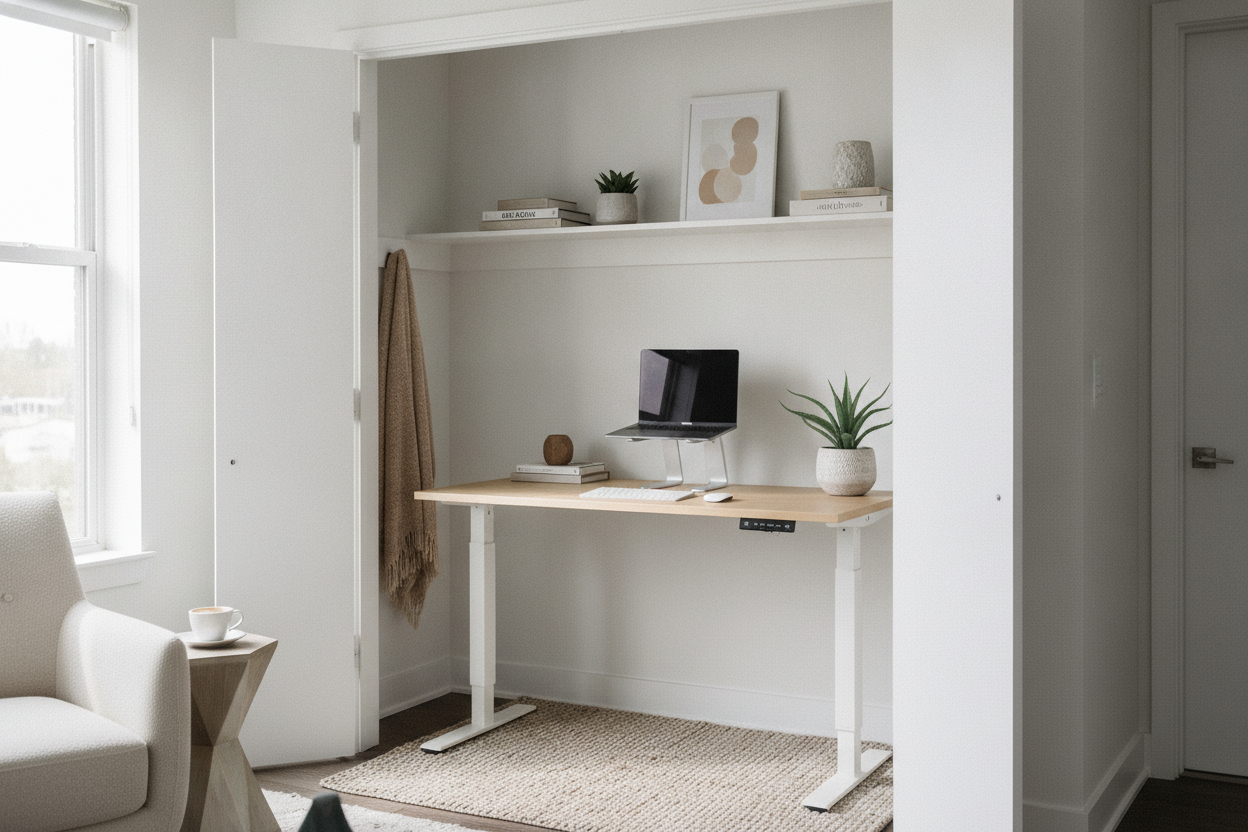
I spent three months working from a sagging velvet sofa before my lower back decided to file for divorce. My 600-square-foot apartment didn't have room for a 'real' office, so I spent weeks staring at my hallway closet until it finally blinked. I realized that if I ripped out the hanging rod and ignored the pile of winter coats now living on my bed, I could fit the best small standing desk inside that 42-inch wide alcove.
- Measure your closet width at the baseboard, not eye-level, to account for trim.
- Prioritize a C-frame leg design to maximize knee clearance in tight spots.
- A monitor arm is non-negotiable for desks under 40 inches wide.
- Heavy steel frames are better than aluminum for preventing 'monitor shake.'
The 'Cloffice' Delusion (And Why I Committed Anyway)
Living in a shoebox means every square inch is a battleground. I briefly considered a small standing desk on wheels, but I knew I'd just end up pushing it into the kitchen and tripping over it while making coffee. The closet was the only way to 'leave' work at 5 PM by literally closing the door on my laptop.
Ripping out the closet internals felt like a point of no return. Once the shelf was gone, I had a 42-inch wide gap of dead space. Most 'standard' desks start at 48 or 54 inches, which left me hunting for something that wouldn't require a chainsaw to install. I needed something that felt like a piece of furniture, not a temporary folding table that would vibrate every time I typed an email.
What Makes the Best Compact Standing Desk Actually Good?
Finding the best compact standing desk isn't just about shrinking a standard frame. Most cheap, small desks use a single-motor system that sounds like a dying blender and wobbles if you breathe too hard. When the footprint is small, weight is your friend. You want a frame made of heavy-duty steel because that mass is the only thing keeping your monitor from wobbling like a bobblehead during a Zoom call.
I looked for a desk with a dual-motor lift. It’s overkill for a 40-inch desktop, sure, but the transition is smoother and it won't burn out after six months of lifting your heavy mechanical keyboard and oversized coffee mug. If the desk frame feels light enough to carry under one arm, send it back. It’s going to frustrate you within a week.
Why Depth Matters Way More Than Width
Everyone looks at width first, but depth is where the real pain happens. If you buy a 20-inch deep desk, your 27-inch monitor will be about six inches from your eyeballs. I learned this the hard way with a cheap wood slab. You need at least 24 inches of depth to maintain a healthy focal distance, even if it means the desk sticks out an inch past the closet door frame. Don't sacrifice your eyesight just to make the doors flush.
C-Frame vs. T-Frame: Save Your Knees
In a closet, you have zero 'kick room.' A standard T-frame puts the lifting column right in the middle of the side profile. A C-frame offsets the legs toward the back of the desk. This gives you several extra inches of clearance for your knees and feet. It’s the difference between feeling like you're at a functional workstation and feeling like you're stuck in an airplane middle seat for eight hours a day.
The Golden Rule: Get Your Monitor Off the Desk
On a tiny desk, your laptop and a notebook will take up 80% of the surface area. I looked at my old 54-inch electric desk and realized I missed the sprawl, but I didn't miss the clutter. By using a clamp-on monitor arm, I floated my screen and reclaimed about two square feet of wood.
You also need an under-desk cable management tray. In a closet office, there is nowhere for wires to hide. If you don't tuck them up against the desktop, you'll be kicking a 'nest' of power strips every time you shift your weight. It’s messy, it’s a fire hazard, and it makes a small space feel even more claustrophobic.
When to Admit You Just Need a Bigger Desk
Let's be real: a closet office is a compromise. If you need three monitors and a dedicated spot for your 10-pound gaming PC, your first standing desk will probably be too small if you go the compact route. Some people are better off with a traditional writing computer desk and a high-quality stool if they can't fit a full-sized standing frame.
If you find yourself constantly hitting your elbows on the closet walls, the novelty will wear off fast. I love my setup, but I also only use one monitor and a very slim keyboard. If your workflow requires physical folders, scanners, or a printer, stop trying to make the closet happen. You’ll just end up working from the dining table anyway.
FAQ
Can I put a standing desk on carpet?
You can, but it will wobble more than it would on hardwood. Buy a thick, hard plastic chair mat to provide a stable base for the desk feet and save your carpet from getting crushed.
Is a 36-inch desk too small for a monitor?
It's the absolute minimum. You can fit a 27-inch monitor and a laptop, but you won't have room for much else. Use a monitor arm to save your sanity.
Do small standing desks break easier?
Not necessarily, but they often have lower weight capacities. Don't stack heavy PC towers or stacks of textbooks on a small motorized frame unless you want to hear the motor struggle.

Dejar un comentario
Este sitio está protegido por hCaptcha y se aplican la Política de privacidad de hCaptcha y los Términos del servicio.