










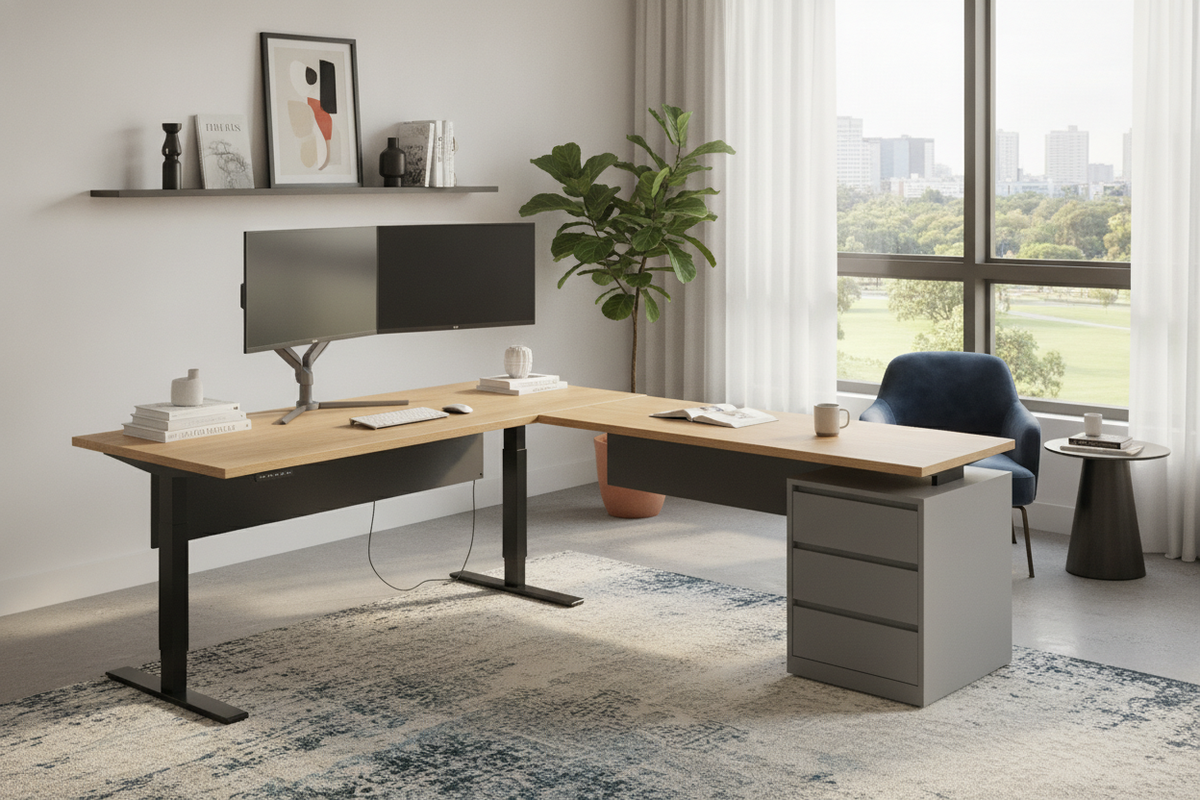
Spatial Geometry and Wing Dimension Categories
Choosing an l shaped standing desk with storage requires a clear understanding of room geometry, circulation paths, and the directional orientation of the desk return. Corner desks are categorized into two primary structural footprints: symmetric designs, where both wings share equal length, and asymmetric designs, where a designated primary worktop extends farther than the side return.
When planning your layout, determine whether a left-hand or right-hand return suits the natural flow of your room. Placing the return against a peripheral wall keeps open floor space clear for foot traffic, whereas positioning the return outward into the room establishes a defined boundary in open-concept floor plans. Ensuring adequate clearance around the perimeter prevents drawer pullouts and mobile seating from colliding with surrounding decor, much like coordinating room layout dimensions in our stand storage drawers guide.
Storage Architecture: Suspended Drawers vs. Under-Desk Pedestals
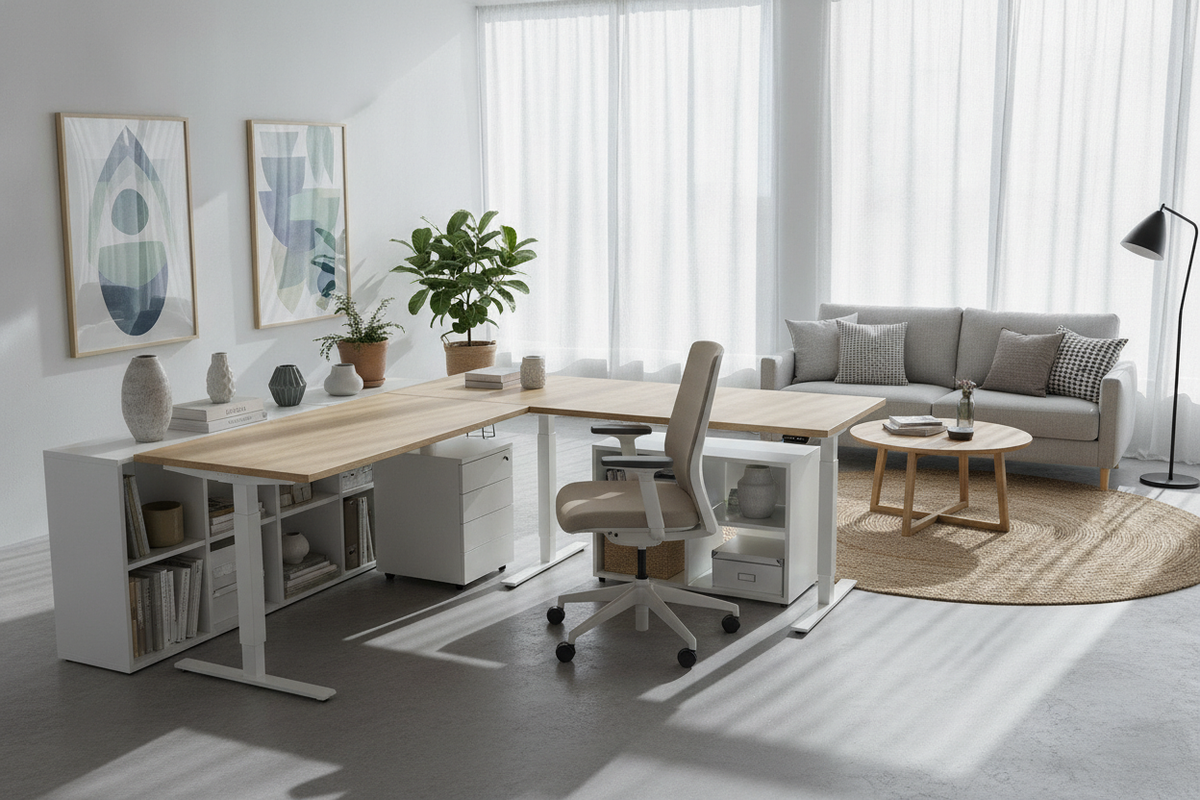
Incorporating storage into an l shaped standing desk with drawers involves balancing accessible organization with unimpeded sit-stand movement. Workstation storage typically takes one of three forms:
- Suspended Under-Desk Drawers: Mounted directly beneath the desktop substructure, these shallow drawers travel vertically with the desk surface. They keep essential stationery, writing pads, and daily peripherals at hand whether standing or seated, without occupying lower legroom.
- Mobile Under-Desk Pedestals: Independent multi-drawer units positioned on casters sit on the floor beneath the return wing. When selecting this format, verify that the desk at its lowest seated height clears the top of the pedestal to avoid structural binding during downward travel.
- Integrated Side Credenzas and Shelving: Fixed side storage modules provide substantial cubic volume for reference binders, hardware towers, and personal organization, aligning well with modular arrangements found across the adjustable storage collection.
For combined worktop and organizer setups, an integrated option such as an electric height adjustable product unifies shelving, drawers, and modular vertical surfaces within a single balanced footprint.
Weight Distribution and Lifting Stability for Storage-Equipped Desks
An l-shaped electric standing desk with storage utilizes multi-leg motorized lifting columns that synchronize height adjustments across both desk sections. Because corner frames support disparate loads across their two wings, careful mass distribution is essential for smooth mechanical travel and frame longevity.
Heavy hardware, such as multi-monitor arms, desktop towers, and dense paper storage, should be positioned strategically relative to the primary lifting columns. Centering heavy displays near the junction bracket or directly above the primary support legs reduces torque on the motorized gearboxes. Similarly, drawer units containing heavy books or files should be distributed evenly across the frame rather than concentrated at the extreme cantilevered end of a secondary wing. Users operating motorized systems like the adjustable height standing product benefit from setting programmable memory heights only after all equipment and drawer contents are fully loaded, ensuring steady, consistent operational balance.
Cable Architecture and Kinetic Clearance for Sit-Stand Motion
Managing power cords, display conduits, and peripheral wiring on an l shape adjustable desk with storage introduces unique kinetic considerations. Because the desktop moves dynamically while wall outlets and floor grommets remain static, cable routing must accommodate full vertical travel without snagging drawer slides or pinching against support crossbars.
Implement a centralized under-desk cable tray along the main spine, routing single high-capacity power feeds downward through an articulated cable spine or flexible wire sleeve. Ensure adequate slack loops near the desk hinge and return junction so that wires do not stretch taut when reaching maximum elevation. Suspended drawer units should feature shielded rear clearance so power cables cannot catch behind drawer slides during rapid opening or closing.
Material Profiles and Structural Rigidity
The structural demands of an adjustable height l shaped standing desk with storage require robust material pairing. The desktop surface must resist deflection across wide span lengths while supporting mounted storage modules.
High-density engineered wood tops surfaced with thermal-fused laminates offer high resistance to surface scratches, moisture, and warping. Underneath, a heavy-gauge steel frame with wide-stance floor feet and reinforced corner brackets mitigates lateral sway, which can become more noticeable when the desk is extended to full standing height. Selecting durable hardware slides with smooth ball-bearing glides ensures that drawer operation remains quiet and does not vibrate delicate desktop monitors.
Dual-Zone Workflow Configuration and Daily Ergonomics
An l shaped sit stand desk with drawers offers a natural ergonomic division between focused digital computing and auxiliary analog tasks:
- Primary Computing Zone: Place primary displays, keyboard trays, and ergonomic mice along the primary wing directly in line with your seated and standing posture. Keep this zone free of bulky clutter to maintain neutral forearm alignment.
- Secondary Task and Storage Zone: Dedicate the return wing to writing pads, secondary tablets, reference materials, and storage drawers. This zoning permits rapid switching between digital workflows and administrative tasks simply by pivoting the chair or turning your stance.
- Vertical Storage Layering: Maximize corner wall space above the return wing with floating ledges or pegboards, following principles detailed in our desk storage guide to keep the active worktop uncluttered.
By harmonizing structural geometry, drawer placement, balanced weight distribution, and functional zoning, an L-shaped standing desk with integrated storage serves as an organized, highly adaptable foundation for productive daily work.

Dejar un comentario
Este sitio está protegido por hCaptcha y se aplican la Política de privacidad de hCaptcha y los Términos del servicio.