











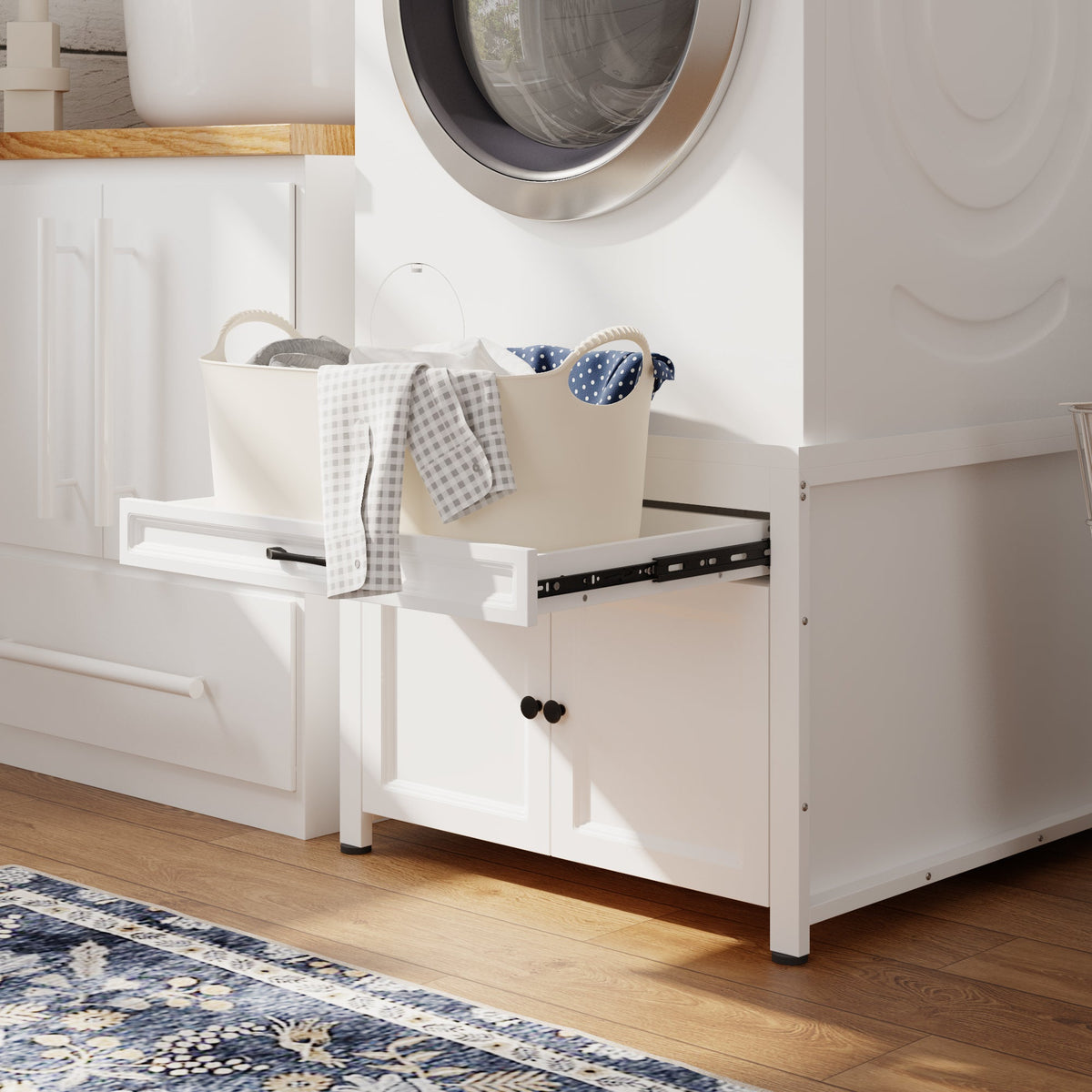
A laundry pedestal is a raised base, usually with a pull-out drawer, that lifts a front-load washer or dryer so the door and drum sit higher and you bend less to load and unload. Before you buy one, check four things: the top fits your machine's footprint (and your machine's instructions don't call for a specific pedestal), the weight rating covers the machine plus water and wet laundry, the floor is level, and the machine is secured the way the instructions say. Then check that the new total height clears any shelf above, and that the hoses, cord and dryer duct still reach without kinks.
Below: height arithmetic, fit, weight, vibration, dryer venting and closet clearance, then the universal pedestal in the FUFU&GAGA bathroom and laundry collection and who should skip it.
Key takeaways
- Height: add the pedestal height to your machine's door height and overall height.
- Fit: every foot of the machine must sit fully on the pedestal top.
- Weight: the rating must cover the machine, water and wet clothes, with room to spare.
- Stability: a level floor, leveled feet and balanced loads stop shaking and walking.
- Dryers: re-route the exhaust duct without crushing or kinking it.
What is a laundry pedestal?
A laundry pedestal (also called a washer pedestal or dryer pedestal) is a sturdy box or frame that sits under one machine. Many have a storage drawer. Family Handyman notes that many makers of washers and dryers sell their own pedestals, which usually cost more than universal ones, and that a pedestal 28 inches wide and deep will fit almost all brands. It also points out that machines from different makers have their feet in different places, so one maker's pedestal may not work with another maker's machine (Family Handyman, washer and dryer pedestals).
Heights vary. Family Handyman says most pedestals raise a washer and dryer by 12 to 14 inches, and Top Ten Reviews gives 12 to 16 inches (Top Ten Reviews, washing machine pedestals). Taller pedestals exist too, and the extra height changes how the machine fits the room and the people who use it, so do the arithmetic below before you choose.
Do I need a laundry pedestal?
No machine needs one to work; it is a comfort and storage upgrade. Top Ten Reviews says a pedestal saves you from bending down to start a wash or dry cycle and brings the controls closer, but that adding height to a top loader can make loading harder.
| A pedestal usually helps if... | Think twice if... |
|---|---|
| You have a front-load washer or dryer and bend to reach the drum | You have a top-load washer: a higher lid and drum are harder to reach into |
| Bending or kneeling is hard on your back or knees | Shorter people in the home already stretch to reach the controls |
| You want a drawer for supplies or a basket under the door | A shelf or cabinet sits low above the machine |
| The floor is solid and level, with room in front to open a drawer | You plan to stack the dryer on the washer |
Family Handyman adds that a tall pedestal can put the dials out of easy reach for people of smaller stature.
Washer pedestal height: do the arithmetic first
A pedestal raises everything on the machine by roughly its own height: the door, the drum opening, the control panel and the top. Measure two things on your machine (or read them from its spec sheet): the height from the floor to the centre of the door, and the overall height to the top. Then add the pedestal height.
Door centre height after raising
Plain addition. Measure your own machine; the left column is only a set of examples.
| Door centre on the floor (example) | On a 12-inch pedestal | On a 16-inch pedestal | On a 22.4-inch pedestal |
|---|---|---|---|
| 16 in | 28 in | 32 in | 38.4 in |
| 18 in | 30 in | 34 in | 40.4 in |
| 20 in | 32 in | 36 in | 42.4 in |
| 22 in | 34 in | 38 in | 44.4 in |
To find your target, hold a laundry basket where you would like the door to be: high enough to reach the back of the drum without stooping, low enough that you are not lifting wet clothes up and out. Measure that height and compare.
Overall height and the controls
Do the same addition for the top of the machine. For example, if your machine is 39 inches tall, a 22.4-inch pedestal brings its top to 61.4 inches and a 14-inch pedestal to 53 inches. Check that against the underside of any shelf, cabinet or window sill above, and leave whatever top clearance your machine's installation instructions ask for. On a front-loader the controls sit at the top front, so the shortest regular user should try reaching that height before you buy.
Will it fit? Footprint and compatibility
Check these before you order:
- Width and depth of the machine against the pedestal top. Family Handyman says a top 28 inches wide and deep fits almost all machines; a larger top gives more margin.
- Foot positions, side to side and front to back. They must land inside the top, not on an edge or lip.
- Your manual. Some makers sell pedestals for their own models. See whether the installation section names one or warns against others, and follow it.
- Washer or dryer. A universal pedestal takes either; if you might swap machines later, size the rating for the heavier one.
Weight capacity: the machine plus water and laundry
A pedestal's rating has to hold more than the machine's empty weight. Family Handyman says washing machines usually weigh 100 to 300 pounds before you add clothes and water, that front-loaders are usually about 10 percent heavier, and that dryers average 100 to 150 pounds. The U.S. Fire Administration notes that a full load of wet clothes can hold as much as one and a half gallons of water (USFA, Clothes Dryer Fires in Residential Buildings), on top of the clothes themselves. A washer holds that water and more while it runs.
Read your machine's weight from its spec sheet, then work out the headroom under the pedestal's rating. For a 330 lb rating:
| Machine weight (empty) | Left for water, clothes and spin | Verdict |
|---|---|---|
| 150 lb (top of the usual dryer range) | 180 lb | Plenty of room |
| 200 lb | 130 lb | Comfortable |
| 250 lb | 80 lb | Workable; keep loads moderate |
| 300 lb | 30 lb | Too tight for a full washer; choose another setup |
A spinning drum pushes on its base harder than a still one, so leave real headroom. If a listing does not say whether its rating includes water and laundry, treat it as the total for everything on top.
Level floor, vibration and walking
Family Handyman warns that pedestals that are cheaply made or don't match the machine's size can make more noise and vibration. Most shaking and walking has simple fixes:
- Floor: set the pedestal on a solid, flat floor, not on a rug or a soft spot.
- Level twice: level the pedestal first with its own feet, checking side to side and front to back with a spirit level, then level the machine on top with its feet.
- Loads: mixed loads balance better than a single heavy item such as a bath mat or comforter on its own.
- Re-check: after the first few spins, make sure every foot still touches.
If a raised washer still moves during spin, stop using it on the pedestal until the cause is found.
Securing the machine and hookups
Follow the pedestal's and the machine's installation instructions together, and don't improvise brackets or straps neither describes. Then check that every connection reaches the new height:
- Fill and drain hoses reach without stretching or kinking.
- The power cord reaches its outlet without an extension cord. The USFA advises making sure the correct plug and outlet are used for a dryer.
- A gas dryer's connector reaches without strain. Have a qualified installer move or reconnect it; the USFA advises having your clothes dryer installed by qualified personnel and having gas dryers inspected by a professional every year.
- The dryer duct reaches the wall without crushing (next section).
Stacking is a separate question. A pedestal holds one machine. If you want a dryer on top of a washer, use the stacking kit your machine's maker specifies and follow its instructions; do not stack onto a pedestal unless both makers' instructions say so.
A dryer on a pedestal: venting and lint fires
Raising a dryer moves its exhaust outlet up by the pedestal's height, so the duct behind it has to be re-routed. The U.S. Consumer Product Safety Commission warns that lint can block the flow of air, cause excessive heat build-up and result in a fire in some dryers, and that flexible plastic or foil duct is more prone to kinks or crushing, which can greatly reduce airflow (CPSC, Overheated Clothes Dryers Can Cause Fires).
The USFA's report on residential dryer fires from 2008 to 2010 found that failure to clean (34 percent) was the leading factor contributing to the ignition of those fires. When you set a dryer on a pedestal:
- Use metal duct. The CPSC says to replace plastic or foil accordion ducting with rigid or corrugated semi-rigid metal duct.
- Check the run behind the dryer. The USFA advises making sure the venting behind the dryer is not damaged, crushed or restricted. Push the raised dryer back slowly and look again.
- Clean the lint screen every load, and clean behind the dryer, where lint builds up (CPSC).
- Watch for blockage. Damp clothes after a normal cycle, or longer drying times, can mean the lint screen or duct is blocked; check that air comes out of the outside vent while the dryer runs (CPSC).
- Keep burnables away. The USFA says to keep the area around the dryer free of items that can burn, so keep oily or solvent-soaked rags out of the pedestal drawer.
- Don't run it unattended. The USFA advises not leaving a dryer running when you leave home or go to bed.
Clearance in a laundry closet
A pedestal changes all three dimensions of a laundry closet, so measure the space with the pedestal included:
- Width: one pedestal's width per machine, plus the side gaps your machine's instructions ask for. Two 29.1-inch pedestals side by side need 58.2 inches before any gaps.
- Depth: the deeper of pedestal and machine, plus room behind for hoses and duct, and in front to open the drawer and the machine door.
- Height: machine height plus pedestal height, plus the top clearance in the machine's instructions.
- Closet doors: if the machines sit behind doors, check your manuals for any door ventilation or opening requirement and follow it; such figures differ from model to model.
- Exhaust: the USFA notes that building codes require clothes dryers to be exhausted directly to the outdoors, never into an attic, soffit, ridge vent or crawl space.
Laundry pedestal buying checklist
- Pedestal top is at least as wide and deep as your machine, and every foot lands on it.
- Your machine's manual doesn't require a specific pedestal.
- Weight rating minus the machine's empty weight leaves clear headroom for water, clothes and spin (30 lb is too little for a full washer).
- Door centre plus pedestal height lands where you can load without stooping.
- Machine height plus pedestal height clears any shelf above, with the manual's top clearance.
- Floor is solid and level; the pedestal has adjustable feet.
- Hoses, cord, gas connector and dryer duct reach the new height without strain or kinks.
- Room in front for the drawer to open fully.
Our pick: a universal laundry pedestal
The FUFU&GAGA laundry pedestal below is a universal design with a top larger than the 28-inch size Family Handyman says fits most machines. Facts come from its product listing; the installation guide is in the User Manual tab on the product page.
29" Universal Laundry Pedestal with Drawer
A white pedestal for one washing machine or dryer, listed as universally compatible. It measures 22.4" H x 29.1" W x 29.1" D. A powder-coated iron frame supports an appliance of up to 330 lb, and the top is an integrated iron basin that the listing describes as sealed and leak-proof. Four black anti-slip, shock-absorbing strips sit under the machine to cut down on vibration, and the feet adjust to level it.
Underneath, a large pull-out drawer rated for 55 lb is big enough for a laundry basket or clothes, so you can slide it out under the door while you unload. The pedestal weighs 66 lb, is made of metal, stainless steel, aluminum and manufactured wood, and the listing calls it rust-, water- and leak-resistant; wipe it clean with a cloth. Installation is required, and you need a screwdriver, which is not included.

Best for: a front-load washer or dryer whose footprint fits a 29.1-inch-square top, for people who want the door well off the floor and a basket drawer underneath.
Skip it if: your washer weighs close to the 330 lb limit empty, since water and wet clothes need room on top of that. At 22.4" tall it is a high pedestal, so also skip it if shorter users already stretch for the controls, if a shelf sits low above the machine, if you have a top-load washer, or if you plan to stack a dryer on top: it is rated for a single appliance.

At a glance
| Feature | 29" Universal Laundry Pedestal |
|---|---|
| Size (H x W x D) | 22.4 x 29.1 x 29.1 in |
| Appliance | One washer or dryer, universal |
| Appliance weight limit | 330 lb |
| Drawer | Pull-out, holds 55 lb |
| Top | Iron basin with 4 anti-slip, shock-absorbing strips |
| Leveling | Adjustable feet |
| Pedestal weight | 66 lb |
| Installation | Required; screwdriver not included |
For the build, see our flat-pack assembly guide. For cabinets and shelving to go beside the machine, see our bathroom storage cabinet guide and browse the bathroom and laundry collection.
FAQ
Do I need a laundry pedestal?
No. A machine works the same on the floor. A pedestal is worth it with a front-loader when bending is uncomfortable, or for the drawer. It rarely suits a top-load washer, a low shelf above the machine, or a stacked pair.
How tall should a washer pedestal be?
Common pedestals raise a machine 12 to 16 inches. Door centre height plus pedestal height should land where you can reach into the drum without stooping, and the total height must clear anything above.
Can a washer pedestal be used for a dryer?
A universal pedestal holds either if the footprint fits and the weight is within the rating. Re-route the raised dryer's duct with rigid or semi-rigid metal, and check nothing behind it is crushed.
Does a pedestal make a washer vibrate more?
It can if the pedestal is flimsy, the wrong size or not level. Use a solid floor, level both pedestal and machine, keep anti-slip pads under the machine, and don't spin one heavy item alone.

Dejar un comentario
Este sitio está protegido por hCaptcha y se aplican la Política de privacidad de hCaptcha y los Términos del servicio.