











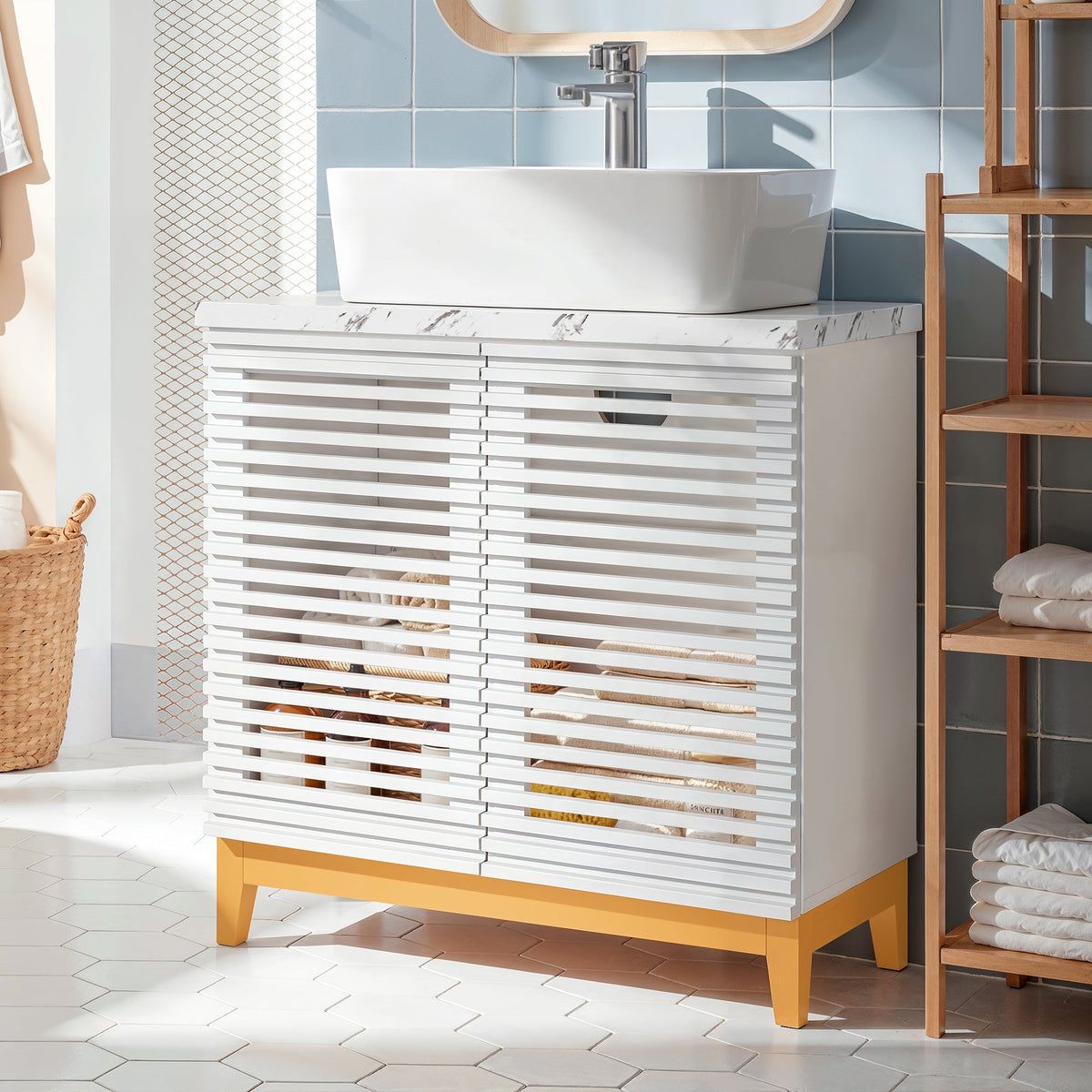
A vessel sink vanity is a bathroom vanity with a bowl that sits on top of the counter instead of inside it, so the bowl adds its full height to the cabinet below. That is why a vessel sink usually goes on a lower cabinet: a 30-inch counter with a 6-inch bowl, or a 32-inch counter with a 4-inch bowl, puts the rim near 36 inches, while a 5-inch bowl on a standard 34-inch vanity ends up at 39 inches. Then choose a faucet that reaches over the rim, a drain that suits a bowl with or without an overflow, and plan for cleaning where the bowl meets the counter.
Below: the height arithmetic, faucets and drains, vessel vs undermount, care and storage, then the two vessel sink vanities in the FUFU&GAGA bathroom vanity collection and who should skip each.
Key takeaways
- Height: rim height = cabinet height + bowl height. Aim the rim at about 3 inches below the main user's elbow.
- Cabinet: 30 to 32 inches suits most 4- to 6-inch bowls; a 36-inch comfort height cabinet with a 5-inch bowl puts the rim at 41 inches.
- Faucet: a tall vessel faucet or a wall-mount faucet that clears the rim.
- Drain: many vessels have no overflow hole, so match the drain to the bowl.
- Care: wipe the bowl-to-counter joint daily; use nonabrasive cleaners.
What is a vessel sink vanity?
A vessel sink is a basin that rests on the countertop like a bowl. Fine Homebuilding notes that vessel sinks have no faucet holes, so the faucet is mounted on the wall or on the counter, and that because the hole cut in the countertop is small, much more of the counter material remains (Fine Homebuilding, bathroom sink styles). A vessel sink vanity has a top drilled for the drain under the bowl and, unless the faucet comes out of the wall, for a faucet beside or behind it.
The bowl does not have to sit fully on top. Supply House Times, summarizing the National Kitchen and Bath Association (NKBA) guidelines, notes that a vessel can be set on or cut into the counter, and that partially recessing it can give the look without all the added height (Supply House Times, NKBA lavatory planning).
Vessel sink vs undermount: which should you choose?
An undermount sink hangs below a hole in the counter; a drop-in (self-rimming) sink sits in the hole with its rim on the counter. The daily differences are height, faucet and cleaning.
| Vessel | Undermount | Drop-in | |
|---|---|---|---|
| Where the bowl sits | On top of the counter | Below the counter | In the counter, rim on top |
| Effect on height | Adds the bowl height; use a lower cabinet | Rim is the counter height | Rim is about the counter height |
| Faucet | Tall deck-mount or wall-mount | Standard faucet | Standard faucet |
| Wiping the counter | Water cannot be wiped into the bowl | Wipe water straight into the sink | The rim stops water being wiped in |
| Counter cutout | Small drain hole; most of the top remains | Waterproof materials only | Cut edge can stay rough |
Fine Homebuilding adds that undermount sinks suit only waterproof counters such as granite, marble or solid surface, and cannot be retrofitted without removing the vanity top.
How tall should a vessel sink vanity be?
Start from the rim, not the cabinet. Supply House Times says to add the counter height and the bowl height together to find the finished height. Pro Remodeler puts standard vanities at 30 to 34 inches, with 34 the average, comfort height at about 36 inches, and says most vessel sink vanities have a sink edge of about 36 inches: a 4-inch bowl calls for a counter no taller than 32 inches, a 6-inch bowl one about 30 inches (Pro Remodeler, vanity height).
Rim height by cabinet and bowl
Plain addition: counter height plus the bowl's outside height (from its drawing, not the inside depth).
| Counter height | Bowl height | Rim height | How it compares |
|---|---|---|---|
| 30 in | 4 in | 34 in | Low; suits shorter adults |
| 30 in | 6 in | 36 in | The usual vessel target |
| 32 in | 4 in | 36 in | The usual vessel target |
| 32 in | 6 in | 38 in | Suits taller adults |
| 34 in (standard average) | 5 in | 39 in | High for many users |
| 36 in (comfort height) | 5 in | 41 in | Too high for most shared baths |
Fit the rim to the people who use it
The NKBA rule of thumb, as Supply House Times reports it, is a work surface about 3 inches below the user's elbow. The recommended range is 32 to 43 inches for adults overall: 37 to 43 inches for men, 32 to 36 inches for women and 26 to 32 inches for children. When two people share one sink, a compromise has to be made (Supply House Times, NKBA fixture placement).
Worked example: measure from the floor to the underside of the bent elbow. At 40 inches, the target rim is 40 - 3 = 37 inches, and with a 5-inch bowl the counter should be 37 - 5 = 32 inches. At 39 inches, the same bowl needs a 31-inch counter.
The lavatory planning article warns that a vessel on a typical 32- to 36-inch cabinet may be too high for a petite user and is inappropriate in a children's bathroom; there, plan a lower undermount or drop-in sink.
Accessible bathrooms and the 34-inch limit
Where a bathroom must meet the 2010 ADA Standards, section 606.3 says the front of the higher of the rim or counter surface must be 34 inches maximum above the finished floor, and section 606.2 calls for a forward-approach clear floor space with knee and toe clearance under the sink (US Access Board, ADA Standards). With a vessel, the rim is the higher surface, so a 5-inch bowl needs a counter at 34 - 5 = 29 inches or lower, plus open knee space. A cabinet vanity with a vessel on top rarely meets both rules, so plan an accessible sink with your designer from the start.
Which faucet works with a vessel sink?
The faucet has to deliver water over the rim and into the middle of the bowl. Hunker's vessel sink guide says you need a high-arc faucet to clear the rim, with the spout at least 1 inch above the rim to satisfy code, and warns that a spout set too high above the base of the bowl makes water splash (Hunker, vessel sink guide). The listing for your vanity names the faucet type it is drilled for; buy that type.
How to check height and reach
- Height: the faucet's outlet height above the counter must be more than the bowl's outside height, plus the clearance the faucet maker asks for.
- Reach: measure from the center of the faucet hole to the center of the drain. The spout reach should bring the stream close to the drain, so it does not hit the sloped side of the bowl.
- Handle: the lavatory planning article advises deck faucets installed beside the vessel rather than behind it, so the overflow and controls stay within reach. If the faucet hole is behind the bowl, check that you can reach the handle comfortably over the rim.
A wall-mount faucet frees the counter, but the spout has to line up with the bowl. Supply House Times notes that a wall-mounted faucet needs to be exactly positioned for the installer, and Hunker adds that it is installed independently of the sink, usually before it. Unless the supply pipes are already in the wall at the right height, that means opening the wall, which is work for a licensed plumber.
Flow and splash
Hunker notes that vessel sinks tend to splash more often, especially with a wall-mount faucet. A lower flow helps a shallow bowl: the EPA says WaterSense labeled bathroom faucets use a maximum of 1.5 gallons per minute and can cut a sink's flow by 30 percent or more from the standard 2.2 gallons per minute (EPA WaterSense).

Drains, overflow holes and mounting
Hunker says vessel sinks generally lack overflow holes, so they can overfill and spill water onto the counter and floor. Fine Homebuilding makes the same point and suggests a grid drain rather than a stopper for households with children or anyone forgetful, since a grid drain cannot be closed. Check your bowl: if it has an overflow hole, buy a drain made for one; if not, buy a drain for a bowl without an overflow.
Hunker also notes that a sink resting directly on the counter is much easier to install, and that an uneven surface such as ceramic tile is a poor base for one. Read the vanity listing for what is included. Neither of our vessel vanities includes a faucet, a drain assembly or a P-trap, so budget for those parts and for the plumber's time where your local rules require a licensed installer.
Vessel sink materials and how to clean them
Hunker's vessel sink guide says fragility is an issue with some materials, naming glass and vitreous china, and that vinegar and common cleaners can etch natural stone, which needs a cleaner made for that stone.
- Ceramic and porcelain: Bob Vila advises warm water, liquid soap and a sponge, nothing that would scratch glass, and no chlorine bleach on colored porcelain (Bob Vila, porcelain sink care).
- Cultured marble and other cast stone (both our picks have one; the listings call them polymarble and cultured stone): Hunker describes cultured marble as a mix of marble powder and polyester resin, and advises mild dish soap or a gentle nonabrasive cleaner, avoiding abrasives (Hunker, cultured marble). Sources disagree on vinegar for stone-look surfaces, so follow the care notes for your sink and test any new cleaner on a hidden spot.
The joint is the part people miss. Hunker calls the underside of the bowl where it meets the countertop the most problematic area to clean. Wipe it with the counter every day, dry any standing water around the base, and look for gaps in the sealant when you clean.
Storage under a vessel sink
The drain drops through the counter under the bowl to the P-trap inside the cabinet, so the pipes take the middle. Plan around them:
- Use bins or baskets on either side of the pipes instead of one wide bin.
- Keep towels and paper on the upper shelf, away from any drip at the trap, and check under the sink for leaks every few weeks.
- Need more room? Our bathroom storage cabinet guide covers towers and over-the-toilet units, and the medicine cabinet size guide shows how to size a cabinet above the vanity so its door clears a tall faucet.
Vessel sink vanities in a small bathroom
A vessel vanity needs the same floor space as any vanity of its size; our 30 inch bathroom vanity guide covers wall length, toilet spacing and clear floor. Two vessel-specific checks: the door and any medicine cabinet door must clear the raised bowl, and a slim bowl leaves more counter for a soap dish and a cup.
Vessel sink vanity buying checklist
- Measure the main user's elbow height and subtract 3 inches for the target rim.
- Subtract the bowl's outside height from the target rim to get the counter height you need.
- Check the rim against 34 inches if the bathroom must be accessible.
- Read the faucet type the vanity is drilled for: single-hole, vessel faucet or wall mount.
- Compare the faucet's outlet height with the bowl height, and its reach with the hole-to-drain distance.
- Note whether the bowl has an overflow hole and buy a matching drain.
- List what is not included: faucet, drain assembly, P-trap, mounting bracket.
- Compare your drain and supply positions with the cabinet interior.
- Book a licensed plumber for wall-mount faucets or any pipe changes.
Our picks: vessel sink vanities
Both FUFU&GAGA vessel vanities below include the sink but not the faucet. Facts come from each product listing.
31.6" Black Single Vanity with Polymarble Vessel Sink
A black cabinet on a solid pine frame and legs, with a white marble-look manufactured wood top and a white rectangular polymarble (artificial stone) vessel sink that has an overflow hole. It measures 36.2" H x 31.6" W x 19" D with the included backsplash. The base is 31.3" tall and the bowl is 4.9" deep inside, so the rim lands a little above 31.3 + 4.9 = 36.2 inches once the bowl's floor is added. The bowl is 22.4" long and 16.7" wide, and two doors open to a cabinet 22.4" H x 29.2" W x 15" D inside, with two shelves.
It takes a single-hole faucet, sold separately along with the drain assembly and P-trap; the backsplash and cabinet handles are included. It weighs 79 lb and one person can assemble it.
Best for: adults who want the rim at about the usual vessel height, and anyone who likes an overflow hole on the bowl.
Skip it if: you want a drawer, or children will use the sink every day. The listing photos show the faucet behind the bowl, so pick one with enough reach to land the stream near the drain.
31.3" White Louvered Vanity with Cultured Stone Vessel Sink
White louvered doors on solid wood legs, with a rectangular composite (cultured) stone vessel sink on a manufactured wood countertop. It measures 37.8" H x 31.3" W x 18.9" D, and the basin is 21.6" long, 12" wide and 4.5" deep inside. The listing says the slatted doors let air move through the cabinet and that an anti-tip device is included. It has a finished back panel, weighs 100 lb and takes a vessel faucet.
Not included: the faucet, drain assembly, P-trap, mounting bracket, cabinet handles, mirror and backsplash. Assembly is required.
Best for: taller adults who like a higher sink, and a bright, airy bathroom.
Skip it if: shorter users or children share the sink, because at 37.8" overall it is the taller of the two. Also skip it if you want a drawer or a backsplash, since neither is included.

Compare the picks
| Pick | Size (H x W x D) | Bowl | Faucet type | Storage | Best for |
|---|---|---|---|---|---|
| 31.6" black | 36.2 x 31.6 x 19 in | Polymarble, overflow hole | Single-hole | 2 doors, 2 shelves | Rim near the usual vessel height |
| 31.3" white louvered | 37.8 x 31.3 x 18.9 in | Cultured stone | Vessel faucet | 2 louvered doors | Taller adults |
Both need assembly; our flat-pack assembly guide covers the build. Compare finishes and sizes across the bathroom vanity collection once you know your target rim height.
FAQ
Should a vanity be lower for a vessel sink?
Usually, yes. The bowl adds its height to the counter, so a 30-inch counter with a 6-inch bowl, or a 32-inch counter with a 4-inch bowl, puts the rim near the 36 inches most vessel vanities have. Work out your own target from elbow height minus 3 inches.
Can you put a vessel sink on a standard vanity?
You can, but check the result. A 5-inch bowl on a 34-inch vanity puts the rim at 39 inches, which suits tall adults and is too high for many others. A partially recessed bowl or a shallower one brings it down.
Do vessel sinks splash more?
They can, especially with a wall-mount faucet or a spout set high above the bowl. Choose a faucet whose stream lands near the drain, and consider a lower-flow faucet; WaterSense models use 1.5 gallons per minute at most.

Dejar un comentario
Este sitio está protegido por hCaptcha y se aplican la Política de privacidad de hCaptcha y los Términos del servicio.