










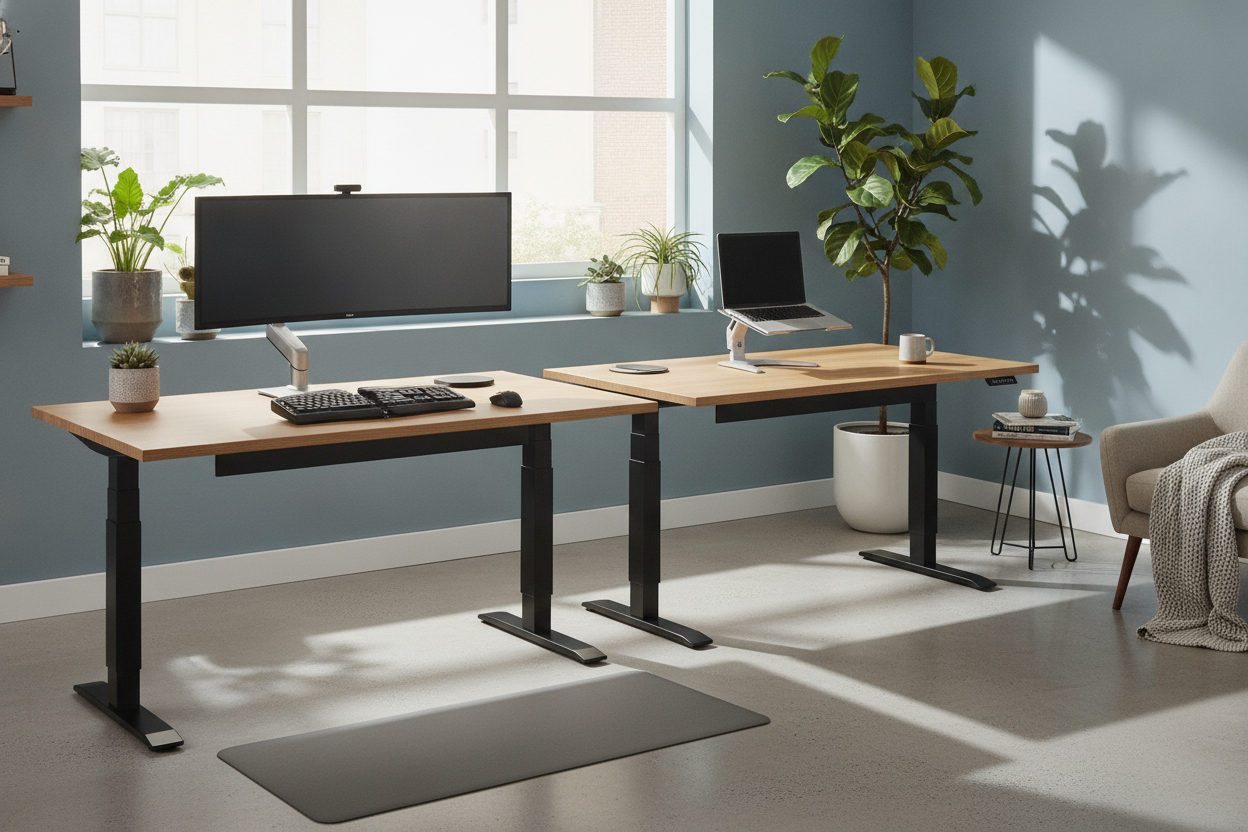
My lower back was screaming by 3 PM every Tuesday. I spent years hunched over a traditional writing computer desk that looked great on Instagram but felt like a torture device after six hours. I finally broke down and bought the details worktools standing desk after realizing my physical therapist was costing more than the furniture. You know that feeling when you try to stand up after a long session and your spine makes a sound like a bag of dry pasta breaking? That was my life. I’d spent hundreds on 'ergonomic' chairs and monitor arms, but I was still ignoring the foundation of the whole setup.
- Rock-solid stability even at the 45-inch max height.
- Motor so quiet you can adjust it during a Zoom call without muting.
- Commercial-grade steel that's heavy enough to be a structural support.
- A price tag that makes you double-check your bank account.
The Breaking Point: Why I Finally Ditched My Cheap Setup
We’ve all been there. You’re three hours into a deep-work session and you realize your chin is basically touching your chest. I tried the 'laptop on a stack of books' trick. I tried the cheap $200 standing desk from the big-box store. Both were disasters. The cheap desk wobbled so much while I typed that my monitor looked like it was in an earthquake. It’s hard to focus on a spreadsheet when your screen is vibrating like a tuning fork.
The physical toll was real. Sciatica, neck cricks, and that weird burning sensation between the shoulder blades became my daily reality. Moving from a static traditional writing computer desk to something adjustable wasn't just about being trendy; it was about survival. I needed something that wouldn't shake when I sneezed and wouldn't sag under the weight of two monitors and a heavy desktop. I realized that my 'affordable' furniture was actually costing me in lost productivity and ibuprofen.
Wait, What Even Is Details Worktools?
If you haven't heard of Details, it’s because they don't usually market to the casual home shopper. They are a Steelcase brand. Think of Steelcase as the heavy-duty, 'we furnish entire skyscrapers' company. Details is their division focused on the ergonomic tools that actually make a desk livable. They aren't trying to win design awards for mid-century modern aesthetics; they are trying to build things that last twenty years in a high-stress office environment.
While consumer brands focus on how a desk looks in a staged photo, Details focuses on how it handles a 200-pound load. It’s industrial-grade stuff. It’s the difference between a kitchen-grade blender and the one they use at the smoothie shop that could probably grind up a hockey puck. You are paying for the engineering, the gauge of the steel, and the reliability of a motor that won't give up the ghost after six months of use.
The Setup: Will It Look Like a Cubicle in My House?
This was my biggest fear. I didn't want my home office to feel like a mid-level accounting firm in 1998. The desk is heavy—we’re talking 100-plus pounds of heavy-gauge steel. It arrives on a pallet, and you’ll definitely want a second person to help you flip it over once the legs are on. If you try to do it solo, you're going to end up with a scratched floor and a very grumpy mood. The assembly is straightforward, but the sheer mass of the components reminds you this isn't a DIY kit from a grocery store.
To keep it from looking too industrial, I had to get creative. I paired the white frame with a warm wood top and threw a thick Persian rug underneath. The contrast between the cold metal legs and the soft textile makes it feel intentional rather than corporate. If you’re struggling with the aesthetic, there are plenty of designer ideas for standing desk layouts that show how to soften the metal with plants and proper lighting. I found that placing a large fiddle-leaf fig next to the motor housing hides the most 'office-y' parts of the desk.
Lighting also plays a huge role. I swapped out the harsh overhead light for a warm desk lamp with a brass finish. It pulls the eye away from the heavy-duty legs and toward the workspace itself. Don't be afraid to mix styles. A commercial-grade frame doesn't mean you have to use a plastic chair. It’s a tool, and tools can be dressed up with the right accessories.
The Coffee Test: Stability at Max Height
This is where the details worktools standing desk earns its keep. Most desks are fine when they're low. But when you crank them up to standing height, they start to 'row'—the top sways back and forth. I performed the coffee test: a full mug of black coffee sitting right next to my mechanical keyboard. I’m a heavy typer; I bottom out my keys like I’m trying to punch through the desk.
Even when I was aggressively typing or leaning my forearms on the edge to read a long document, the surface stayed dead still. It’s significantly more stable than the 71 w height adjustable standing desk I tested at a local showroom last year. That extra-thick steel in the legs and the precision-fit glides make a massive difference in dampening vibrations. Cheap desks use thinner metal that flexes under pressure. This thing uses cold-rolled steel that feels like it could survive a small explosion without a scratch.
The Motor and Memory Features I Actually Use
I’ve used cheap electric desks that sound like a dying vacuum cleaner. This motor is a whisper. It’s a smooth, gliding motion that doesn't jerk when it starts or stops. That’s vital when you have a standing desk with electric lift system because a sudden jolt is how you end up with coffee in your keyboard. The electronics are snappy, and the motor never feels like it's straining, even with a heavy oak top.
The memory presets are the only reason I actually stand. If I had to hold a button for twenty seconds every time I wanted to change positions, I’d never move. I have one setting for my 'active' standing height and another for my 'sitting' height. It hits the mark every single time without needing recalibration. It’s a small detail, but when you’re in the middle of a flow state, you want the desk to move with you, not become a chore you have to manage.
The Final Verdict: Is It Overkill for a Home Office?
Look, if you only use your desk for an hour a day to pay bills, this is absolutely overkill. Go buy something cheaper. But if you are a 10-hour-a-day warrior who is tired of feeling like a pretzel by Friday afternoon, this is the move. It’s expensive, yes. But it’s a 'buy once, cry once' situation. You won't be replacing this in three years because the motor burned out or the legs started to wobble.
My back pain hasn't magically vanished, but the frequency of those 'I can't move my neck' mornings has dropped significantly. You’re paying for the engineering and the peace of mind that the gear can handle the grind. In my book, that’s worth the premium every time. If you value your spine, stop buying disposable furniture and get something built for the long haul.
How loud is the motor?
It is incredibly quiet. You can hear a faint whir, but it is much quieter than a typical office conversation. Your coworkers on a video call won't even know you're moving.
Can I use my own desktop?
Yes, the frame is adjustable and can fit various top widths. Just ensure your top is at least 1 inch thick to provide enough bite for the mounting screws.
Is it hard to move once assembled?
Yes. It is very heavy. If you plan on moving it between rooms, I highly recommend adding the optional casters, otherwise, it's a two-person job to slide it across a floor.

Dejar un comentario
Este sitio está protegido por hCaptcha y se aplican la Política de privacidad de hCaptcha y los Términos del servicio.