










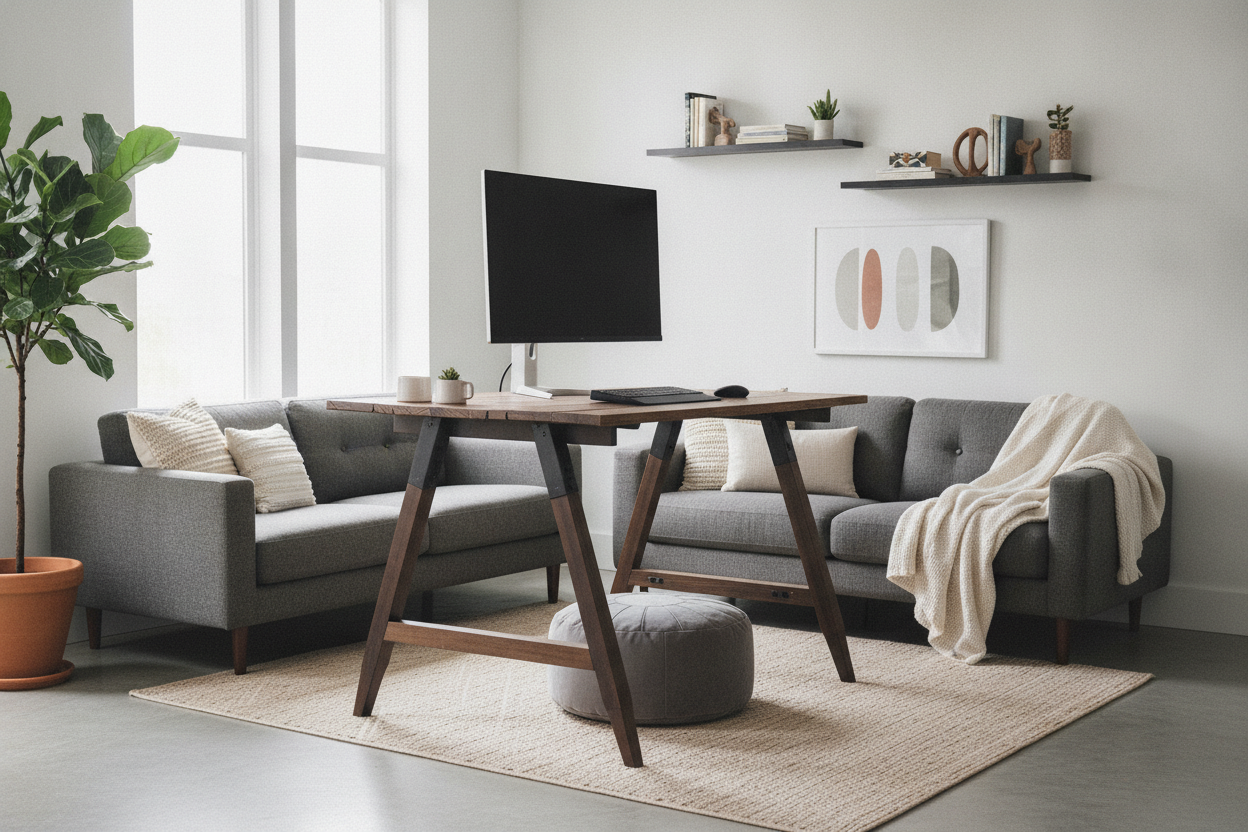
I’ve spent the last three years trying to convince myself that my velvet sofa is a productive workspace. It isn't. By 3 PM, my spine usually feels like a question mark and my neck is screaming for mercy. If you are like me, you have probably stared at your living room furniture and wondered if a coffee table to standing desk conversion is the secret to reclaiming your health without cluttering your apartment with a motorized slab of gray MDF.
Quick Takeaways
- Standard lift-top coffee tables are for eating pizza, not standing to work.
- A true standing conversion requires heavy-duty pneumatic brackets with at least 15 to 20 inches of travel.
- Stability is the main hurdle; most coffee tables are too light to prevent the 'typing wobble.'
- If your table is lightweight pine or particle board, the hardware will likely rip the screws out.
The Lure of the Living Room Workstation
We have all been there. You start the morning with your laptop on a pillow, move to the dining chair by noon, and end up hunched over the coffee table like a gargoyle by sunset. The back pain is real, and the desire to fix it without buying a clunky, industrial-looking standing desk is even more real. Living in a small apartment means every square inch has to earn its keep.
The idea of a standing desk coffee table is intoxicating. You get to keep your aesthetic living room vibe while secretly housing a functional office. It feels like a brilliant hack. But before you start drilling holes into your favorite mid-century centerpiece, you need to understand that the physics of a 19-inch-high table trying to reach a 42-inch standing height are working against you.
The Mechanics of a Coffee Table to Standing Desk Conversion
Most people think they can just buy any 'lift-top' kit from Amazon and call it a day. Those basic $30 spring-loaded hinges are designed to raise a tabletop about 5 or 6 inches—just enough to reach your lap while you sit on the couch. To get to standing height, you need heavy-duty scissor lifts or pneumatic gas struts that can handle a massive vertical leap.
When you are making your own standing desk out of a vintage table, weight is your biggest variable. A solid oak or walnut top provides the gravity needed to keep the base from tipping over when the desk is extended. However, that same weight requires brackets rated for 50+ pounds. If you go too cheap on the hardware, the top will either refuse to stay up or, worse, come crashing down on your fingers during the 10 AM All-Hands meeting.
Why Most 'Lift-Tops' Aren't Tall Enough
The marketing for most 'convertible' coffee tables is misleading. They show a person sitting comfortably, but they rarely show a person standing. A standard coffee table sits around 18 inches high. A comfortable standing height for someone 5'10' is roughly 42 inches. That is a 24-inch gap. Most pre-built lift-tops only bridge a quarter of that distance. You aren't standing; you are just slightly less hunched over.
The Ergonomic Nightmare (and How to Avoid It)
Here is the part nobody tells you: even if you get the height right, the ergonomics can be a disaster. Most coffee tables have a solid base or a storage shelf at the bottom. This means there is zero knee clearance. When you stand at a normal desk, your feet can go under the surface. With a coffee table standing desk, you often find yourself standing six inches back from the edge, reaching forward like a T-Rex to type.
Then there is the wobble. Unless your table is made of solid 2-inch thick hardwood and the base is weighted with lead, the act of typing will make your monitor dance. I once tested a DIY setup where every 'Enter' key strike made my laptop screen vibrate for three seconds. It is enough to give you a headache by lunch. To avoid this, you need hardware with locking pins and a table base that is significantly wider than the top.
Does It Ruin the Room's Vibe?
Aesthetics are usually why we try this hack in the first place. The problem is that heavy-duty lifting mechanisms are not pretty. They are bulky, greasy steel skeletons. If your coffee table has an open-leg design, everyone is going to see the 'guts' of your desk. You really need a table with a deep apron or a trunk-style base to hide the hardware when it is retracted.
Styling is also a challenge. You cannot keep a tray of candles or a stack of heavy art books on a table you intend to lift five times a day. You have to keep the surface relatively clear, which can make the room look a bit sterile. My advice? Stick to a few low-profile items that won't slide off when the pneumatic struts kick in.
The Verdict: Hack It or Buy It?
If you have a high-quality, heavy vintage table and you are handy with a drill, the DIY route is a fun weekend project. It allows you to customize the height exactly to your elbow level. But for most people, the engineering required to make a coffee table stable at 40 inches high is more trouble than it is worth. You might find that you have replaced my desk and coffee table with one lift-top hybrid that actually has the counterweights and clearance built in from the factory.
Ultimately, if you value your sanity and your laptop's safety, buying a purpose-built hybrid is the smarter move. Hacking a piece of furniture that wasn't meant to fly often ends in a wobbly mess and a trip to the chiropractor.
FAQ
Can I use any coffee table for this?
No. You need a table with a solid frame and enough internal space to mount the brackets. Thin particle board will crumble under the tension of pneumatic struts.
How do I stop the table from tipping over?
You may need to add weight to the bottom of the table base. Sandbags hidden inside the base or a heavy bottom shelf can help counteract the weight of the extended top.
Is it better than a real standing desk?
Rarely. A real standing desk is built for stability and legroom. A coffee table conversion is a compromise for small spaces where a second desk isn't an option.


Dejar un comentario
Este sitio está protegido por hCaptcha y se aplican la Política de privacidad de hCaptcha y los Términos del servicio.