










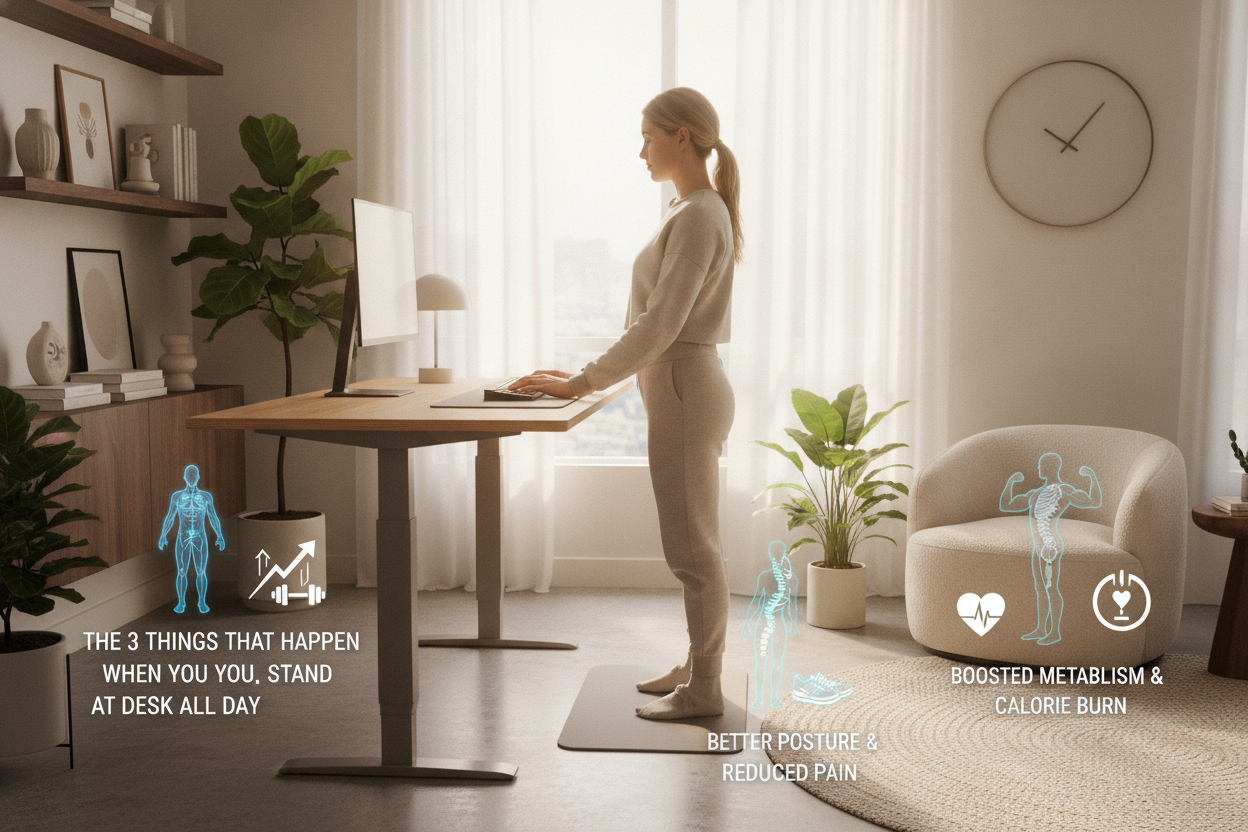
I remember the day my motorized standing desk arrived. I was convinced I’d never sit again. I literally moved my office chair into the garage, thinking I’d unlocked some secret level of productivity and health. I was going to stand at desk all day and emerge with the posture of a prima ballerina and the energy of a marathon runner.
By Wednesday, my ankles were the size of softballs and I was typing emails while leaning my chest against the desktop like a tired toddler. It turns out, the 'standing revolution' has a dark side that nobody mentions in the marketing copy. If you’re planning to ditch the chair entirely, you’re in for a very sore awakening.
Quick Takeaways
- Standing still is just as taxing on the circulatory system as sitting still.
- Locking your knees for hours can lead to lower back strain and 'concrete heel' syndrome.
- Static standing actually kills deep-focus productivity for most people.
- The magic ratio is a mix of sitting, standing, and walking—not just one posture.
The 'Never Sit Down' Delusion
We’ve been told for a decade that sitting is the new smoking. Naturally, our overachieving brains decided that if sitting is poison, standing must be the antidote. We treat our desks like a gym membership we have to use for eight hours straight. But here is the reality: your body isn't designed for static positions, period.
When I first started trying to stay upright from 9 to 5, I felt like a hero for the first hour. By hour four, I was shifting my weight from side to side like I was waiting in the world’s longest DMV line. You aren't actually 'active' just because you're vertical. You're just putting 100% of your body weight on your joints instead of a cushion.
The Brutal Physical Reality of Locking Your Knees
The first thing that hits you is 'concrete heel.' It’s a dull, throbbing ache that starts in your calcaneus and radiates up to your calves. By the time 3:00 PM rolls around, every step feels like you’re walking on LEGOs. Then comes the lower back overcompensation. When your legs get tired, you naturally tilt your pelvis forward, putting a nasty curve in your spine that leaves you stiffer than a board by Friday.
The weirdest side effect, though, is the brain fog. You’d think standing keeps you sharp, but trying to stand at computer desk workstations while performing deep-focus tasks—like coding or heavy editing—is a nightmare. Your brain starts diverting energy to your aching feet instead of your prefrontal cortex. I found myself making typos I haven't made since middle school because my body was screaming at me to sit down.
What the Science Actually Suggests
If you look at what standing desk studies actually say, the 'all or nothing' approach is a total myth. Ergonomists generally recommend a 2:1 or 3:1 ratio. For every hour of work, you should sit for 40 minutes, stand for 15, and move or stretch for 5. This keeps the blood flowing without causing the venous pooling that happens when you're a human statue.
When you use a standing desk all day without breaks, you're actually increasing your risk of varicose veins and joint inflammation. The goal isn't to stand; it's to change your posture frequently enough that no single muscle group gets exhausted. Movement is the medicine, not the standing itself.
How I Fixed My Routine (Without Giving Up the Desk)
I didn't sell my desk; I just learned how to use it like a tool instead of a treadmill. The biggest change was getting a desk with a memory preset controller. If I have to manually crank a desk or even hold a button for 30 seconds, I won't do it. Having one-touch presets for my 'focus height' and 'meeting height' made the transition frictionless.
I also invested in a high-quality anti-fatigue mat—the kind with topographic bumps that force your feet to move. Standing on a flat, hard floor is a recipe for disaster. Now, I set a timer. I stand during my morning calls and while I'm clearing out my inbox. The moment I need to draft a long-form report, I bring the desk down and take a seat.
Give Yourself Permission to Sit
There is no trophy for suffering through a workday with throbbing calves. Some tasks are objectively better suited for a traditional writing computer desk setup. For me, heavy creative drafting requires the physical stability of being seated. It grounds me. Meanwhile, administrative tasks and 'maintenance' work feel much more energetic when I'm on my feet.
Stop treating your chair like an enemy. It’s a tool, just like your monitor or your keyboard. The best workstation is the one that lets you move before you start hurting. If your feet are talking to you, listen to them. Lower the desk, sit down, and get your work done.
FAQ
Do I need special shoes to stand at my desk?
Don't try to stand in flat dress shoes or, god forbid, heels. If you're working from home, a supportive pair of sneakers or even high-quality recovery slides make a massive difference. Barefoot on hardwood is a one-way ticket to plantar fasciitis.
How long should I stand at first?
Start small. Try 20 minutes an hour. If you try to go from zero to eight hours on day one, you'll hate your desk by day three. Build up the 'standing stamina' over a few weeks.
Are anti-fatigue mats actually worth it?
Yes. A thousand times yes. A 3/4-inch thick foam mat is the difference between feeling fine at 5:00 PM and feeling like you’ve been standing on a sidewalk all day. It’s the best $50 you’ll spend on your office.



Dejar un comentario
Este sitio está protegido por hCaptcha y se aplican la Política de privacidad de hCaptcha y los Términos del servicio.