










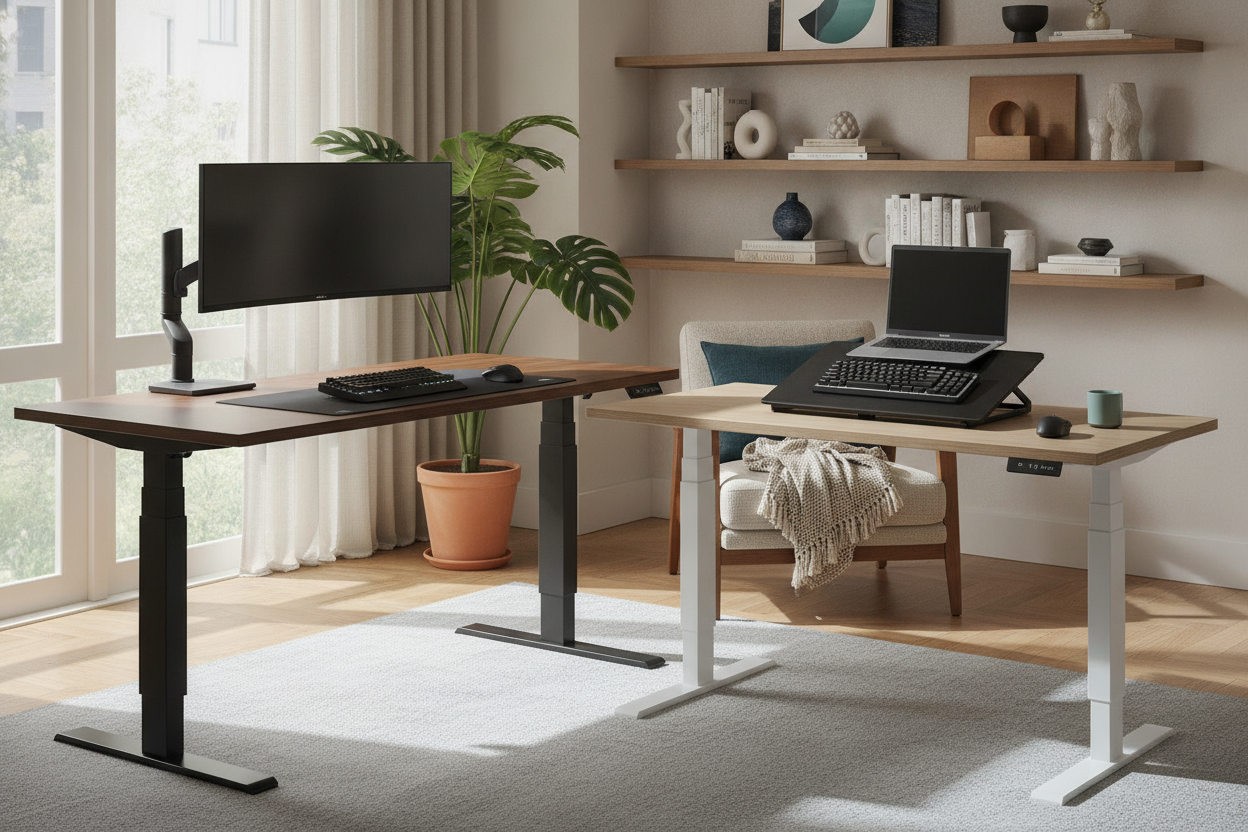
I spent three weeks staring at my laptop while it sat precariously on a stack of coffee table books before I finally caved and bought a standing motorized desk. The ads for the Vari sit-stand desk were everywhere, promising me a pain-free spine and the productivity of a Silicon Valley CEO. But as I sat there with 47 browser tabs open, I couldn't help but wonder if the $800 price tag was actually buying me quality or just funding their marketing budget.
After testing three different frames in two years, I’ve learned that the price gap between a 'premium' brand and a generic one is often smaller than the marketing departments want you to believe. It is easy to get sucked into the hype, but your back only cares about stability and motor reliability, not the logo on the handset.
- Dual Motors are Mandatory: Single motors are louder, slower, and prone to burning out under the weight of two monitors.
- Stability Matters Most: Cheap desks wobble at heights over 40 inches; look for heavy steel T-style legs.
- Warranty is Your Safety Net: Electronics fail; a 5-year warranty is the bare minimum you should accept for a motorized frame.
- Desktop Material: Most budget desks use thin 0.5-inch particle board; aim for at least 0.75-inch or 1-inch thick tops to prevent bowing.
The Illusion of Premium Desk Brands
Here is the dirty secret of the office furniture industry: most standing desk suppliers aren't actually manufacturing their own lift columns. They are sourcing them from a handful of massive factories. When you buy a high-end brand, you are often getting a white-labeled frame that has been slightly customized with a proprietary controller or a specific paint finish.
I’ve seen 'boutique' desks that cost nearly a thousand dollars using the exact same Jiecang or Linak components found in mid-tier models. You are paying for the convenience of fast shipping, a better assembly manual, and the peace of mind that comes with a US-based customer service team. While those things have value, they don't necessarily make the desk move up and down any better than a well-reviewed alternative.
The flashy Instagram ads are designed to make you feel like you're buying a piece of precision engineering. In reality, you're buying a steel frame and a small electric motor. Once I realized that the core technology is largely commoditized, I stopped looking at the brand name and started looking at the weight capacity and the gauge of the steel.
Is the Vari Sit-Stand Desk Actually Better?
The vari sit-stand desk gained its reputation for one main reason: assembly. Most motorized desks require an hour of frustration and a dozen different screws. The Vari arrives almost entirely pre-assembled, which is a massive win if you value your Saturday afternoon. But once it is built, the performance difference between it and a $400 competitor starts to blur.
A solid desk with an electric lift system will often feature the same 200+ pound weight capacity and memory presets. Where the premium brands win is in the 'fit and finish.' The laminate on a Vari top is thicker and more resistant to scratches than the paper-thin veneers found on big-box store specials. If you are prone to spilling coffee or dragging heavy equipment across your workspace, that durability matters.
However, if you are on a budget, you can find 90% of that quality for 50% of the price. The daily comfort of a desk comes down to whether it stays still while you type. If a desk is built with thin, lightweight legs, it will vibrate every time you hit the 'Enter' key, regardless of how much you paid for it.
The 3 Specs You Actually Need to Check
Whether you are searching for a 'varied desk' or a 'very desk standing desk' (shoutout to everyone's autocorrect), you need to ignore the marketing fluff and look at the spec sheet. First, check the motor count. If it doesn't explicitly say 'Dual Motor,' it's likely a single-motor system that will struggle to lift a heavy setup. I actually ruined my first motorized standing desk by trying to save $100 on a single-motor frame that eventually seized up under the weight of my dual-monitor mount and a heavy PC tower.
Second, look at the weight rating. A quality frame should be rated for at least 220 pounds. This isn't because you have 200 pounds of gear, but because a motor rated for 220 pounds will operate much more smoothly and quietly when only lifting 50 pounds. It's about headroom and longevity. If you are opting for a massive 71-inch height adjustable standing desk, this becomes even more critical because the sheer weight of the desktop itself eats into your lifting capacity.
Finally, check the crossbar or the leg stage count. A three-stage leg (identifiable by the two visible 'seams' on the column) will almost always be more stable and offer a wider height range than a two-stage leg. If you are taller than 6'0", a two-stage leg will likely feel like a wet noodle when fully extended.
When to Skip the Motor Entirely
I’m going to be honest: not everyone needs a motor. If you find that you only stand for ten minutes once a week, you've just paid a 'motor tax' for a feature you don't use. Motorized desks are inherently less stable than fixed desks because of the moving parts. If you are a heavy-handed typer or a gamer who gets intense, the slight wobble of a standing desk might drive you crazy.
In those cases, you are much better off investing in a high-quality traditional writing computer desk made of solid wood or heavy-duty steel. You'll get a rock-solid surface that will last twenty years, whereas any motorized desk has a built-in expiration date dictated by its electronics. Don't buy the tech just because it's trendy; buy it because you actually plan to change positions three or four times a day.
My Personal Experience: The Cold Brew Incident
The biggest mistake I made with my first budget desk was ignoring the 'soft start/stop' feature. I bought a generic frame that was powerful but jerky. The first time I hit my 'Standing' preset, the motor kicked in so violently that it sent a full cup of cold brew sliding right off the edge and into my surge protector. It was a $200 mistake that taught me that motor smoothness is just as important as lifting power. Now, I always test the movement with a half-full glass of water; if it ripples significantly, the controller is junk.
Frequently Asked Questions
How long do motorized desks usually last?
A mid-to-high-end desk should last 5 to 10 years. The motor is usually the first thing to go, followed by the control box. Avoid desks with only a 1-year warranty; it's a sign the manufacturer doesn't trust their own electronics.
Are standing desks wobbly at the highest setting?
Almost all of them have some 'front-to-back' sway when fully extended. Higher-end brands like Vari mitigate this with heavier steel and tighter tolerances in the leg columns, but no two-leg desk is perfectly still at 45 inches high.
Can I use my own desktop with a separate frame?
Yes, and it's often the best way to save money. You can buy a high-quality dual-motor frame for $300 and pair it with a solid wood top from a local hardware store. Just make sure the top is at least 1 inch thick so the mounting screws have enough grip.


Dejar un comentario
Este sitio está protegido por hCaptcha y se aplican la Política de privacidad de hCaptcha y los Términos del servicio.