










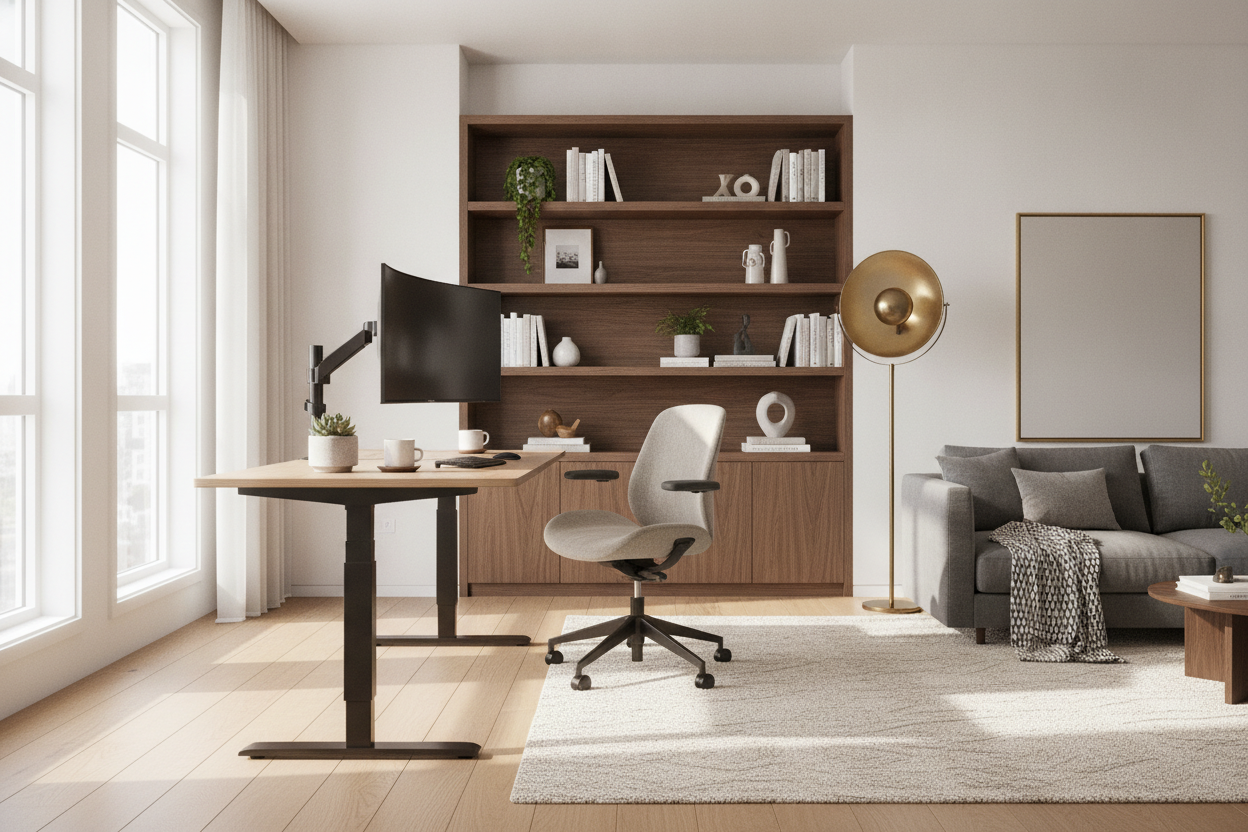
I remember staring at my first motorized desk, coffee in hand, terrified that if I pressed 'up,' my $2,000 iMac would end up as a floor decoration. I’d spent a week’s pay on what looked like two metal legs and a piece of wood. I had to know: how do standing desks work? Is there a tiny crane in there, or is it all smoke and mirrors?
- Motors drive 'spindle gears' inside the legs to push the desk up.
- Dual motors are quieter and lift more weight than single-motor budget builds.
- A control box acts as the 'brain' to keep the desk level.
- Manual desks use hand cranks or gas springs, similar to an office chair.
The Magic Trick: What Is Actually Inside Those Heavy Legs?
When you hit that button, you aren't just activating a simple motor. You’re triggering a linear actuator. Inside each steel leg is a long, threaded rod called a spindle gear. Think of it like a giant screw. As the motor spins that screw, a nut attached to the inner leg section moves up or down the threads, forcing the telescoping leg to extend.
The engineering challenge here isn't just the lift; it's the friction. Quality desks use high-grade glide pads—usually made of specialized plastics like Delrin—between the metal leg stages. If these pads are cheap, your desk will stutter, squeak, and eventually burn out the motor. This is why a heavy, 80-pound frame is actually a good sign. It means there is real steel and substantial gearing inside, not just hollow tubes.
Single vs. Dual Motor: How Does a Standing Desk Work Under Pressure?
If you're looking at a desk and the price seems too good to be true, it’s probably a single-motor system. These use one motor to turn a 'hex rod' that stretches across the under-frame to the other leg. They work, but they are often slower, louder, and have a lower weight capacity. If you have a heavy desktop or multiple monitors, you'll hear that single motor straining like a car trying to go uphill in fifth gear.
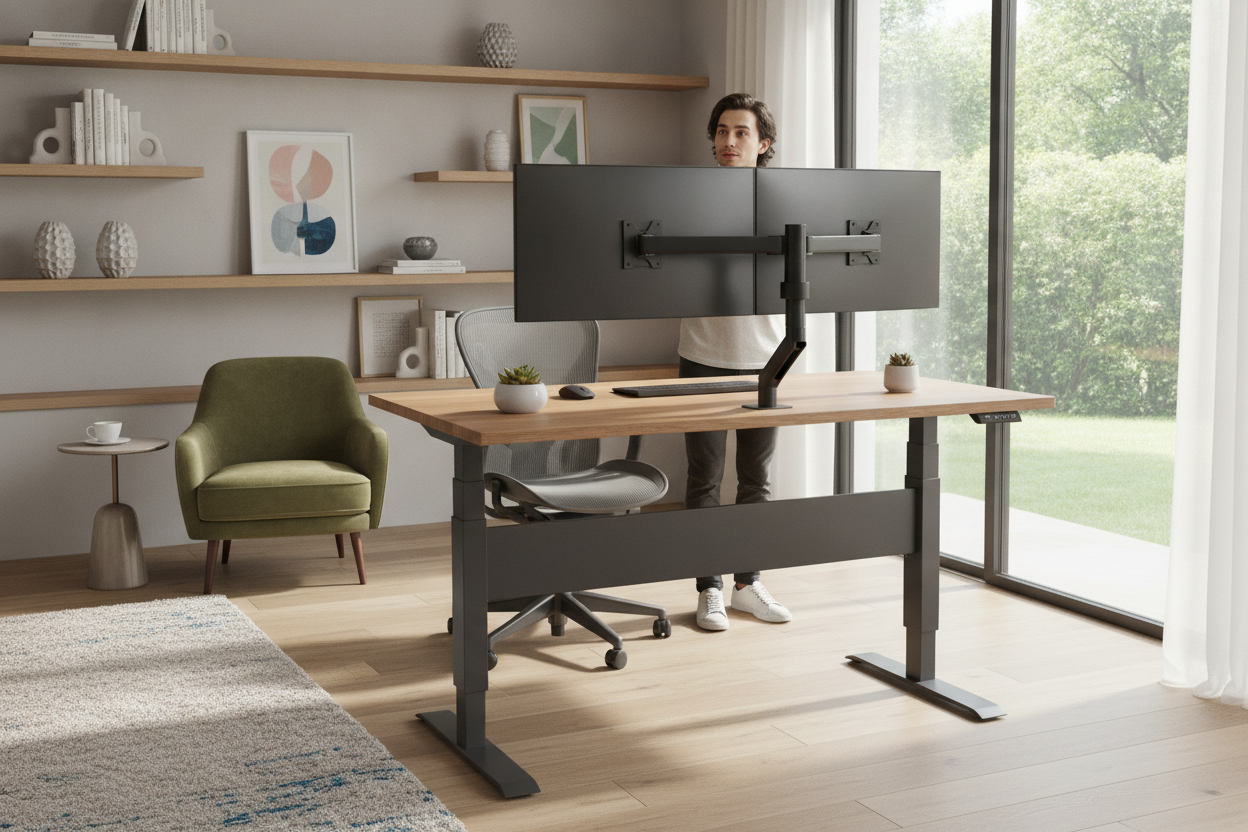
Dual-motor systems place an independent motor in each leg. This is the gold standard. They are faster and significantly more stable because the power is distributed. For larger height adjustable standing desks, dual motors are non-negotiable. When you’re trying to lift a 71-inch solid wood top plus a PC tower, you need that synchronized power to prevent the frame from racking or tilting.
The Brains of the Operation: Control Boxes and Memory Presets
Ever wonder why one leg doesn't move faster than the other? That’s thanks to the control box tucked under the desktop. This is a small computer that monitors 'Hall Effect sensors' inside the motors. These sensors count every single rotation of the spindle gear. If one leg falls behind by even a fraction of a millimeter, the control box adjusts the voltage to keep everything perfectly level.
This 'brain' is also what handles your saved heights. When you use a standing desk with an electric lift system, the control box stores the specific rotation count for your 'sitting' and 'standing' positions. You aren't just saving a height; you're saving a digital map of the gear's position. It’s remarkably precise, which is why your monitor doesn't wobble every time you switch modes.
What About Manual and Pneumatic Desks?
Not everyone wants to crawl under their desk to manage more power cords. Manual desks use a hand crank to turn those same spindle gears. It’s reliable and cheaper, but let’s be honest: after the third day, you’ll stop cranking it because it takes 30 turns just to go from sitting to standing. It’s the treadmill you eventually use as a coat rack.
Pneumatic desks are the cooler, faster cousins. They use nitrogen gas cylinders, much like the hatch on a SUV or the base of your office chair. You squeeze a lever, and the gas pressure does the heavy lifting. They are lightning-fast and silent, but they have lower weight limits. If you’re a 'minimalist' with just a laptop, they’re great. If you have a triple-monitor mount, stick to electric.
Why Knowing the Mechanics Makes You a Better Buyer
Understanding how does a standing desk work helps you spot the junk. If a manufacturer doesn't list the 'lift capacity' or the 'decibel level,' run away. You want a desk that can handle at least 200 lbs and operates under 50dB. Cheap frames use thin 1.5mm steel that wobbles at full height; look for 2.5mm or 3mm steel for a rock-solid experience.
My advice? Don't skimp on the frame to get a prettier top. You can always replace a desktop later, but the motors and gears are the heart of the machine. Before you select a home office furniture desk, check the warranty on the electronics. A company that only offers a 1-year warranty on the motor doesn't trust their own spindle gears. Aim for 5 years or more.
How long do standing desk motors last?
A high-quality motor is usually rated for 10,000 to 20,000 cycles. If you move it four times a day, that’s well over 10 years of life. Cheap motors usually fail due to heat or poor lubrication in the gears.
What happens if the power goes out?
The desk stays exactly where it is. The spindle gears are 'self-locking,' meaning gravity won't pull the desk down. You just won't be able to move it until the power comes back on.
Why does my standing desk wobble at the top?
This is usually due to 'overlap' issues in the telescoping legs. Better desks have more overlap between the leg segments when fully extended, which acts like a brace against side-to-side movement.

Dejar un comentario
Este sitio está protegido por hCaptcha y se aplican la Política de privacidad de hCaptcha y los Términos del servicio.