










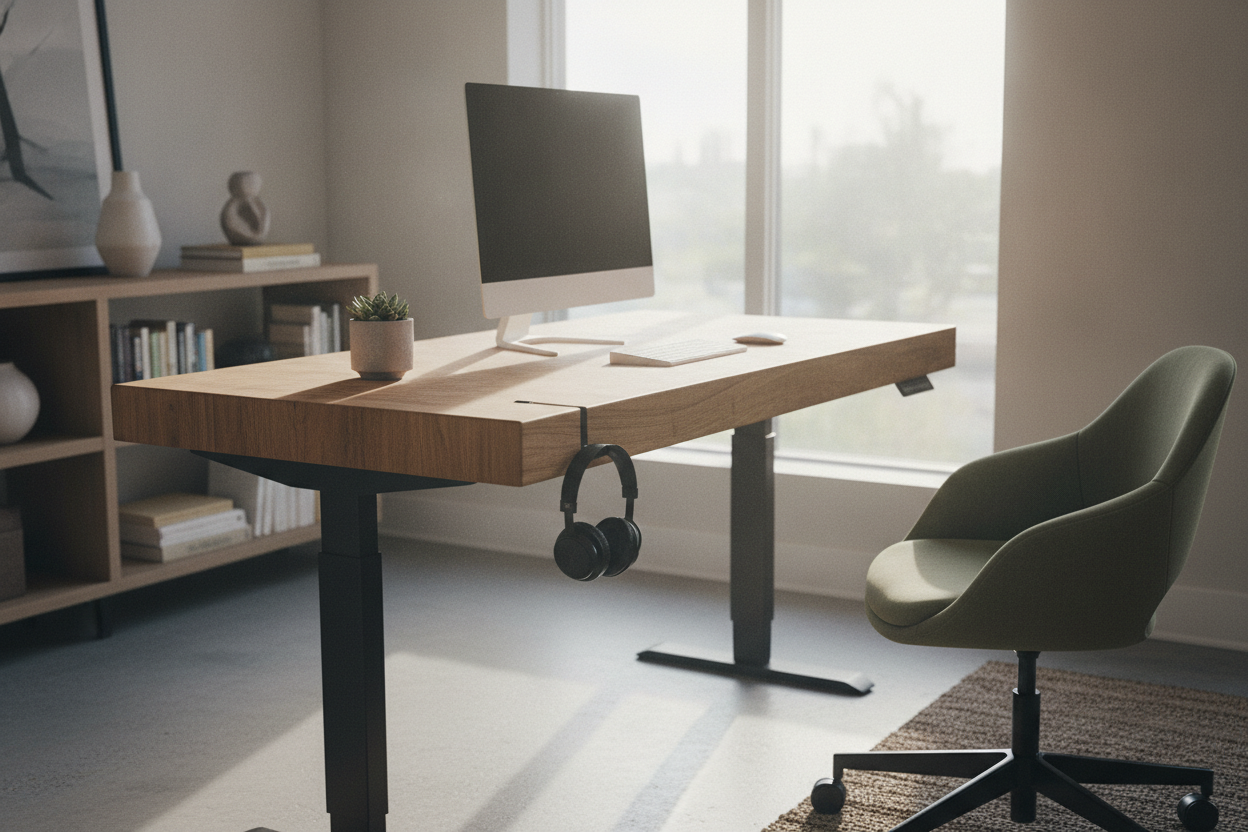
I spent three weeks staring at a $900 standing desk in my cart before I finally snapped. It looked great in the professional studio photos, but the reviews told a different story: the 'solid wood' top was actually a thin veneer over a core of compressed cardboard and regret. If I’m going to spend nearly a grand, I want something that doesn't feel like it’s going to snap when I lean on it.
That’s when I realized the motor is the only part I actually needed to buy from a tech company. By pairing autonomous desk legs with a heavy-duty slab of birch from a local hardware store, I built a setup that’s tougher, wider, and significantly cheaper than the pre-packaged options.
- Most high-end desks use cheap MDF tops; DIY-ing with real wood is more durable.
- The autonomous standing desk frame is one of the few that handles 300+ lbs without shaking.
- Pre-drilling is non-negotiable—don't wing it or you'll split your wood.
- Cable management requires some creative mounting since there are no factory grommets.
The Dirty Secret About Most Standing Desk Tops
Most 'premium' standing desks are basically IKEA furniture with a motor attached. You’re paying for a top made of medium-density fiberboard (MDF) that’s been shrink-wrapped in a plastic-y finish. It feels hollow, it scratches if you look at it wrong, and it lacks the soul of a standard writing computer desk that you’d find in a proper study.
I wanted a desk that felt like an actual piece of furniture. A 1.5-inch thick butcher block has a weight and texture that MDF just can't replicate. Once I figured out I could buy the smartdesk frame separately, the decision was a no-brainer. I wanted the tech of the future with the materials of a 1920s workshop.
Why I Chose the Autonomous Frame Over Cheaper Amazon Clones
I looked at the $150 frames on Amazon, but they all had the same problem: the 'death wobble.' When you extend a desk to 45 inches high, any slight imperfection in the autonomous standing desk legs becomes a massive vibration every time you type. I needed something with dual motors and a heavy steel gauge.
The autonomous desk frame is rated for about 300 pounds. My butcher block weighs 80 pounds on its own. Add two 32-inch monitors, a heavy mechanical keyboard, and my habit of leaning my elbows on the desk, and those cheap clones would have burned out their motors in a month. The autonomous smartdesk frame feels like it’s built for a commercial office, not a dorm room.
The Slightly Sweaty Reality of a Smart Desk DIY Build
Building a smart desk diy isn't just about turning a few hex keys. When the autonomous legs arrived, they were heavy—like, 'don't lift this alone' heavy. Attaching them to a raw slab of wood requires a bit of patience and a decent power drill. I spent an afternoon measuring three times and marking holes with a pencil because if you're off by even a quarter inch, the frame won't align.
Pro tip: Pre-drill your holes. I’ve seen people try to force the screws directly into the wood, only to have the butcher block crack right down the middle. Once the frame was secured, I started thinking about the layout. Successfully pulling off a smartdesk diy project usually leads to an obsession with the details, like mastering DIY desk organization to match the custom vibe of the wood.
Hiding Cables When You Don't Have Factory-Drilled Grommets
The biggest hurdle of an autonomous diy desk is that you don't have those convenient little plastic holes for your cables. You’re looking at a solid, unbroken slab of wood. At first, it’s intimidating, but it actually forces you to be better at cable management. I ended up mounting a heavy-duty surge protector directly to the underside of the block using industrial-strength Velcro.
This approach to bespoke desk DIY organization means I don't have a single wire touching the floor. I used J-channels and adhesive clips to route everything along the smart desk frame from autonomous. It’s cleaner than any factory-drilled solution because I placed the wires exactly where my specific hardware needed them to go.
The Final Cost Breakdown: Was It Actually Cheaper?
Let's talk numbers. The smartdesk frame cost me roughly $350 during a sale. I found a 60-inch birch butcher block at a local hardware store for $150. Toss in $30 for some wood oil and screws, and I’m all-in for $530. For context, a high-end electric standing desk with memory presets of the same size and material would easily run $900 to $1,100.
I saved nearly $400 and ended up with a desk that is literally one-of-a-kind. It doesn't shake, the motors are whisper quiet, and the wood will only look better as it ages. If you aren't afraid of a little sawdust, buying the legs and sourcing your own top is the only way to go.
Is the motor loud?
Not at all. It’s a low hum that’s quieter than my coffee maker. My cat doesn't even wake up when I transition from sitting to standing.
How hard is it to finish the wood?
If you buy a 'pre-conditioned' block, you just need a few coats of Odie’s Oil or a similar wax. It takes about 20 minutes of actual work and a day of drying time.
Does it wobble at max height?
With the autonomous standing desk frame, there is a tiny bit of movement if I’m aggressively typing, but it’s 90% more stable than the single-motor desks I’ve used in the past.

Dejar un comentario
Este sitio está protegido por hCaptcha y se aplican la Política de privacidad de hCaptcha y los Términos del servicio.