










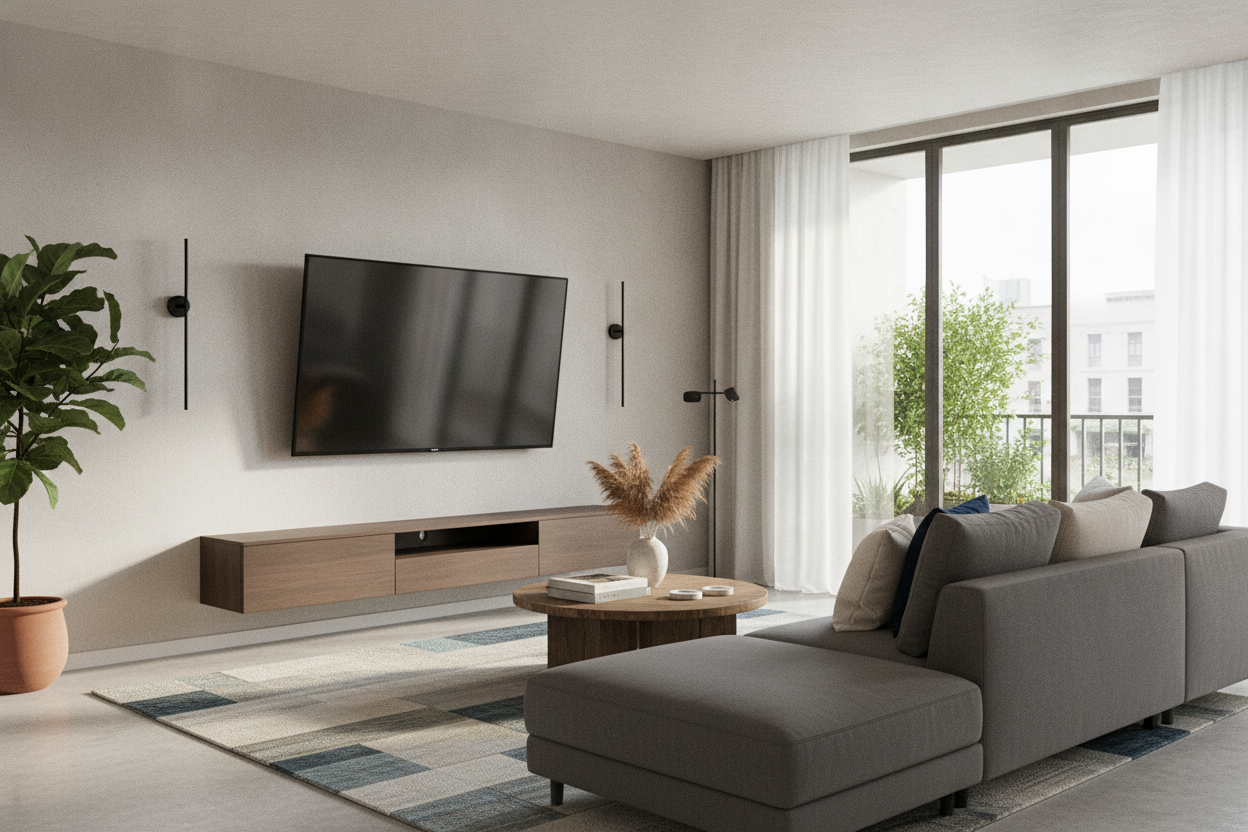
I have spent way too many Saturdays squinting at a blank wall with a pencil behind my ear and a spirit level that I probably should have calibrated months ago. There is a specific kind of heartbreak that happens after you spend three hours drilling into studs, only to sit back on your sofa and realize your new 65 inch floating tv stand makes the room look like a Buffalo Wild Wings. If you are craning your neck to see the score of the game, you have already lost.
- The center of your TV screen should ideally sit 42 inches from the floor.
- Your floating console usually looks best when the top surface is 20 to 24 inches off the ground.
- Always leave a 4-to-6-inch gap between the bottom of the TV and the top of the shelf.
- If you cannot find two studs, do not hang the unit; drywall anchors are for pictures, not heavy media furniture.
The 'Art Gallery' Mistake Ruining Your Living Room
The reason most people mess this up is psychological. When we are measuring for a floating tv shelf 65 inch setup, we are almost always standing up. We hold the tape measure at chest height, look at the wall, and think, 'Yeah, that looks about right.' We treat the furniture like a piece of art in a gallery. But your living room is not the Louvre, and you are not standing while you watch three hours of prestige television.
When you hang a console at standing eye-level, you create a massive visual gap between the furniture and the floor. This makes the stand look like it is trying to escape through the ceiling rather than grounding the room. It also forces the TV even higher. I have seen beautiful, expensive walnut units look like cheap afterthoughts simply because they were hovering 36 inches off the rug. You want the unit to feel like an extension of the floor's energy, not a shelf for a trophy you haven't won yet. Trust me, lower is almost always better for the 'built-in' look that makes floating furniture actually work.
The Exact Math for a Comfortable Setup
Let's get into the actual numbers because 'vibes' won't save your cervical spine. The average sofa seat height is about 18 inches. When you sit down, the distance from the seat to your eyes is usually another 24 inches. That puts your seated eye level at roughly 42 inches from the floor. This 42-inch mark is where the vertical center of your TV screen should live. If you are working with a different screen size, the math for a smaller setup changes slightly, but for a 65-inch screen, the rules are rigid because the panel is so physically large.
A 65-inch TV is roughly 32 inches tall. If the center is at 42 inches, the bottom of the TV will sit at 26 inches off the floor. Now, you need a 'breathing gap' between the TV and your 65 inch floating tv stand. I usually recommend 4 to 6 inches. If you go tighter than 4 inches, it looks cramped; if you go wider than 8, the two pieces look disconnected. Subtract that 5-inch gap from your 26-inch TV base, and your console's top surface should be exactly 21 inches off the floor. This height allows for a comfortable viewing angle and keeps the furniture looking intentional. It also gives you enough room to place a small soundbar or a few low-profile decorative objects without blocking the bottom of the screen.
Wait, What About the Wall Outlets?
Here is where the math meets the reality of modern construction. You do all the calculations, find the 21-inch sweet spot, and realize that is exactly where your double-gang outlet plate is located. It is a total nightmare. Many people end up mounting the stand higher just to clear the outlets, which brings us right back to the 'neck-ache' problem. I have seen people so terrified to hang heavy furniture near electrical lines that they end up with a console that is practically touching the ceiling.
If your outlets are in the way, you have two real options. First, you can use a recessed 'media box' outlet that sits back into the wall, allowing the console to sit flush over the top of the plugs. Second, you can slightly adjust your height by an inch or two—but never more than that. If the outlet is still peaking out from the bottom or top, use a cord management kit that matches your paint color. Whatever you do, do not sacrifice the ergonomic height just because a builder put an outlet in a stupid place. It is easier to paint a cord cover than it is to fix a permanent tilt in your neck.
Don't Leave the Gap Empty (How to Style the Floor)
Once the floating tv shelf 65 inch is finally on the wall, you are left with a vacuum of space underneath it. If you leave it totally bare, it can feel a bit clinical, or worse, it becomes a graveyard for dust bunnies and stray dog toys. The goal is to 'ground' the unit without making it look like a standard floor-standing cabinet. I love using low-profile woven baskets or a stack of oversized coffee table books to fill that negative space. It adds texture and hides the fact that your baseboards might not be perfectly straight.
Keep the decor underneath simple. You want to keep the interior organized so that the clutter stays behind closed doors, leaving the floor space for items that feel intentional. A pair of matching felt bins can hold extra throw blankets or gaming controllers while visually anchoring the 'floating' piece to the rug. Avoid putting anything with legs under a floating stand—it creates a 'leg-on-leg' visual clutter that is just messy. Stick to solid, bottom-heavy items like stone bowls or chunky baskets to give the eye a place to rest.
My Personal Lesson in Gravity
I once mounted a heavy oak floating unit in a rental apartment using what I thought were 'heavy duty' toggle bolts. I ignored the studs because they weren't centered on the wall. Big mistake. Three weeks later, I woke up to a sound like a car crash. The weight of the console, plus a few books and a receiver, had literally unzipped the drywall. I learned the hard way: if you can't hit two studs, don't buy a floating stand. I ended up having to patch a hole the size of a dinner plate and lost my security deposit. Now, I use a stud finder twice and measure three times. No piece of furniture is worth a structural failure.
Frequently Asked Questions
Can I mount a floating stand on a plaster wall?
You can, but it is much riskier than drywall. You absolutely must find the wood lath or the studs behind the plaster. Standard anchors will crumble the plaster over time under the constant downward pressure of a heavy media unit.
How much weight can a 65 inch floating tv stand actually hold?
Most well-built units are rated for 50 to 75 pounds if mounted correctly into studs. Always check the manufacturer's specs. Remember, the TV usually stays on the wall, so the stand only needs to hold your components and decor.
What if my studs aren't centered where I want the TV?
Use a mounting cleat or a piece of 3/4-inch plywood screwed into the studs first, then mount the console to the plywood. You can paint the plywood to match your wall, and the console will hide most of it anyway. It is the only way to get a centered look with off-center studs.


Dejar un comentario
Este sitio está protegido por hCaptcha y se aplican la Política de privacidad de hCaptcha y los Términos del servicio.