










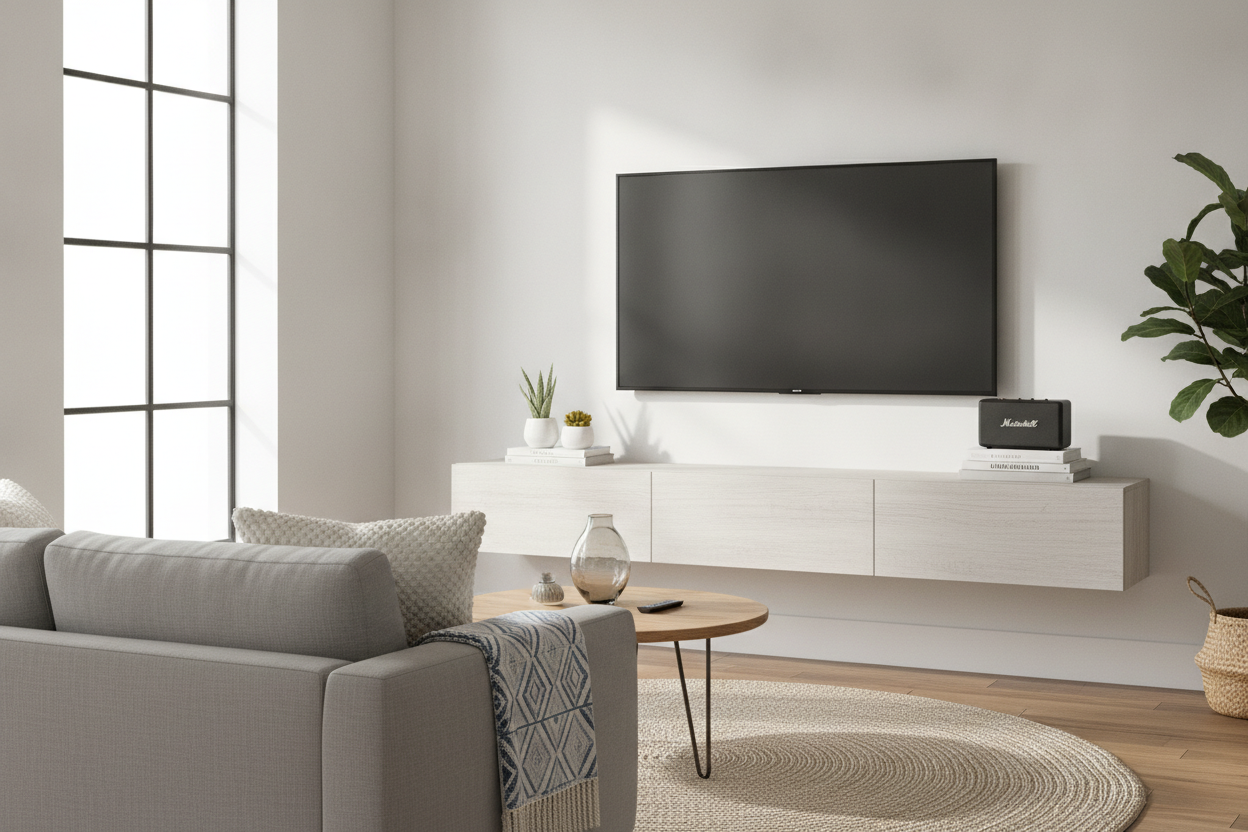
I spent my Saturday morning on my hands and knees with a flashlight, trying to fish a cat toy out from under my media console. What I found instead was a sentient colony of dust bunnies and three years' worth of pet hair that had somehow woven itself into a rug. I realized my heavy, four-legged furniture was basically a gated community for allergens. That was the moment I decided my floor-dwelling furniture had to go. I didn't need more storage; I needed a floating tv shelf target sells for less than a fancy dinner.
- Eliminates the 'dead zone' where dust and pet hair accumulate.
- Makes small living rooms feel significantly larger by exposing floor space.
- Requires upgraded hardware (toss the included anchors).
- Mandatory cable management is the secret to making it look expensive.
The Brutal Reality of Floor-Dwelling Furniture
Traditional media consoles are basically just fancy dust traps with legs. If you have a dog that sheds even a little, that three-inch gap between the bottom of the unit and your rug becomes a high-density fur storage facility. Most of us aren't moving a 100-pound solid wood console every time we vacuum, so the grime just builds up until it becomes a legitimate health hazard. It is gross, plain and simple.
It is not just the dust, either. It is the physical strain of trying to reach behind a heavy unit to plug in a new HDMI cable, only to realize you have pinned your hand against the wall while the console refuses to budge. I am done with furniture that requires a gym membership to clean under or around. When you can’t reach it with a vacuum attachment, you just stop cleaning it, and that is how 'old house smell' starts.
Enter the Hovering Console Solution
There is a psychological trick to interior design: if you can see more of the floor, the room feels bigger. By mounting your media unit, you are removing a massive visual block from the center of the wall. This is a massive win for anyone living in a 600-square-foot apartment where every inch of floor space is precious. Plus, if you have a robot vacuum, you have just given it a new lease on life. No more getting stuck on the tapered legs of a mid-century modern stand.
I eventually replaced my bulky console with a floating wooden tv shelf and the shift was immediate. The floor looks continuous, the shadows are gone, and the whole vibe shifted from 'cluttered' to 'curated.' It is the difference between a room that feels weighed down and one that feels light. My Roomba can now glide all the way to the baseboard, meaning I haven't seen a dust bunny in months.
Does the Hardware Actually Hold Up?
Let us get real about the build quality of big-box furniture. Most of these Target options are made from engineered wood—think MDF with a decent laminate. They look great, but they are not indestructible. The biggest mistake people make is trusting the plastic drywall anchors that come in the box. Throw those in the trash immediately. They are flimsy and prone to stripping your drywall if you put even an ounce of pressure on the shelf.
If you want to hold a soundbar, a PlayStation, and maybe a decorative vase, you need to hit at least one stud. If you can't find a stud where you need it, go to the hardware store and buy metal toggle bolts. A floating tv shelf target unit is usually rated for about 30 to 50 pounds, but that rating assumes it is actually staying flush against the wall. Don't overload it with a collection of heavy coffee table books, or you will see it start to sag or pull away from the drywall within a month. Use a level, take your time, and buy the $5 metal anchors.
The Cord Concealment Reality Check
The biggest lie in the product photos is the lack of cords. In the real world, you have power bricks, ethernet cables, and HDMI snakes. A floating shelf looks like a disaster if those are just dangling in the breeze. You have two choices: the easy way or the right way. The easy way is a plastic cord raceway that you stick to the wall and paint the same color as your latex. It is cheap and takes ten minutes.
The right way involves a recessed cable management kit that hides everything behind the drywall. If you aren't ready to deal with the cords, don't buy a floating shelf. It is a package deal. I spent $15 on a small cable management box to sit on top of the shelf, and it hid the mess perfectly without requiring me to cut a massive hole in my rental's wall. It keeps the minimalist aesthetic intact without the fire hazard of tangled wires.
Is the Installation Anxiety Worth It?
Yes, the installation is a bit of a weekend project. You will need a level, a drill, and a stud finder (and maybe a partner to hold the other end while you swear at the wall). But the payoff is a space that feels cleaner and more modern. The stress of drilling holes is temporary, but the ease of cleaning is forever.
When I finally hung a walnut floating tv shelf, the warm wood grain broke up the 'white box' feel of my apartment. It is a small investment that pays dividends every time I run the vacuum and don't have to move a single piece of furniture. The bottom line? Your floor deserves to be seen, and your back deserves a break from moving heavy consoles.
FAQ
Can it hold a heavy TV?
No. These shelves are designed for your components, remotes, and decor. Your TV should be mounted separately to the wall studs above the shelf for safety.
What if I am a renter?
You will have to patch a few holes when you move out, but it is no worse than hanging a heavy mirror. Just keep some spackle and a bit of touch-up paint handy.
How high should I mount it?
Aim for about 10-12 inches below your TV. You want enough space for your soundbar or a few books, but low enough that it doesn't look like it is drifting off into space.

Dejar un comentario
Este sitio está protegido por hCaptcha y se aplican la Política de privacidad de hCaptcha y los Términos del servicio.