










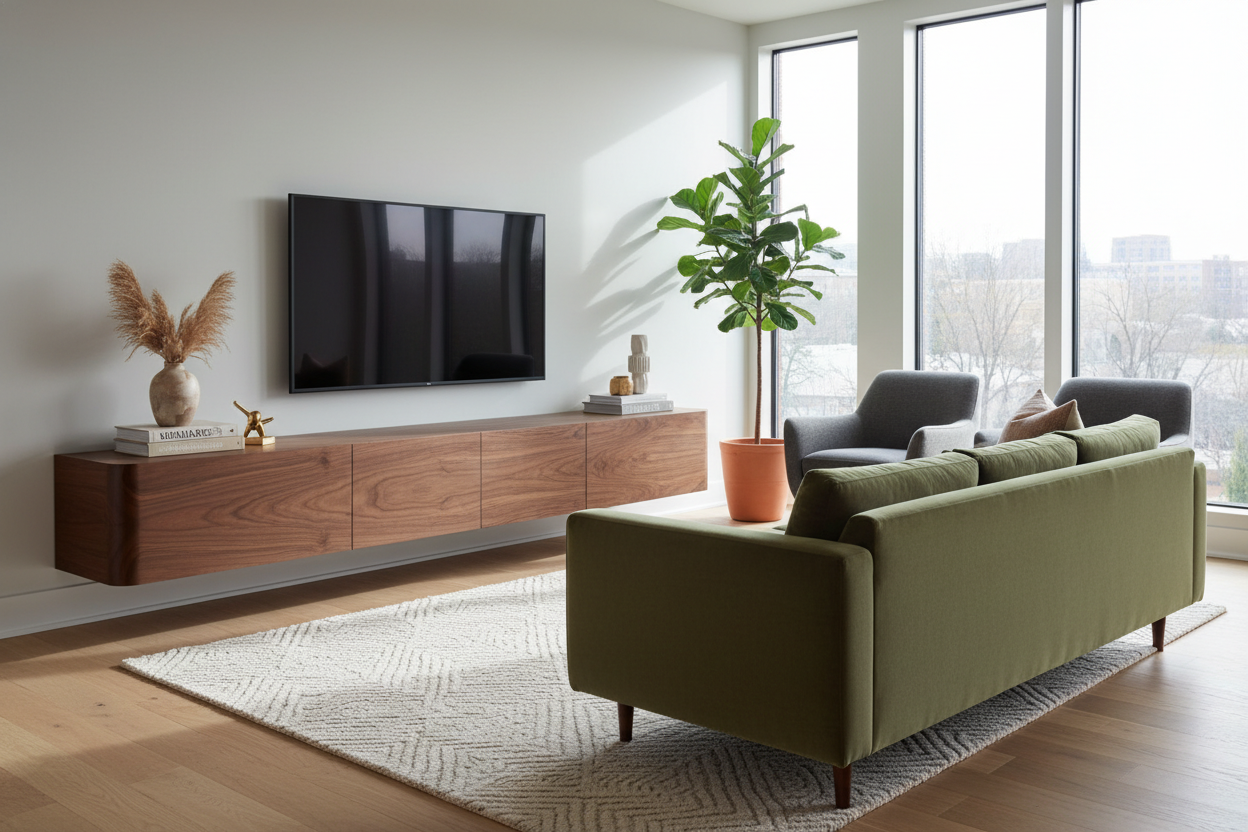
I spent three weeks staring at a tangled mess of HDMI cables and dust bunnies under my old media unit, convinced that anything I bolted to the wall would eventually rip out the drywall or look like a shelf in a dentist's waiting room. I wanted that airy, architectural look, but I was terrified of my living room feeling flimsy or sterile. Then I finally bit the bullet on a walnut floating tv stand, and honestly, I should have done it two years ago.
Quick Takeaways
- Walnut’s dark grain adds the 'weight' needed to make a floating piece feel permanent rather than temporary.
- Mounting your console 8-10 inches off the floor makes a small room feel twice as large by showing more floor.
- Never buy a stand that is the same width as your TV; it looks unbalanced and top-heavy.
- Cable management is not optional; visible wires will ruin the high-end aesthetic instantly.
Confession: I Used to Think Wall-Mounted Consoles Looked Like Dorm Furniture
For years, I avoided wall-mounted storage because I associated it with those cheap, melamine shelves you see in college dorms or depressing airport lounges. They always seemed to sag in the middle after six months of holding a few books. I stuck with heavy, clunky freestanding TV stands that took up four square feet of floor space and acted as a magnet for cat hair and lost remote batteries.
The shift happened when I realized that the problem wasn't the 'floating' part—it was the material. Most of those cheap units are made of hollow particle board. When you switch to something with the density and rich texture of real wood, the vibe changes from 'temporary shelf' to 'built-in furniture.' My walnut unit feels like it's part of the house, not just something I hung up on a whim.
The 'Visual Weight' Trick of a Walnut Floating Entertainment Center
The secret to making a floating piece work is the material. A white laminate shelf looks like a shelf, but a walnut floating entertainment center looks like a piece of architecture. The deep, chocolatey tones and varying grain patterns of walnut provide an organic warmth that balances out the giant 'black hole' of a turned-off TV screen. It gives the room a mid century modern floating tv stand vibe that feels intentional and expensive.
I noticed that the walnut grain actually draws the eye away from the TV itself. Instead of a tech-heavy corner, that area of my living room now feels grounded. The wood acts as a frame for the electronics, making the whole setup look like a deliberate design choice rather than just a place to put the PlayStation.
Will a Walnut Floating Console Clash With Your Hardwood Floors?
I get the 'wood on wood' anxiety. My living room has light oak floors, and I was worried a walnut floating console would look like a mistake. Here is the truth: matching your woods perfectly is the fastest way to make your home look like a boring furniture catalog. High-contrast wood tones actually create depth and make the room feel curated over time.
If you are still nervous, throw down a textured jute or wool rug to break up the sightline between the floor and the wall. Understanding why a TV console walnut finish works so well is about realizing that walnut is a neutral in the world of high-end design. It plays well with almost everything from industrial concrete to traditional rugs.
Hiding the Cords (Because Floating a TV With Visible Wires is a Crime)
Let’s be real: if I see an HDMI cord dangling from your walnut floating media console, we aren't friends. A floating setup only works if it looks like magic. I spent an afternoon installing an in-wall cable routing kit, and it was the best $25 I ever spent. You want the wall behind the TV to be as clean as the furniture itself.
If you can't cut into your drywall because you're renting, look for a floating tv stand wall mounted media console that features a recessed back panel. This allows you to tuck a power strip and all those excess cables inside the unit. I personally used velcro ties to bundle my wires inside the cabinet, ensuring that even when I open the doors to grab a controller, it doesn't look like a bird's nest.
The Sizing Rule for Your Walnut Floating TV Console
The biggest mistake I see people make is the 'narrow stand' syndrome. If your TV is 55 inches wide, and your walnut floating tv console is also 55 inches wide, the whole thing looks top-heavy and precarious. It creates a mushroom effect that is visually jarring. You want the stand to be at least 25-30% wider than the screen itself.
For my 65-inch TV, I went with an 80-inch console. This creates a 'ledge' effect on either side of the screen. I used that extra space to put a single ceramic vase on one side and a small stack of design books on the other. This simple ratio trick makes the TV feel like it's resting in a gallery rather than just hanging on a wall.
FAQ
How high should I mount my floating console?
The sweet spot is usually 8 to 12 inches off the floor. You want enough clearance for a robot vacuum to pass under easily, but you don't want it so high that you're looking up at the TV like you're in the front row of a movie theater.
Can a floating stand hold a heavy gaming receiver?
Yes, but only if you secure it to the studs. Do not trust drywall anchors for anything heavier than a picture frame. I used 3-inch lag bolts into three different studs, and I can literally sit on my console without it budging.
Is walnut hard to maintain?
Not really. Just avoid those greasy aerosol sprays. A slightly damp microfiber cloth followed by a dry one is all you need. Every six months, I hit mine with a tiny bit of wood wax to keep the grain looking 'wet' and deep.


Dejar un comentario
Este sitio está protegido por hCaptcha y se aplican la Política de privacidad de hCaptcha y los Términos del servicio.