






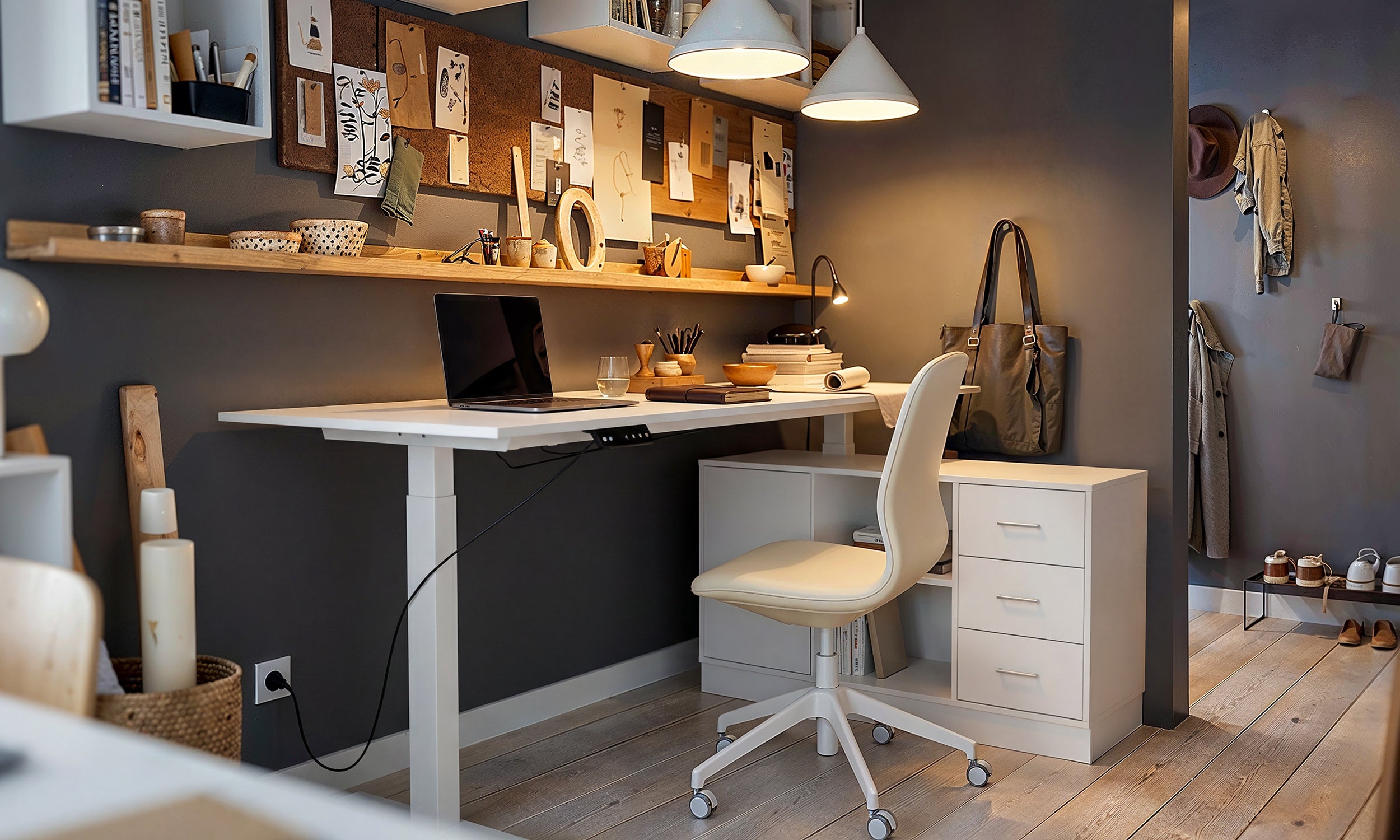




The right workbench height depends on the job, not on a single standard number. Ergonomics guidance puts precision work at or a little above elbow height and heavy work, where you press down, well below it, so one fixed bench can't suit every task. An adjustable height workbench lets one surface move between those zones; when you compare models, check the adjustment range and method, the load rating, the pegboard and the power outlet first.
This guide covers work heights by task with the arithmetic, how benches adjust, stability, pegboard layout, power and cords, and garage versus craft room or office use. It ends with an honest look at the workbench in the FUFU&GAGA home office deals collection and one standing desk with a pegboard as an alternative.
Key takeaways
- Measure your elbow height first. Every recommendation below is measured from it, standing and sitting.
- Match the height to the task. Precision work at or above the elbow, light work a little below, heavy work well below.
- Read the range in inches, not just the word "adjustable".
- Check what the capacity covers: a frame rating and what a motor can lift are not always the same figure.
- Check the outlet's rating before plugging in tools that draw a lot of power.
What is an adjustable height workbench?
It is a sturdy work surface whose top can be set at more than one height, so you can sit for detailed work, stand for assembly and lower the top for tasks that need force. Many add storage underneath, a pegboard for tools and a power strip. The category overlaps with standing desks: a sit-stand desk with a pegboard and outlets can serve as a light-duty craft bench, while a shop bench is built for heavier, rougher work.
What height should a workbench be?
Start with your elbow, because both sources below measure from it. The Canadian Centre for Occupational Health and Safety (CCOHS), in its page on working in a standing position, puts precision work "such as writing or electronic assembly" about 5 cm above elbow height, with elbow support; light work "such as assembly-line or mechanical jobs" about 5 to 10 cm below; and heavy work "demanding downward forces" 20 to 40 cm below. It also says: "Working tables and benches should be adjustable."
The Centre of Research Expertise for the Prevention of Musculoskeletal Disorders (CRE-MSD) at the University of Waterloo gives slightly different figures in its guide to standing workstation height for manual tasks: 5 to 10 cm above elbow height for precision tasks, with wrist or forearm support, 5 to 10 cm below for light tasks, and 10 to 25 cm below for heavy tasks. The two agree on light work and differ on precision and heavy work, so the table gives both.
Workbench height by task
Converted to inches and rounded (5 cm is about 2 inches, 10 cm about 4, 20 cm about 8, 25 cm about 10, 40 cm about 16). The last column works the numbers for a standing elbow height of 42 inches; swap in your own.
| Type of work | CCOHS | CRE-MSD | Example: 42-inch elbow height |
|---|---|---|---|
| Precision: fine assembly, models, detailed drawing | About 2 in above elbow, elbow supported | 2 to 4 in above, forearm supported | 44 to 46 in |
| Light: assembly, mechanical jobs, sorting parts | 2 to 4 in below | 2 to 4 in below | 38 to 40 in |
| Heavy: work that needs downward force | 8 to 16 in below | 4 to 10 in below | 26 to 34 in (CCOHS) or 32 to 38 in (CRE-MSD) |
For example, heavy work by CCOHS is 42 minus 16 (26) to 42 minus 8 (34). Look at the spread: for one person, the suggested standing heights run from about 26 to 46 inches, a 20-inch span. Few benches cover all of it, so choose the zone you work in most and handle the rest another way. CRE-MSD suggests equipment such as blocking, height-adjustable carts or tables, and platforms. A small, stable riser lifts fine work closer to your eyes; sturdy sawhorses or a low table suit work that needs force.
Sitting at the bench
For seated work, CCOHS's page on working in a sitting position recommends "materials at or slightly below elbow height," tasks within easy reach, and a footrest "if the chair height is high and desk height is not adjustable." It also points to alternating between sitting and standing. A bench with a low setting near desk height lets you sit for soldering or painting miniatures, then stand for assembly.
How to measure your elbow height
Wear your work shoes and stand where the bench will go, on any mat you will use. Let your upper arms hang relaxed, bend your elbows to about a right angle, and have someone measure from the floor to the underside of your elbow. Repeat seated on the chair or stool you will use. Compare both numbers with a bench's listed settings; if a listing gives only one height, check the manual for the others before you buy.
How do adjustable workbenches adjust?
The method decides how often you will really change the height. A bench that takes a wrench to reset tends to stay at one height.
| Method | How it moves | Suits | Watch for |
|---|---|---|---|
| Pin or bolt legs | Legs reset in a row of holes | Setting the height once per project | Clearing the top; keeping all legs even |
| Telescoping legs with knobs | Legs slide and lock | Occasional changes | Each leg locked at the same mark |
| Hand crank | A crank turns a gear in the legs | Changes without power | Slow travel with a loaded top |
| Push-button power lift | A motor moves the top, often to saved settings | Sitting, standing and leaning in one session | Lifting capacity, cord slack, pinch points |
Before you press a lift button, clear the area under and around the moving top and keep hands, cords and stored items out of the gap.
Stability and load: what to check
- What the capacity covers. Some listings give one weight capacity for the whole frame; a power lift may also have a separate figure for what the motor can raise. If only one number is given and the top moves, ask which it is.
- Where the weight goes. Heavy tools and cases are steadier in base cabinets than on the moving top.
- The type of force. Steady weight is different from repeated blows. Before you hammer, chisel or mount a vise on any lifting top, check the manual; heavy pounding belongs on a fixed, solid bench.
Garage floors are often not level, so check the top with a level and adjust any leveling feet before loading it. CCOHS advises covering concrete or metal floors with mats, but warns against thick foam-rubber mats because "too much cushioning can cause fatigue and increase the hazard of tripping."
Pegboard layout: tools within easy reach
CCOHS's standing-work guidance says to organize work "so that the usual operations are done within easy reach" and to position tools so they can be reached "without twisting or bending." On a pegboard, that means:
- Center the tools you use every session straight in front of you, between shoulder and waist height.
- Group by task: measuring and marking, cutting, fastening, so one project uses one area.
- Point sharp edges down or sideways, away from where your hands reach across.
- Hang light items only unless the listing gives a pegboard load; heavy power tools go in a cabinet.
On a bench whose pegboard moves with the top, tools stay at the same height relative to the work whether you sit or stand. Check that nothing hangs past the board's edges before you lower the top. For pegboards on an office wall, see our desk wall ideas guide.
Power and cords at the bench
A built-in outlet strip puts chargers, a task lamp and small tools at the bench without a cord across the floor. The U.S. Consumer Product Safety Commission's sheet on extension cords and power strips sets out the basics:
- "Don't overload a cord or power strip."
- Use extension cords "only when necessary and only on a temporary basis."
- "Use only three-wire extension cords for appliances with three-prong plugs."
- "When using outdoor tools and appliances, use only extension cords labeled for outdoor use."
- "Look for a certification label from an independent testing lab on the package and on the product."
Before you plug a saw, heat gun or compressor into a bench's strip, find the strip's current rating and certification label and compare them with the tool's rating plate. A powered lift also needs cord slack: every cord from the top to the wall must cover the full travel, which is the highest setting minus the lowest. Run the top through its range once before tying cords off.
Garage, craft room or home office?
| Room | Typical work | Height used most | What to plan |
|---|---|---|---|
| Garage or shop | Repairs, assembly, sanding | Light and heavy zones, standing | Level floor, mat on concrete, outdoor-rated cords for outdoor tools, closed storage against dust |
| Craft or hobby room | Painting, models, jewelry, cutting | Seated precision, standing to cut | Task lamp, forearm support, pegboard for small tools |
| Home office | Computer work, paperwork, light making | Sitting and standing at elbow height | Monitor height, cable slack, a chair that fits the low setting |
In a garage, keep a manufactured wood top dry and store finishes and solvents as their labels say, not on the bench. In an office, the bench doubles as a sit-stand desk; our guide on how to make a desk taller covers heights for computer work.
Buying checklist
- Measure your standing and seated elbow heights.
- Find the lowest and highest settings in inches and check they cover the zones you use most.
- Choose a method you will use: pins for set-and-forget, a power lift for switching often.
- Read what the capacity covers and keep the top's load to the work itself.
- Measure the top against your largest project, with room to stand and pull out a chair.
- Check the pegboard's size and where it sits when the top moves.
- Find the outlet's count, current rating and certification label.
- Match storage to your tools: drawers for small parts, cabinets for power tools and cases.

Our picks: a workbench with pegboard and an alternative
Our range has one adjustable workbench and a few sit-stand desks with pegboards. The workbench comes first; the standing desk is the alternative for a room that is mostly an office. Every size and feature below is as the FUFU&GAGA listing states it.
54.3" Industrial Adjustable Height Workbench-Desk with Pegboard and Power Outlet
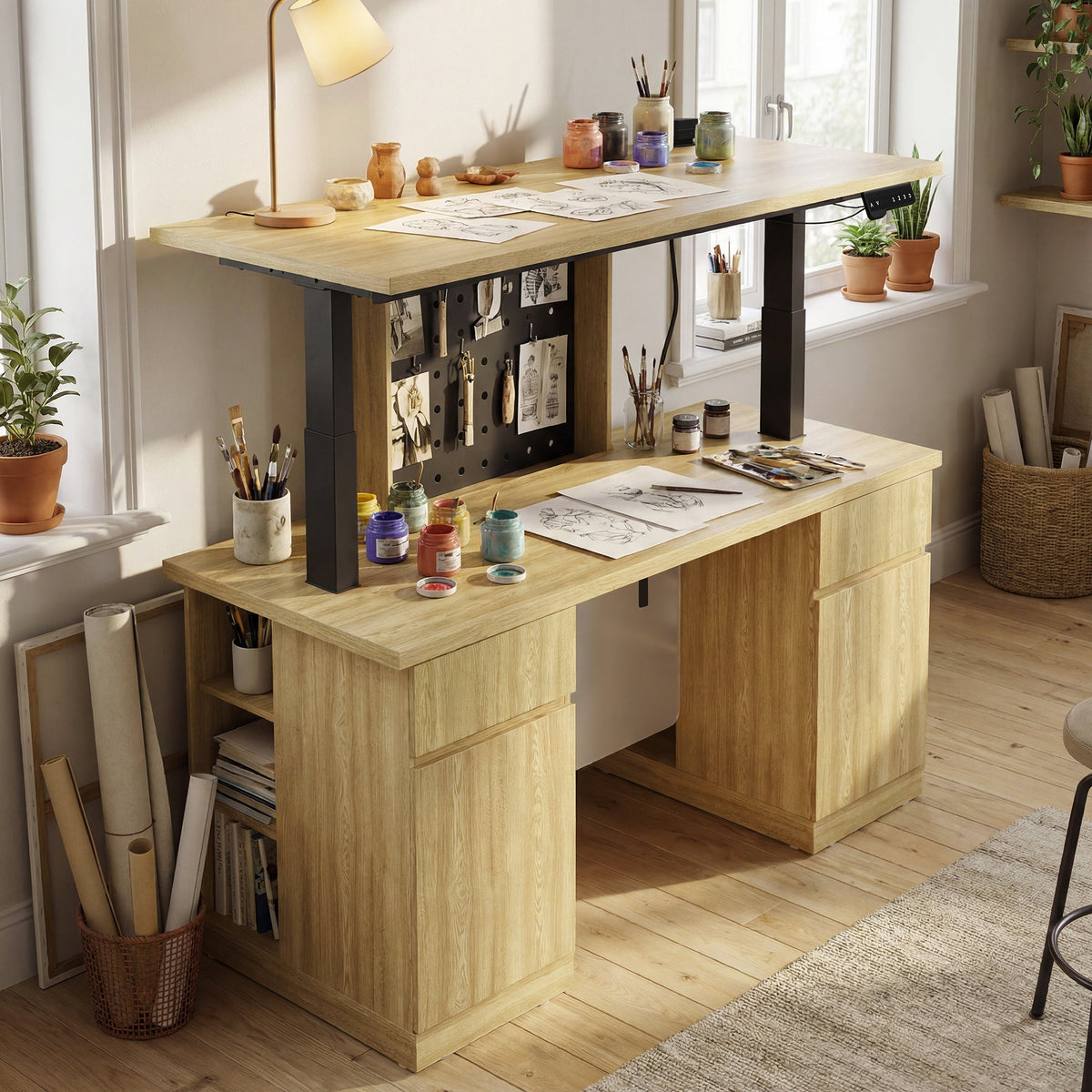
The listing calls it a desk, but its spec gives the product type as a workbench, and it is built like one. The top moves between three heights at the push of a button, for sitting, standing or leaning. Under the top, a full pegboard rises and falls with the desktop, so hanging tools follow the work, and a built-in outlet strip powers lights, chargers and tools at the bench.
Storage suits a workshop: two drawers for screws and small parts, and two cabinets with adjustable shelves for power tools and cases behind doors. The listed size is 30.9" H x 54.3" W x 23.6" D. The MDF top resists scratches and wipes clean, the frame is metal, and the listed weight capacity is 600 lb. It weighs 175.6 lb, comes in a natural or brown medium wood finish, and needs assembly; the product page has a User Manual tab.
What the listing does not give: the three height settings in inches (only the 30.9" overall height), whether the 600 lb is what the lift can raise or the frame's static rating, and the outlet count and rating. The photos show the natural finish set up as an art studio rather than a garage.
Best for: a craft room, hobby corner or home office that doubles as a light workshop, where you sit for detailed work and stand for assembly, with tools on a pegboard that moves with you.
Skip it if: you need specific heights confirmed before buying (check the manual against your elbow measurements), you plan heavy pounding or a vise on the moving top, or you need the outlet's rating before running high-draw power tools.

59" Walnut Electric Standing Desk with Pegboard, Power Strip and 3 Drawers (alternative)
An electric sit-stand desk for a room that is mainly an office but also hosts light making. The walnut-look desktop is 59" W x 21.7" D and rises up to 45.3", and a programmable control panel saves 1 to 3 memory presets. A 19.6" pegboard stands above the desktop for small tools and notes, with a keyboard tray, three drawers, four open shelves and a built-in power strip.
The top is laminated MDF on an iron frame, lifting capacity is 170 lb, and the overall size is 56.1" H x 59" W x 21.7" D. It weighs 174 lb and arrives in 2 boxes; two people take about 1.5 hours to assemble it. The listing gives neither the lowest height nor the power strip's outlet count and rating.
Best for: a home office or study where a computer stays on the desk and a pegboard keeps small supplies in view.
Skip it if: you need a low seated height confirmed (only the top height is listed), work with heavy tools, or want closed cabinets for power tools; its lifting capacity and open shelves suit an office, not a shop.
Both arrive flat-packed; our guide on how to assemble flat-pack furniture covers sorting hardware and working in pairs.
Compare the picks
| Feature | 54.3" workbench-desk | 59" standing desk |
|---|---|---|
| Top size | 54.3" W x 23.6" D | 59" W x 21.7" D |
| Height as listed | Three push-button settings; 30.9" H listed | Up to 45.3"; 1 to 3 presets; lowest not listed |
| Pegboard | Full pegboard under the top, moves with it | 19.6" pegboard above the desktop |
| Power | Built-in outlet strip | Built-in power strip |
| Storage | 2 drawers, 2 cabinets with adjustable shelves | 3 drawers, 4 open shelves, keyboard tray |
| Capacity | 600 lb weight capacity | 170 lb lifting capacity |
| Best for | Craft room or light workshop | Office with light making |
FAQ
What is the best height for a workbench?
It depends on the task and your elbow height. CCOHS puts precision work about 2 inches above elbow height, light work 2 to 4 inches below and heavy work 8 to 16 inches below; CRE-MSD gives 2 to 4 inches above for precision and 4 to 10 inches below for heavy work.
Can a standing desk be used as a workbench?
For light work such as electronics, crafts and small assembly, yes. Check the lifting capacity, keep heavy tools off the moving top, and don't hammer on it or clamp a vise to it unless the manual allows it.
Is a pegboard worth it on a workbench?
Usually. It clears the work surface and keeps the tools you use most within easy reach, as CCOHS recommends. Hang light tools only unless the listing gives a pegboard load.
Can I plug power tools into a workbench outlet?
Only if the strip's rating covers the tool. CPSC advises never overloading a cord or power strip and looking for a certification label from an independent testing lab.
Browse workbenches, pegboard desks and storage in our home office deals collection.

Leave a comment
This site is protected by hCaptcha and the hCaptcha Privacy Policy and Terms of Service apply.