


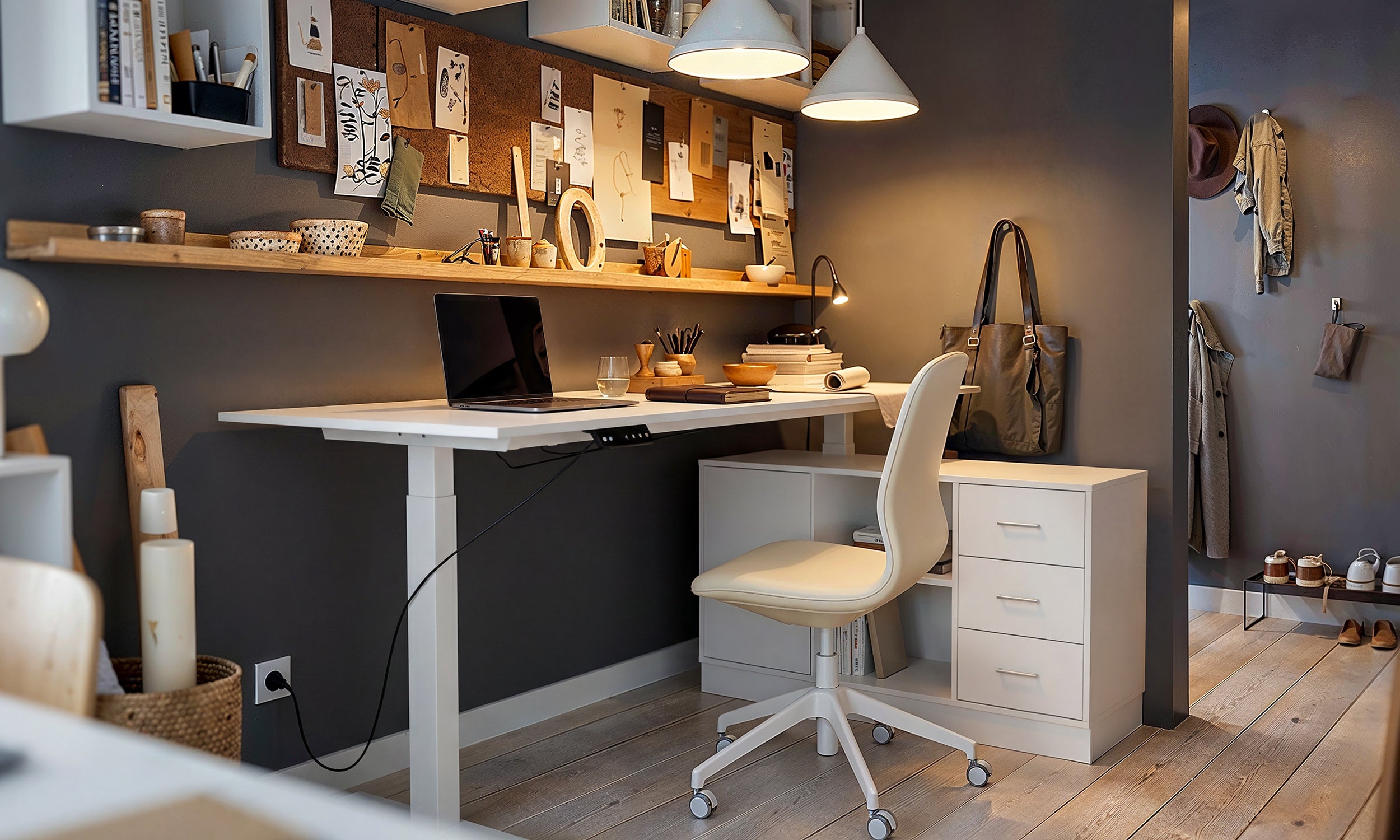
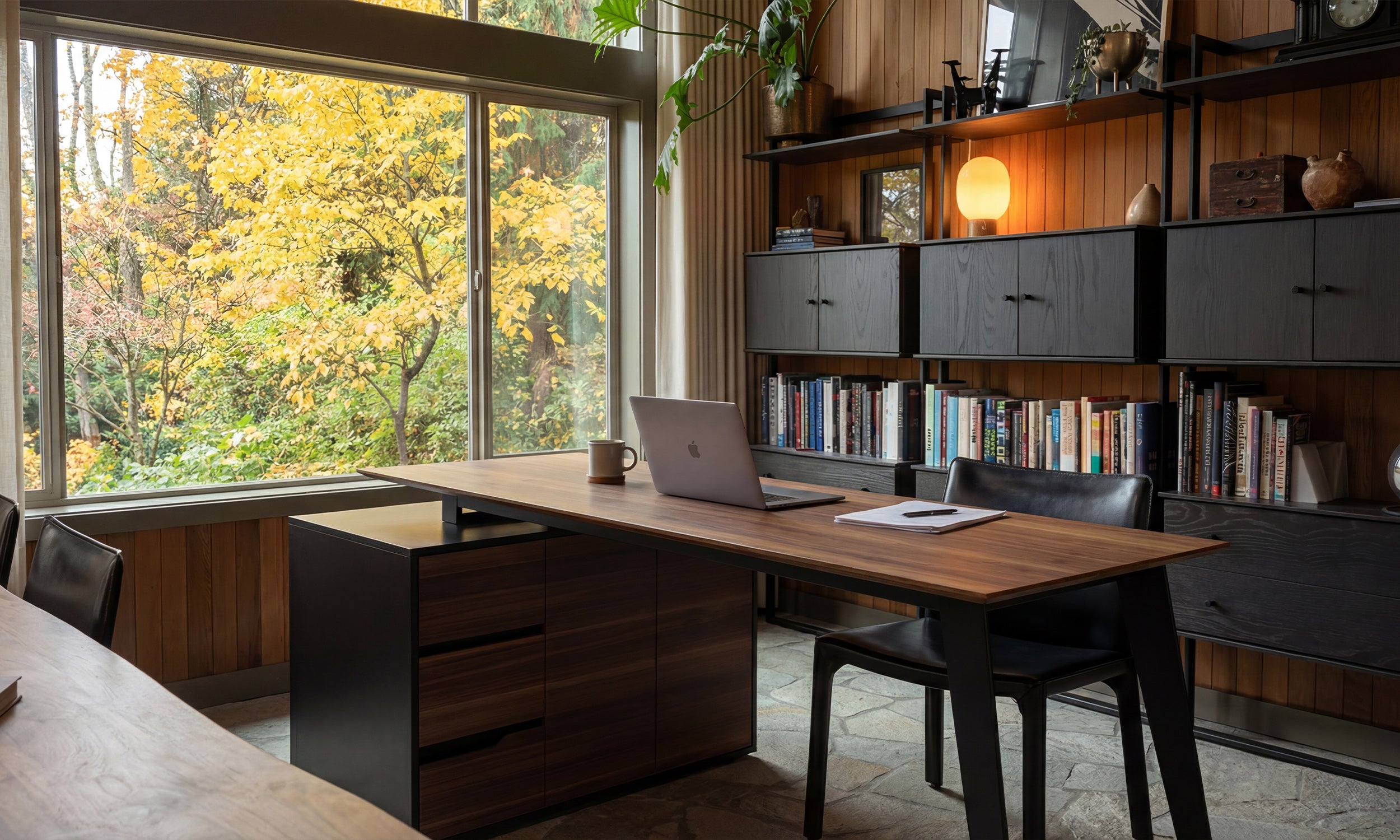



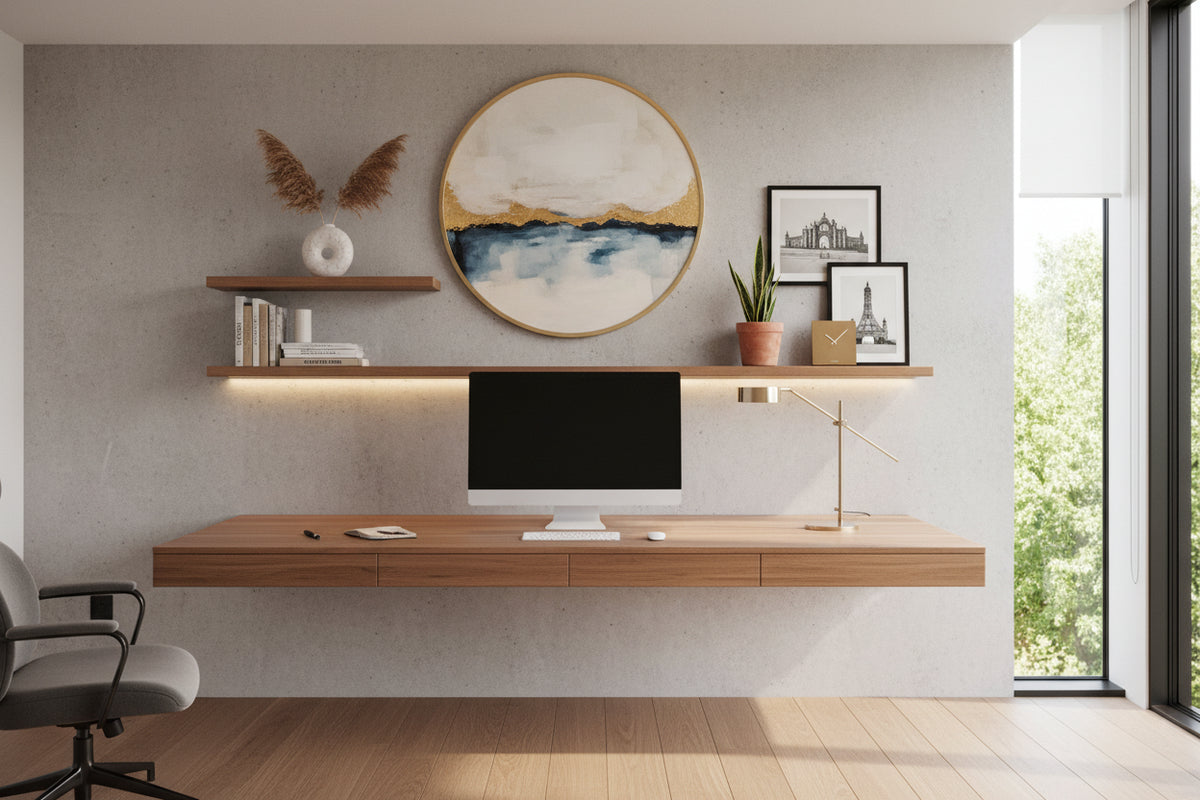
"Desk wall ideas" covers two different walls. If your desk faces a wall, the best options for the wall above the monitor are shallow shelves, a pegboard or a hutch desk for storage, plus one large piece of art or a gallery grid hung clear of the screen. If the wall shows behind your chair on video calls, keep it calm: a tidy bookcase, a textured or painted accent wall and a plant, with soft light from the front and no bright window behind your head.
Below are 12 ideas with size rules and what to watch for, then glare, renter and safety notes, and six picks from the FUFU&GAGA writing and computer desk collection and our wider range.
Key takeaways
- Art height: Framebridge puts the bottom of a frame 7 to 10 inches above the furniture. On a desk, measure from the top of the monitor.
- Art width: about two-thirds to three-quarters of the desk width, so 39 to 44 inches over a 59-inch desk.
- Glare: OSHA says to set the screen at right angles to windows and paint the walls around it a medium, non-reflective color.
- On camera: Stanford Medicine advises a plain background and light in front of you, not behind.
Which wall is "behind your desk"?
If the desk is pushed against a wall, you look at it all day, so it has to work with the monitor: storage in reach, nothing that reflects into the screen, decor above the screen. If the desk faces into the room, the wall behind your chair is what colleagues see on calls. Ideas 1 to 3 and 6 are for the wall you face, a mirror (7) belongs on a side wall, the rest work on either wall, and 12 is the classic video-call backdrop.
12 desk wall ideas, with sizes and what to watch for
1. Shallow shelves above the desk
A wall shelf keeps books and a plant off the desktop. Keep it shallow so you don't hit your head leaning in. As a rule of thumb, treat the lowest shelf like art and leave the 7 to 10 inches above the screen that Framebridge suggests above furniture.
Watch for: load, fixing and standing height. Load a shelf only to its listed rating, screw into studs where you can and use anchors rated above the load where you can't. On a standing desk, do the math at full height: a desktop at 45.3 inches with a screen top 18 inches above it (an example; measure your own) puts the screen top at 63.3 inches. Add 7 inches and a 31.5-inch-tall shelf would run from 70.3 to 101.8 inches, past an 8-foot (96-inch) ceiling. Over a sit-stand desk, hang a shorter shelf, or hang it beside the desk.
2. A pegboard for tools, cables and notes
A pegboard puts headphones, chargers and notebooks at arm's height. It suits a desk without drawers too; our guide to a desk without drawers covers where that storage goes. Some desks carry their own pegboard on a frame above the top, so nothing goes into the wall.
Watch for: it reads as busy on camera. Use it on the wall you face and give each hook a job.
3. A hutch or bookcase desk
A desk with a built-in hutch turns the wall above the monitor into storage in one piece, which helps when the wall is plaster, brick or rented.
Watch for: the opening between desktop and hutch. Compare your monitor's height on its stand with the opening on the dimension diagram, and anchor the hutch as its instructions say.
4. A textured accent wall: faux stone or brick panels
A stone or brick texture gives a plain wall depth and reads well on camera: detail without words or faces. Our faux stone wall panels guide covers materials, adhesive and installation, so here is just the desk-wall math.
A panel 47.2 inches wide by 23.6 inches tall covers 7.74 sq ft. Two side by side make a field 94.4 inches wide, which extends 17.7 inches past each end of a 59-inch desk ((94.4 - 59) / 2). Four rows are 94.4 inches tall, leaving a 1.6-inch strip under a 96-inch ceiling for trim. That is 8 panels; add 10 percent for cuts (8.8) and round up to 9. A set of 9 covers about 69.7 sq ft (9 x 7.74) and fits with no spare; a set of 10, listed at about 77 sq ft, leaves one.
Watch for: thickness and heat. A 1.18-inch panel moves the desk 1.18 inches into the room. The panel guide explains why polyurethane needs care near heat, so keep panels away from space heaters, and don't rely on a "fire resistant" or "soundproof" line in any listing without a test report. Panels go on with adhesive, so they are not a renter's option.

5. Art or a gallery grid sized to the desk
One large piece, or a tight grid that reads as one piece, gives the wall a focal point. The common rules come from hanging art over furniture:
- Height: Framebridge suggests the bottom of the frame 7 to 10 inches above the furniture and, on an open wall, a center about 57 inches above the floor, a figure Bob Vila also gives.
- Width: Decorating Den says art should take up about two-thirds to three-quarters of the width of the furniture below it.
- Grids: Framebridge treats a grouping as one big piece; Decorating Den spaces frames 2 to 3 inches apart.
A monitor changes the height math. Say the desktop is 29 inches high and the screen top sits 18 inches above it (examples; measure yours). The screen top is at 47 inches, so the frame's bottom goes at 54 to 57 inches, and a 20-inch-tall frame centers at 64 to 67 inches. On a desk wall the monitor, not the 57-inch rule, sets the height.
| Desk width | Two-thirds | Three-quarters |
|---|---|---|
| 47 in | 31.3 in | 35.3 in |
| 59 in | 39.3 in | 44.3 in |
| 63 in | 42 in | 47.3 in |
| 71 in | 47.3 in | 53.3 in |
Watch for: glass in frames, which can reflect a window into your eyes or flash on camera. Matte prints or canvas avoid both.
6. A pinboard, whiteboard or calendar
A pinboard or calendar in your line of sight keeps deadlines visible. A framed fabric or cork board looks neater than a bare one.
Watch for: privacy. Anything behind you is readable on a call, so keep schedules and client names on the wall you face.
7. A mirror, used with care
A mirror makes a small office feel lighter, but on the wall you face it reflects a window or lamp behind you back at your eyes; OSHA notes that reflected light from polished surfaces may cause annoyance. Behind you, it shows the room and can bounce light into the camera.
Watch for: hang it on a side wall, at right angles to the screen, and check it from your chair before you drill.
8. A wall light or bias light
BenQ describes bias lighting as a soft light behind the monitor that reduces the sharp brightness difference between the screen and its surroundings. It doesn't light your keyboard or papers, so you still need a task light. Citing ANSI/IES office lighting guidance, BenQ says screen and surroundings should generally stay within 3:1 of each other.
Watch for: too much light. OSHA notes that bright light sources behind the display create contrast problems, so a sconce shining toward you is worse than none.
9. Acoustic panels for echo on calls
A bare room sounds hollow on a microphone. A Walls & Ceilings article explains what absorbent panels can and can't do: they reduce echo and reverberation in a room, but they are not soundproofing and won't stop sound traveling through the wall. Blocking sound takes mass, in layers.
Watch for: expectations. Panels make your voice clearer to others; they won't keep a neighbor's TV out.
10. Plants
A trailing plant on a high shelf or a tall plant beside the desk softens a wall of screens and has no text to read on camera. Keep watering away from power strips.
Watch for: a plant directly behind your head can look like it grows out of it on camera; set it to one side.
11. Paint color
Paint is the cheapest desk wall idea and the easiest to undo. OSHA's workstation guidance says to limit reflections from walls around the screen with a medium colored, non-reflective paint, and to use light, matte colors on walls and ceilings to reflect indirect light.
Watch for: gloss, and very dark or very bright colors right behind the screen.
12. A bookcase as the video-call backdrop
For the wall behind your chair, a bookcase looks organized, stores things and adds depth. Stanford Medicine advises a plain background so viewers focus on you, not on photos or wall art, so style it lightly: books, a few objects and empty space. Its lighting tips matter as much: light in front of you, not behind, and face a window rather than sitting with one at your back.
Watch for: glass doors that reflect lamps, clutter at head height, readable labels and anchoring. A TV behind you raises the same camera questions; our office with TV guide covers where it can go.
Glare and eye comfort at a desk against the wall
The wall you face is part of your screen's surroundings. OSHA's computer workstation guidance gives the core rules: place the face of the screen at right angles to windows and light sources, use blinds or drapes to cut glare, tilt the monitor down slightly so it doesn't reflect overhead light, and aim a desk lamp so its light doesn't reflect on the screen. A desk against a wall perpendicular to the window, with a matte medium wall, a soft bias light and a task lamp, ticks every box. Monitor distance and desk depth are covered in our desk for photographers guide.
Renter-friendly desk wall ideas without drilling
- Lean, don't hang: stand a large framed print on a low bookcase or the back of the desk.
- Bring the wall with the desk: a desk with its own pegboard adds vertical storage with no holes.
- Removable hooks and strips: for light frames and calendars; stay under the package's weight limit and test on your paint first.
Adhesive wall panels, screwed-in shelves and the anchors a tall hutch or bookcase needs all mean holes or residue, so ask your landlord first.
Hanging and anchoring safely
Use the hardware the maker supplies or anchors rated above the load, and never load a shelf beyond its listed rating. For tall pieces, CPSC's Anchor It campaign says anchoring all furniture with drawers, doors and shelves to the wall prevents tip-over injuries and deaths. Our guide to anchoring a bookcase to the wall covers wall types and hardware.
Our picks for the wall behind your desk
Two panel sets, two desks that bring their own wall storage, and two storage pieces for behind the chair or above the desk. Sizes and ratings are as listed.
Gray faux stone wall panel set of 10
A cool gray stone texture that suits a black or white desk and reads as calm on camera. Each urethane panel is 47.2" W x 23.6" H x 1.18" thick, the set of 10 is listed at about 77 sq ft and weighs 39 lb, and jigsaw edges interlock. It is an adhesive mount.
Best for: a full feature wall behind a desk, with a spare panel.
Skip it if: you rent, or want to change the color later; the listing doesn't say it can be painted.
Beige square faux stone wall panel set of 9
A warmer, sandy stone look for wood desks. Nine urethane panels, each 47.2" W x 23.6" H x 1.18" thick (7.74 sq ft per panel), cover about 69.7 sq ft by our arithmetic and weigh 30 lb as a set. Shiplap edges interlock, and the panels can be painted or stained.
Best for: a warm accent wall you may repaint later.
Skip it if: your wall needs more than nine panels; the listing's coverage figure is the area of one panel, so count from the panel size.
59" walnut standing desk with pegboard
A sit-stand desk with its own pegboard wall, so the wall you face needs no holes. The 59" W x 21.7" D desktop rises to 45.3 inches and saves up to three memory presets, the pegboard is 19.6 inches tall, and there are three drawers, four open shelves, a keyboard tray and a built-in power strip. Lifting capacity is 170 lb; it arrives in 2 boxes.
Best for: renters, and anyone who wants tools and cables in reach at a desk against a wall.
Skip it if: you need a low sitting height; the listing gives the top height but not the lowest. Check clearance under any shelf above, since the pegboard frame sits on the desktop in the photos.

62.2" traditional writing desk with bookcase
A desk and hutch in one, 82.7" H x 62.2" W x 21.1" D, with a 59.1" wide desktop rated for 200 lb. The bookcase above has cabinets and adjustable shelves, nine drawers sit below, and plug-in LED lighting switches between warm, natural and cool light. Wall anchoring hardware is included and the drawers have safety stops. Brown or natural.
Best for: a traditional study where the wall you face should be all storage.
Skip it if: you use a tall monitor or a monitor arm; the listing gives no desktop height, so check the opening under the hutch on its diagram first.

Vila 63" white display cabinet and bookcase
A built-in look for the wall behind your chair: 78.7" H x 63" W x 15.7" D, with six hinged doors including glass-front cabinets, an open countertop section and three drawers. Its nine shelves hold 33 lb each and the whole unit 407 lb, and a tip restraint is included. It is listed as a kitchen and dining cabinet, but the closed storage suits office files too.
Best for: a video-call backdrop with closed storage below and a few books on display above.
Skip it if: a lamp or window faces it; clear glass doors can reflect light on camera. At 236.7 lb, two people are recommended for assembly.
55.1" farmhouse wall display shelf
A wall-mounted shelf with turned spindles and arched openings, 31.5" H x 55.1" W x 7.9" D. Its three solid wood shelves are 51.6 inches wide and 4.5 inches deep, each rated for 20 lb. Metal brackets come pre-attached and wall anchors are included.
Best for: a shallow display above a fixed-height desk, or behind your chair above shoulder height.
Skip it if: it would hang over a standing desk (see idea 1), or you need deep shelves for binders.
Picks compared
| Pick | Size | Standout | Best for |
|---|---|---|---|
| Gray stone panels, set of 10 | 47.2" x 23.6" x 1.18" panels | Listed 77 sq ft | Full feature wall |
| Beige stone panels, set of 9 | 47.2" x 23.6" x 1.18" panels | Paintable, about 69.7 sq ft | Warm accent wall |
| 59" pegboard standing desk | 59" x 21.7" top, up to 45.3" H | Pegboard, power strip | No-drill wall storage |
| 62.2" desk with bookcase | 82.7" H x 62.2" W x 21.1" D | Hutch, 3-color LED | All-storage wall you face |
| Vila 63" display cabinet | 78.7" H x 63" W x 15.7" D | Glass doors, drawers | Wall behind your chair |
| 55.1" wall display shelf | 31.5" H x 55.1" W x 7.9" D | 20 lb per shelf | Shallow shelf above a desk |
FAQ
How high should art be above a desk?
Framebridge suggests the bottom of a frame 7 to 10 inches above the furniture. With a monitor on the desk, measure from the top of the screen: a screen top at 47 inches puts the bottom of the frame at 54 to 57 inches. Size the piece to about two-thirds to three-quarters of the desk width.
What is the best background for video calls?
A plain, uncluttered one. Stanford Medicine advises a plain background so people focus on you, with light in front of you rather than behind. A tidy bookcase or a textured wall works when it carries only a few objects and nothing readable.
Do faux stone panels reduce echo on calls?
Don't count on it. Our panel listings give no sound absorption rating, and blocking sound takes mass, not a decorative layer. For echo, absorbent acoustic panels, a rug and a full bookcase do more.
Ready to plan the wall? Start with the desk: compare sizes and built-in storage in the FUFU&GAGA writing and computer desk collection.


Leave a comment
This site is protected by hCaptcha and the hCaptcha Privacy Policy and Terms of Service apply.