





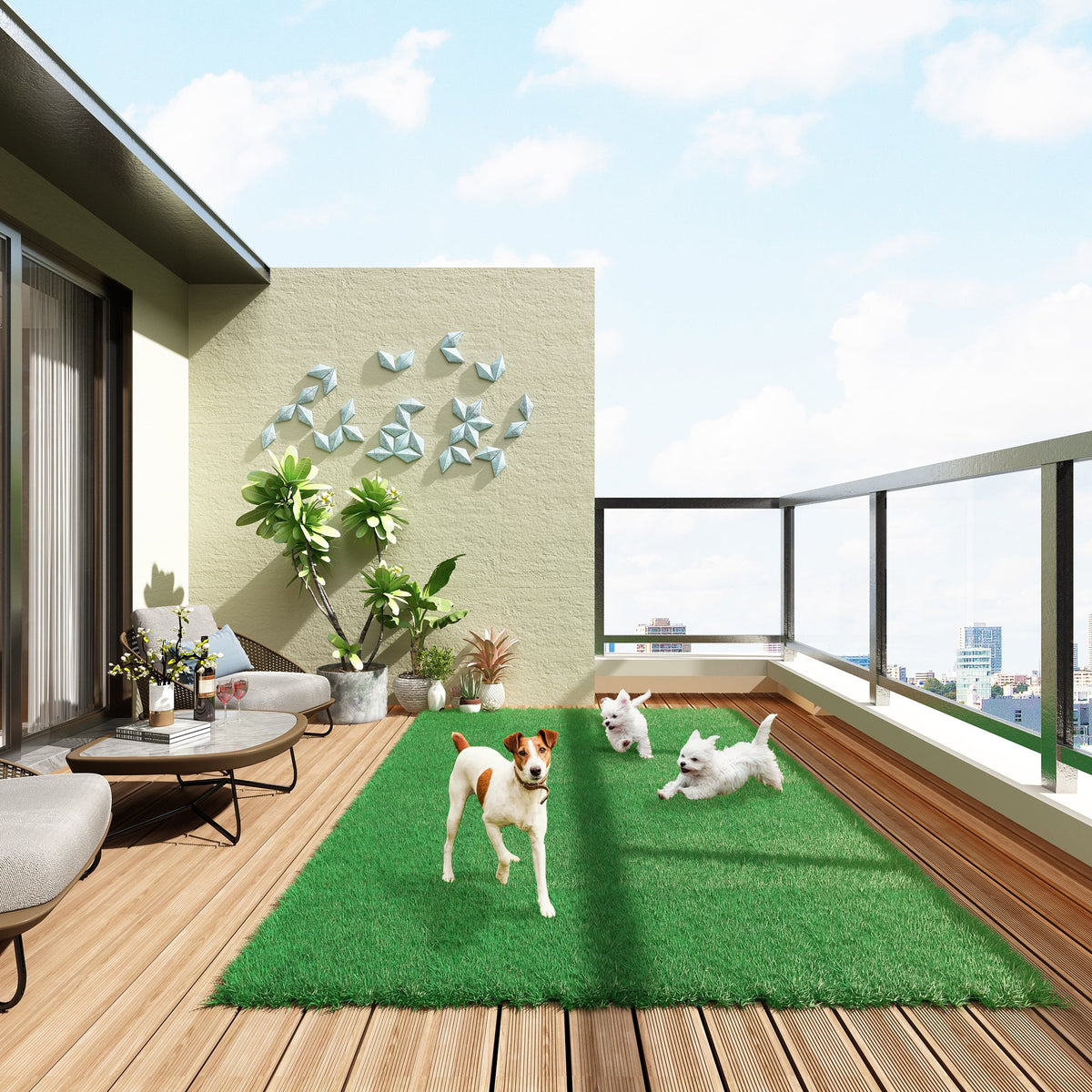
Artificial turf panels are interlocking tiles or ready-cut pieces that you lay by hand on a flat, hard surface such as a balcony, patio, deck or playroom floor, and lift again when you move. Rolls are wide lengths of turf cut to fit a lawn or large area, laid over a prepared, draining base with seams where pieces meet. For a small, flat or temporary space, panels or one ready-cut piece are the simpler choice; for a yard, rolls over a proper base are the long-term option.
To work out how much you need, multiply length by width in feet, then count how many whole pieces of the sizes you can buy cover it. Below: that arithmetic with real sizes, drainage, pets, heat, cleaning, and two ready-cut turf pieces from the FUFU&GAGA outdoor structures collection.
Key takeaways
- Panels for hard, flat, small spaces such as balconies, patios, decks and play corners, especially if you rent.
- Rolls for lawns and big areas: fewer seams, but soil needs a draining base and some cities require a permit.
- Count whole pieces: in one example below, piece size changes the extra turf from about 66 percent to about 10 percent.
- Plan for water, sun and pets: keep drains clear, add shade, and rinse pet areas often.
Artificial turf panels vs rolls: what is the difference?
The difference is how the turf is sold and installed. Interlocking panels, often called turf tiles, are small squares of turf on a backing with clips or tabs along the edges, so you press them together into a larger surface. Rolls are long, wide lengths that you unroll, cut to shape and join with seams, and on soil they are fixed over a compacted, draining base.
Between the two sits a third option that many listings also call panels: a single ready-cut piece sold at a fixed size, like a rug. It rolls out in one go with no joining, and it is the format of both picks at the end of this guide. Names are loose: a listing titled "turf panels" may be one sheet, not a box of tiles.
| Format | How it goes down | Base needed | Best for | Watch out for |
|---|---|---|---|---|
| Interlocking panels (tiles) | Press or clip tiles together by hand | A flat, hard surface | Balconies, rooftops, odd-shaped corners, renters | A joint at every tile edge |
| Ready-cut piece (turf rug) | Unroll one piece | A flat, hard surface or indoor floor | Patios, decks, play areas, camping | Fixed size; check whether it can be trimmed |
| Rolls (cut to length) | Unroll, cut, seam and fix down | Prepared, draining base on soil | Lawns and large yards | Heavy to handle, base work, local rules |
When panels or a ready-cut piece make sense
Panels and ready-cut pieces suit any space where the surface underneath is already hard, flat and draining. On a concrete balcony, tiled patio, wooden deck or rooftop there is no soil to dig out and no base to build, so the turf simply sits on top. Nothing is fixed down, so renters can take it with them, and a damaged tile can be replaced on its own.
The trade-off is the look: tiles show joints, and a ready-cut piece reads as a rug with a border of floor around it, which on a balcony usefully leaves the drain open.
When rolls are the better choice
Rolls make sense when you are replacing a lawn or covering a large area, because wide lengths mean far fewer seams and the turf can follow curved beds. The cost is the work underneath. UF/IFAS turfgrass scientist Jason Kruse notes that synthetic turf systems are installed over compacted soil, which reduces infiltration, and that stormwater runoff is a concern (UF/IFAS).
Some cities spell out what a draining base looks like. The City of Tampa's synthetic turf guidelines count a turf system as pervious only if every layer has a permeability of 10 inches per hour, there is a reservoir layer of 4 inches or more of clean stone, and the soil underneath stays uncompacted. Tampa also bars turf from drainage swales, ditches and stormwater ponds, has its forester review separation from existing trees, and handles turf through a building permit (City of Tampa). Rules differ by city, so check with your local government and any homeowners' association before you dig.
How much artificial turf do I need?
Start with square feet, then convert to whole pieces:
- Measure length and width at the longest and widest points, in feet (divide inches by 12).
- Multiply them for square feet. Split an L-shape into two rectangles and add them.
- Count pieces each way: divide the area's length by the piece length and its width by the piece width, round each up, and multiply. Try both orientations.
- Compare the coverage with the area. The difference is what you trim, turn under or leave as a border.
For tiles the arithmetic is simple: a 12-inch square tile covers 1 square foot, so a 60-square-foot balcony needs 60 tiles before trimming. For ready-cut pieces, the sizes on our two listings work out like this:
| Listing | Size (inches) | Size (feet) | Coverage |
|---|---|---|---|
| 118" turf panels | 118 x 79.2 | 9.83 x 6.6 | 64.9 sq ft (as listed) |
| Turf rug, smaller size | 118.1 x 78.7 | 9.84 x 6.56 | 64.5 sq ft |
| Turf rug, larger size | 157.2 x 78.7 | 13.1 x 6.56 | 85.9 sq ft |
Three worked examples show why piece size matters as much as square footage:
- A 10 x 8 ft patio (80 sq ft). One 9.83 x 6.6 ft piece covers 64.9 sq ft. Centered, it leaves about 1 inch at each end and about 8.4 inches along each side (8 minus 6.6 is 1.4 ft, split in two): a large outdoor rug with no cutting.
- A 14 x 7 ft balcony (98 sq ft). One 13.1 x 6.56 ft piece fits, leaving about 5.4 inches at each end and 2.6 inches along each side, which keeps the edge channel and drain clear.
- A 12 x 13 ft play area (156 sq ft). With 9.83 x 6.6 ft pieces you need 2 x 2 = 4 pieces, or 259.6 sq ft, about 66 percent more turf than the area. Two 13.1 x 6.56 ft pieces side by side cover 171.8 sq ft, about 10 percent more, with one seam and about 13 inches to trim or turn along one side.
Waste allowances quoted by installers vary; a piece count for your own space shows exactly how much extra you buy. If you will need to trim, check first that the product can be cut: neither of our listings says either way, so ask customer service.
Drainage: what goes under artificial turf
Turf drains only as well as what sits under it. Water passes through holes in the backing, and both of our picks list a rubber backing with drainage holes. Then the water needs somewhere to go:
- Balconies and roof decks: keep floor drains and edge channels uncovered; a border of bare floor around a ready-cut piece makes this easy.
- Patios: lay the turf so it does not hold water against the house wall or block the way rain drains.
- Wooden decks: a rubber backing slows drying of the boards beneath, so lift the turf after long wet spells.
- Soil: use rolls over a draining base, not turf laid straight onto bare earth.
Infill matters for lawns too. UF/IFAS notes research showing runoff from synthetic turf can carry heavy metals and other pollutants, especially when rubber infill is used. Neither of our ready-cut listings mentions infill.
Artificial grass for dogs: cleaning and odor
Artificial grass works for dogs on a balcony or patio as long as it is cleaned often. Veterinarian Dr. Georgina Ushi, quoted by the American Kennel Club, says artificial grass is soft, durable and easy to maintain but can hold urine if it is not cleaned thoroughly. The AKC advises rinsing the surface regularly to remove urine, and using a non-toxic turf cleaner, diluted, scrubbed in with a soft brush and rinsed off with a hose (American Kennel Club). Kruse makes the same point: homeowners often need to rinse synthetic turf to manage pet waste, control odors and remove dust.
In practice: pick up solid waste straight away, rinse the dog's spot often in warm weather, make sure rinse water reaches the drain, and lift a ready-cut piece now and then to dry the floor under it.
Turf you can hose down suits a dog's spot better than one whose care line says to wipe it with a dry cloth. And turf is a play surface, not a place to leave a pet for hours in the sun; for a comfortable resting spot indoors, see our dog crate furniture buying guide.
Does artificial turf get hot?
Yes, much hotter than real grass. UF/IFAS researcher Marco Schiavon says that on the hottest summer days artificial turf surfaces can reach 79°C (174°F), while natural turf stays closer to 39°C (102°F); in his California study, natural turf was consistently cooler, often by more than 10°C (18°F) (UF/IFAS). Kruse adds that surface temperatures can exceed 160 degrees in full sun, which poses risks for both people and pets.
Schiavon warns that homeowners may end up watering artificial turf to make it tolerable, which defeats the purpose. Instead, place turf where it gets afternoon shade or under an umbrella or awning, touch the surface before children or pets go out on a sunny day, and use it mornings and evenings in summer. "Heat resistant" on a listing describes the material, not how hot the surface gets in sun.
Cleaning and upkeep
Synthetic turf needs no mowing or watering, but Kruse is clear it is not maintenance free: it needs periodic brushing and replacement of infill, and synthetic turf usually lasts between 10 and 20 years, with limited recycling options. For a ready-cut piece or tiles on a patio, upkeep is simpler: clear leaves with a plastic rake, rinse off dust and let it dry flat, brush flattened areas against the grain, and follow the listing's care line.
Where artificial turf should not go
- Near heat sources. Turf blades are plastic. Keep grills, smokers, fire pits and patio heaters off and well away from turf, following each appliance's clearance instructions; our propane fire pit table guide covers placement.
- Over drains and drainage routes. Never cover a balcony or patio drain, and keep lawn turf out of swales, ditches and stormwater ponds.
- Around tree roots, where digging and compacting a base can do harm, and anywhere your lease, HOA or city code says no.
- Under heavy, narrow-legged furniture left for months. Narrow legs dent the pile; choose wide feet or light pieces you can lift off for cleaning, such as those in our HDPE outdoor furniture guide.
Buying checklist
- Check the surface: hard and flat means panels or a ready-cut piece; soil means rolls over a draining base.
- Count whole pieces in both orientations and compare the coverage with your area.
- Look for drainage holes in the backing.
- Read the care line: hose or pressure washer suits pets better than a dry cloth only.
- Plan shade for a sunny spot used by children or pets.
- Ask whether it can be cut, and check your lease, HOA or city rules before a lawn install.
Our picks: ready-cut artificial turf from FUFU&GAGA
Our current range has two ready-cut turf pieces rather than interlocking tiles or cut-to-length rolls. Both suit balconies, patios, decks and play areas rather than full lawns.
118" Natural Green Artificial Grass Turf Panels

Despite the name, this is one sheet, not a box of tiles: it rolls out to 118 x 79.2 inches and covers 64.9 square feet. It weighs 18 lb and needs no assembly. The description mentions four-tone blades and a rubber backing with drainage holes so it dries quickly after rain or a rinse.
Key facts: listed as water-, UV- and mold- and mildew-resistant, pet friendly, and for indoor décor, outdoor, lawn, patio, balcony and pool use. The care line says to wash it with a garden hose or pressure washer, which makes it the easier of the two to keep fresh in a dog's corner. The description calls it non-toxic and lead-free. Our product records disagree on its fiber material and pile height, so we have left those out; ask customer service if they matter to you.
Best for: a patio or balcony turf rug, or a pet corner you want to hose down often.
Skip it if: you need a confirmed pile height or fiber type, tiles to fit an odd shape, or wall-to-wall coverage of a large yard.
Custom Size Realistic Green Artificial Grass Turf with Self-Draining & UV Resistance

This one comes in two fixed sizes, one piece per order: 118.1 x 78.7 inches (16.72 lb) or 157.2 x 78.7 inches (20.57 lb). Despite "Custom Size" in the title, those are the only sizes offered. The larger size covers the balcony example above in a single piece.
Key facts: listed pile height about 1.02 inches; the description says polypropylene yarns on a rubber backing with drainage holes. The listing calls it heat-, UV-, impact- and weather-resistant and pet friendly, for indoor or outdoor use including balconies, play areas and camping. Its care line says to wipe it clean with a dry cloth, even though the description says water drains through the backing, so confirm how to wash it before you plan a pet area on it.
Best for: covering a longer balcony or patio in one piece, or a portable play or picnic surface.
Skip it if: you need a custom cut size, or turf you can hose down daily for a dog without first checking the care instructions.
Compare the picks
| Pick | Size (from the listing) | Weight | Care (listed) | Best for |
|---|---|---|---|---|
| 118" turf panels | 118" x 79.2" | 18 lb | Garden hose or pressure washer | Patio rug, pet corner |
| Turf rug, 2 sizes | 118.1" or 157.2" x 78.7" | 16.72 or 20.57 lb | Wipe with a dry cloth | Longer balconies, play, camping |
FAQ
Can you put artificial grass on a balcony?
Yes. Lay a ready-cut piece or tiles on the floor with no fixing, keep the drain and edge channel uncovered, choose a backing with drainage holes, lift it after wet spells so the floor can dry, and check your lease or building rules first.
Is artificial grass good for dogs?
It can be, with regular cleaning. A veterinarian quoted by the American Kennel Club notes that artificial grass can hold urine if it is not cleaned thoroughly, so pick up waste promptly, rinse the area regularly and scrub with a diluted pet-safe turf cleaner when it smells. Give dogs shade on hot days.
What do you put under artificial turf?
On a balcony, patio or deck, nothing: ready-cut pieces and tiles sit directly on the hard surface. On soil, rolls go over a prepared, draining base; Tampa's guidelines, for example, call for a reservoir layer of at least 4 inches of clean stone and layers that drain 10 inches per hour. Follow the turf maker's instructions and your local rules.
Browse both ready-cut turf pieces in our outdoor structures collection.

Leave a comment
This site is protected by hCaptcha and the hCaptcha Privacy Policy and Terms of Service apply.