










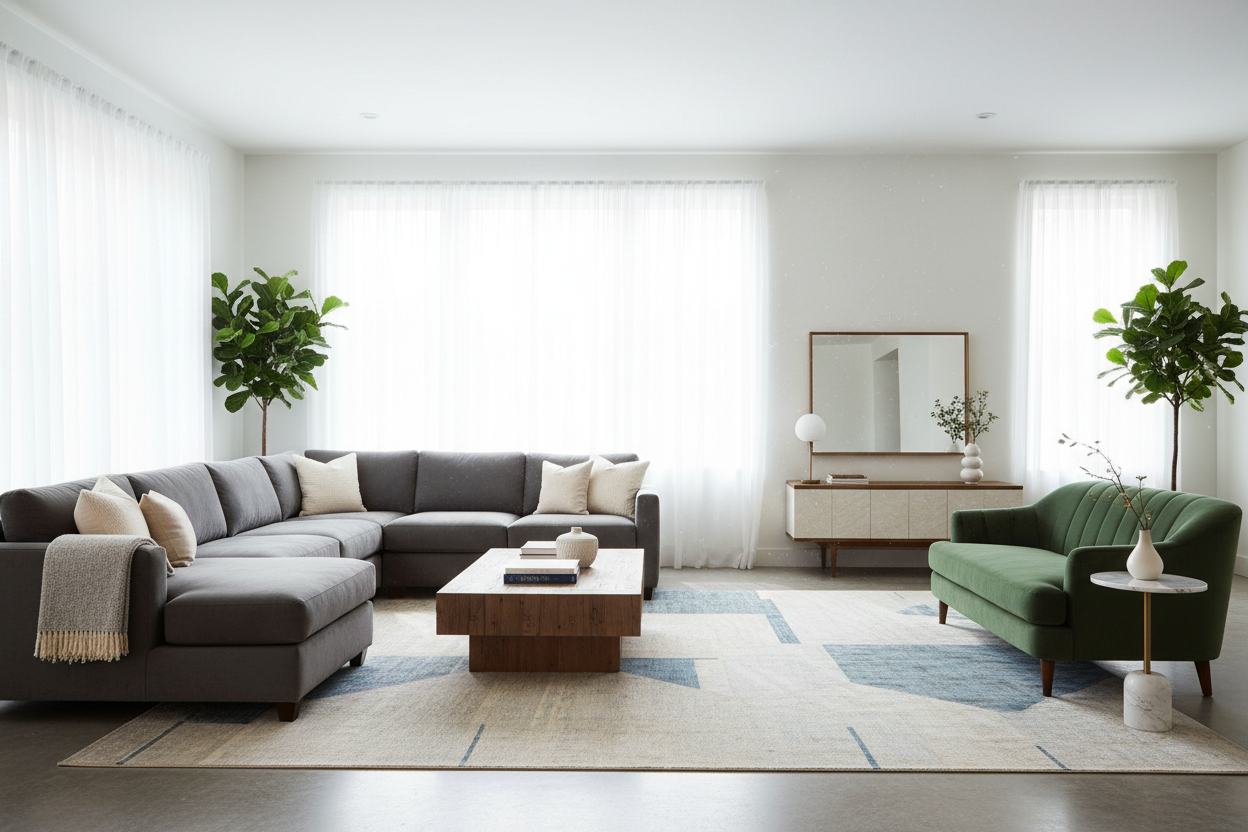
One of the most frequent dilemmas I encounter when consulting on a floor plan involves scale. Clients often fall in love with a specific silhouette in the showroom, only to realize it dominates their living space—or conversely, gets swallowed by it. The debate of couch vs loveseat isn't just about seating capacity; it is about traffic flow, visual weight, and how you actually live in your home.
Whether you are furnishing a cozy apartment or balancing a grand living room, understanding the nuances between these two staples is essential for a cohesive design.
Quick Decision Guide: The Key Differences
- Dimensions: A standard sofa (or couch) typically ranges from 72 to 96 inches long. A loveseat is compact, usually sitting between 48 and 72 inches.
- Seating Capacity: Sofas comfortably seat three or more adults. A loveseat is strictly a two-seater (hence the name).
- Functionality: Sofas are ideal for lounging and napping. Loveseats are better suited for conversation nooks or secondary seating.
- Visual Balance: A sofa anchors a room; a loveseat complements the anchor or serves as a solution for narrow spaces.
Defining the Players: Sofa vs Couch vs Loveseat
Before we dive into layouts, let's clear up the terminology. In the design industry, we generally use the term "sofa" for upholstered seating with arms and a back. The word "couch" implies something more casual, often used for lying down. However, for most homeowners, the terms are interchangeable.
So, what is a loveseat? Simply put, it is a mini-sofa designed for two people. You might see it spelled as love seat or loveseat; both are correct, though the single-word variation is more common in modern catalogs. Occasionally, you might hear the term what is a love couch or what is a loveseat sofa—these are colloquialisms for the same piece of furniture. The defining characteristic is always the two-cushion configuration.
Is a Loveseat Just a Small Couch?
Technically, yes, is a loveseat a couch in terms of construction? Absolutely. They share the same suspension systems (sinuous springs or eight-way hand-tied), frame materials (kiln-dried hardwood is the gold standard), and upholstery options. The difference between couch and loveseat lies entirely in the length and the intended use.
Space Planning and Visual Weight
When deciding on a sofa or loveseat, the footprint is your primary constraint. However, you must also consider the "visual weight"—how heavy the piece looks in the room.
The Loveseat vs Couch Size Debate
In a standard 12x12 living room, a full-sized sofa can block traffic paths. Here, using a loveseat instead of couch allows for better circulation. A common layout mistake is forcing a large sofa into a bay window area; a loveseat often tucks in perfectly without obscuring the architecture.
Conversely, in a large open-concept space, a standalone loveseat will look like a postage stamp. If you are comparing a loveseat vs 2 seater sofa (a European term often synonymous with loveseats), ensure the piece is grounded by a rug that extends at least 6 inches beyond the front legs.
Layout Configurations: Mixing and Matching
The sofa and loveseat difference becomes most apparent when you try to pair them.
The "L" Configuration
A classic approach is placing a sofa and a loveseat perpendicular to each other. This creates a natural conversation corner. However, be wary of the loveseat vs chair decision here. Two accent chairs often provide more flexibility and better visual permeability than a blocky loveseat.
Loveseat as the Primary Seating
Can you use a loveseat instead of sofa as your main piece? In a studio apartment or a formal sitting room (a "reception room"), yes. However, if this is your primary TV-watching room, a loveseat restricts you. You cannot stretch out fully. If comfort is the goal, but space is tight, look for "apartment sofas" which bridge the gap—usually around 70 inches wide.
Lessons from My Own Projects: The "Middle Cushion" Syndrome
I want to share a specific insight from a project I worked on in a historic row house, where narrow hallways dictated our furniture choices. We opted for a high-end velvet loveseat because a sofa simply wouldn't fit up the stairs.
Here is the unpolished truth about love couch sofa use that catalogs won't tell you: Loveseats often age faster in the center than sofas do. Why? Because when a single person sits on a loveseat, they naturally gravitate toward the exact center to use both armrests, sitting right on the crack between the two cushions. Over six months, I noticed the fabric pooling and the foam dipping right in the middle, whereas on a three-cushion sofa, people tend to pick a side. If you buy a loveseat, I always recommend a bench cushion (one single long cushion) rather than two separate ones to avoid this "crater" effect.
Conclusion
Choosing between a couch vs loveseat ultimately comes down to measuring your space honestly and assessing how you lounge. Don't let the showroom floor deceive you; tape out the dimensions on your floor to see the real footprint. Whether you choose the expansive comfort of a sofa or the cozy intimacy of a loveseat, ensure the scale respects your room's architecture.
Frequently Asked Questions
What is a love seat used for in a large bedroom?
In a master suite, a loveseat is often placed at the foot of the bed or in a bay window. It serves as a private spot for reading or putting on shoes, adding a layer of hotel-like luxury to the bedroom design.
Is a loveseat cheaper than a sofa?
Generally, yes. Because a loveseat requires less fabric, padding, and frame material, it is usually less expensive than its matching sofa counterpart. However, a high-end designer loveseat will still cost more than a budget-friendly full-sized couch.
What is the standard size of a loveseat?
While sizes vary by style (a rolled-arm traditional piece is wider than a mid-century modern track-arm piece), the standard length is between 52 and 72 inches. Always measure the depth as well, as this affects the walkable space in your room.


Leave a comment
This site is protected by hCaptcha and the hCaptcha Privacy Policy and Terms of Service apply.