










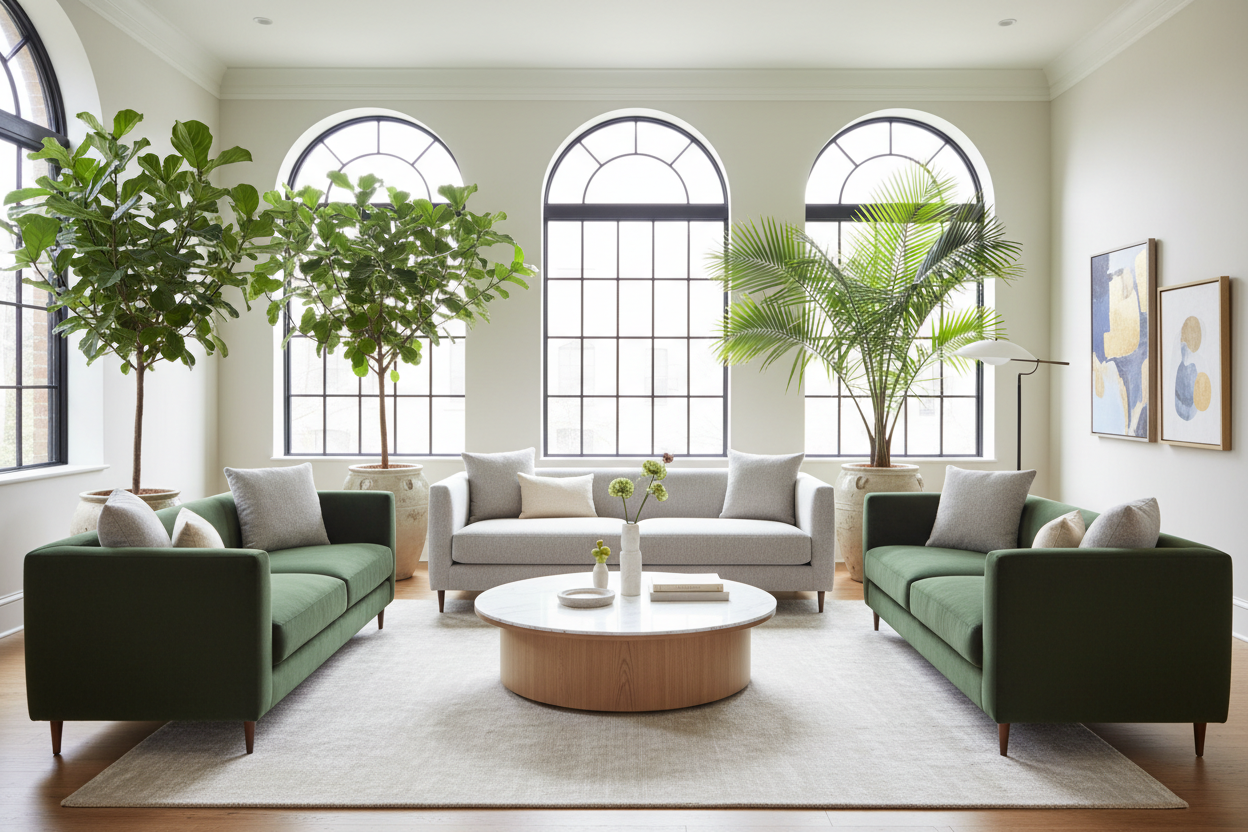
One of the most frequent challenges clients bring to me isn't choosing a color palette—it's spatial planning. Specifically, they struggle with the relationship between their primary seating pieces. Creating a cohesive living area requires more than just pushing furniture against the walls; it demands a keen understanding of how **sofas loveseats** interact with one another to establish flow, conversation zones, and visual balance.
Quick Decision Guide: Key Features to Look For
- Scale and Proportion: Ensure the loveseat is roughly 60% of the sofa's length to maintain visual hierarchy.
- Seat Depth Consistency: Verify that both pieces share similar seat depths (ideally 21-24 inches) for uniform comfort.
- Frame Construction: Look for kiln-dried hardwood frames with corner-blocked joinery for longevity.
- Upholstery Durability: For high-traffic areas, prioritize fabrics with a rating of at least 30,000 double rubs.
- Leg Silhouette: Matching leg styles (e.g., tapered wood vs. metal sled) helps tie disparate pieces together if the fabrics differ.
Orchestrating the Layout
The placement of your seating dictates the energy of the room. The most classic and functional arrangement for couches loveseats is the 'L-shape' configuration. By placing the pieces perpendicular to one another, you create a natural conversation pit that anchors the living space without closing it off entirely.
In larger, open-concept homes, avoid pushing the furniture against the walls. Floating the pieces in the center of the room, anchored by a substantial area rug, defines the zone. Ensure the front legs of both the sofa and loveseat sit on the rug to ground the arrangement.
Navigating Traffic Flow
Functionality is paramount. You need a minimum of 30 to 36 inches of clearance around your seating group to allow for comfortable movement. If the loveseat blocks a natural pathway, consider swapping it for a pair of club chairs, which offer similar seating capacity but with more visual permeability.
Materiality and The "Matchy-Matchy" Trap
A decade ago, buying a matching suite was the standard. Today, as a designer, I advise against it. Purchasing identical loveseats sofas can make a room feel like a showroom rather than a curated home.
Instead, aim for coordination over duplication. If your main sofa is a heavy, textured bouclé in cream, consider a loveseat in a smooth, cognac leather. This contrast in texture adds depth and prevents the room from feeling flat. If you must buy a matching set for budgetary reasons, break up the uniformity with contrasting throw pillows and distinct throw blankets that introduce new colors and textures.
My Personal Take on Sofas Loveseats
I learned a hard lesson early in my career regarding seat depth discrepancies. I once sourced a high-end vintage set for a client where the sofa was a deep lounger, but the accompanying loveseat was remarkably shallow and upright. While they looked beautiful together, nobody wanted to sit on the loveseat because it felt like a church pew compared to the cloud-like sofa.
Another detail I always check now—and one you won't find on a spec sheet—is the "creak test" on the arms. I lean my full weight on the armrest of the loveseat. Since loveseats are lighter, manufacturers sometimes use thinner framing materials on the sides than they do on the full-sized sofas. If it flexes or creaks under my weight, I walk away. It’s a small detail, but structural integrity is non-negotiable.
Conclusion
Pairing these pieces is about finding the equilibrium between comfort and style. By paying attention to scale, avoiding overly matching sets, and respecting traffic flow, you can curate a living space that feels both sophisticated and inviting.
Frequently Asked Questions
How much space should be between a sofa and a loveseat?
Ideally, leave about 14 to 18 inches between the corners of the two pieces if they are arranged in an L-shape. This allows for a side table to be placed in the corner, providing a surface for lighting and drinks without crowding the legroom.
Can I mix a modern sofa with a traditional loveseat?
Yes, but with caution. The unifying factor should be the visual weight or color palette. For example, a modern track-arm sofa can pair with a traditional roll-arm loveseat if they share a similar fabric tone or leg height. Drastic differences in silhouette usually require a professional eye to pull off.
Are loveseats outdated compared to accent chairs?
Not at all. While accent chairs offer flexibility, loveseats provide the unique benefit of "cuddle space" or room for a parent and child to sit together. In narrow rooms where a full sofa and two chairs might feel cluttered, a sleek loveseat streamlines the look while maintaining seating capacity.


Leave a comment
This site is protected by hCaptcha and the hCaptcha Privacy Policy and Terms of Service apply.