










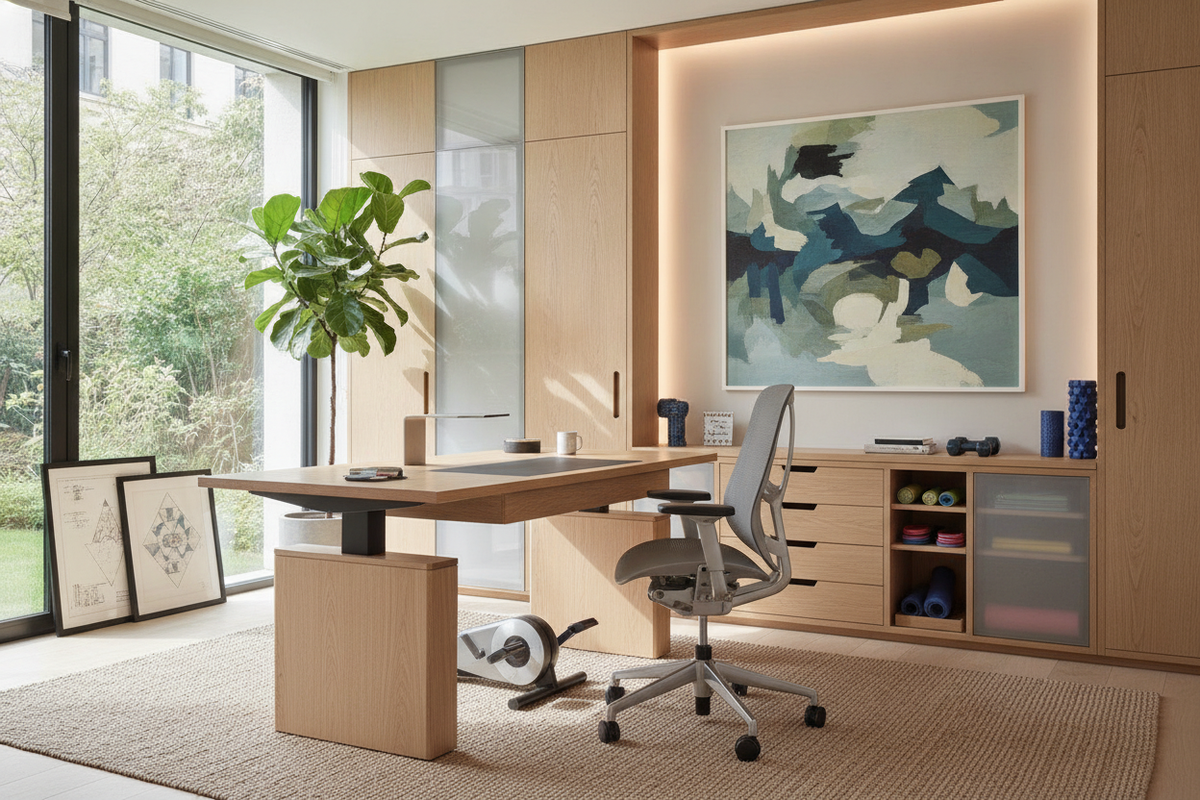
Modern knowledge work often tethers professionals to their seats for extended stretches throughout the day. While sustained focus powers project delivery, continuous static posture can leave your body feeling stiff and sluggish. Integrating physical micro-movements directly into your workday—often referred to as a daily desk exercise routine—provides a practical way to encourage circulation, refresh mental focus, and maintain joint mobility without interrupting key tasks.
Achieving a sustainable active routine requires more than sheer willpower; it depends heavily on the physical architecture of your workstation. A cramped footwell, an unstable desktop, or surface clutter can quickly discourage subtle physical activity. When you plan your space with intentional movement envelopes, you transform a traditional desk setup into a responsive hub for both deep work and kinetic vitality.
The Dynamic Workstation: Why Desk Exercise Demands Intentional Space Planning
Approaching physical activity at work begins with spatial awareness. Rather than treating physical movement as an isolated event reserved strictly for gym sessions, dynamic workstation design treats light movement as an ongoing element of your daily workflow. Following an office desk that guide tailored toward functional comfort helps you establish an ergonomic baseline where posture shifts occur naturally.
When a workstation provides open sightlines and generous physical clearance, you are far more likely to perform light stretches during a virtual conference call or engage your core while drafting a report. Harmonizing your desk layout with your body's natural movement arcs removes friction, making subtle physical activity an effortless, intuitive part of working hours.
Kinetic Clearances: Workstation Dimensions That Enable Movement
Executing seated or standing desk exercises safely requires adequate clearance beneath and around your primary work surface. Restrictive framing, intrusive modesty panels, or low-hanging crossbars can limit your range of motion and lead to awkward postures during exercise.
Under-Desk Clearance and Footwell Freedom
The space beneath your desktop serves as your personal kinetic zone. To perform lower-body movements such as leg extensions or ankle circles, your footwell must offer unimpeded depth and vertical height. Ensure that under-desk drawer units or cable trays do not encroach upon your knees or shins when your chair is drawn up to typing height. Maintaining this unobstructed spatial envelope enables fluid transitions between neutral seating and dynamic leg stretches.
Surface Stability and Edge Loading Considerations
Engaging in desk-supported stretches—such as seated forearm extensions, standing calf presses, or light desk planks—places targeted downward and lateral forces along the desk edge. Sturdy desk joinery, solid frame construction, and balanced weight distribution prevent wobbling or surface deflection when you apply gentle pressure during movement routines. Prioritizing solid foundational support ensures that your furniture remains dependable throughout every movement session.
Seated Desk Exercises: Low-Impact Routines for Focused Workflows
Seated exercises provide subtle, low-impact ways to stimulate muscle engagement and relieve physical stiffness while maintaining continuous workflow. These movements require no specialized equipment and can be performed discreetly during reading tasks or collaborative calls.
Lower-Body Micro-Movements: Calves, Thighs, and Glute Engagement
- Seated Calf Raises: Plant the balls of your feet firmly on the floor and lift your heels as high as possible, contracting the calf muscles at the peak before lowering slowly. Perform steady repetitions to promote blood flow through the lower legs.
- Seated Leg Extensions: While seated upright, extend one leg forward until it is parallel with the floor, holding for a brief moment before lowering with control. Alternate legs to engage the quadriceps and encourage knee articulation.
- Isometric Glute Squeezes: Contract your gluteal muscles firmly while seated, hold the tension for several seconds, and release smoothly. This quiet exercise activates hip stabilizers during passive reading periods.
- Under-Desk Ankle Circles: Lift your feet slightly off the floor and rotate your ankles in controlled clockwise and counterclockwise circles to reduce joint stiffness caused by stationary seating.
Upper-Body Postural Alignment: Neck, Shoulders, and Wrists
- Shoulder Blade Retractions: Draw your shoulder blades backward and downward toward each other, opening the chest and counteracting rounded shoulder tendencies.
- Seated Spinal Rotations: Place your right hand on the outer edge of your left thigh or desk corner, gently rotating your torso toward the left while keeping your hips square to lengthen the spine. Repeat on the opposite side.
- Wrist Flexor and Extensor Releases: Extend one arm forward with the palm facing up, gently drawing your fingers backward with your opposite hand, then invert the palm downward to release typing tension across the forearm.
- Neck Lateral Tilts: Gently lower your right ear toward your right shoulder without lifting the shoulder, holding briefly before repeating on the left side to relieve upper trapezius tightness.
Standing and Perching Movements: Expanding Your Active Range
Transitioning between sitting and standing throughout the workday introduces varied gravitational loads and movement angles to your routine. When you stand, your functional exercise perimeter broadens significantly. Stepping away for dedicated micro-intervals or pairing active standing with our out office when guide strategies helps create structured mental and physical boundaries between intense screen focus and renewal breaks.
Effective standing routines include desk-supported calf stretches, where you step one leg back and press the heel into the floor while holding the desktop edge for balance. You can also incorporate standing hip abductions, lightly steadying your hand on the work surface while lifting one leg outward to engage lateral hip stabilizers. Gentle wall-supported chest openers and standing pelvic tilts further refresh full-body posture before you resume seated tasks.
Organizing the Active Office: Storage Solutions for Equipment and Clear Workspaces
A cluttered office floor or crowded desktop creates physical and mental barriers to daily movement. If small exercise accessories like mini resistance bands, massage trigger balls, or compact yoga blocks are scattered across the floor, they present tripping hazards and limit your legroom. Implementing smart storage keeps active accessories accessible yet discreetly stowed.
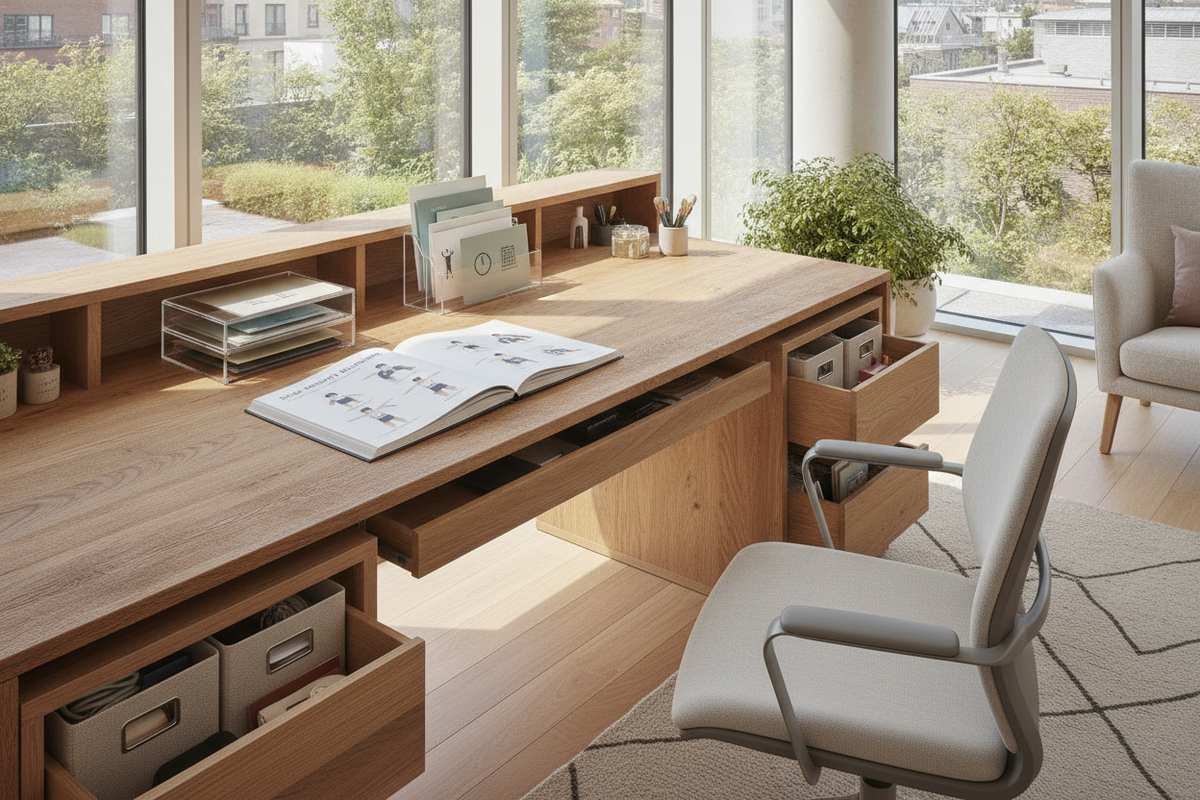
Utilizing vertical wall organization or integrating a desk that office guide for elevated shelving ensures that horizontal desktop surfaces remain free for stretching and note-taking. Furthermore, selecting an integrated office desk product featuring dedicated cabinetry allows you to organize physical fitness accessories alongside professional files, preserving a clean visual landscape that fosters both focus and mobility.
Workstation Selection: Matching Furniture Archetypes to Active Work Routines
Selecting the right furniture archetype determines how easily your workspace adapts to movement routines. Different desk formats offer unique spatial advantages depending on room dimensions and personal workflow habits:
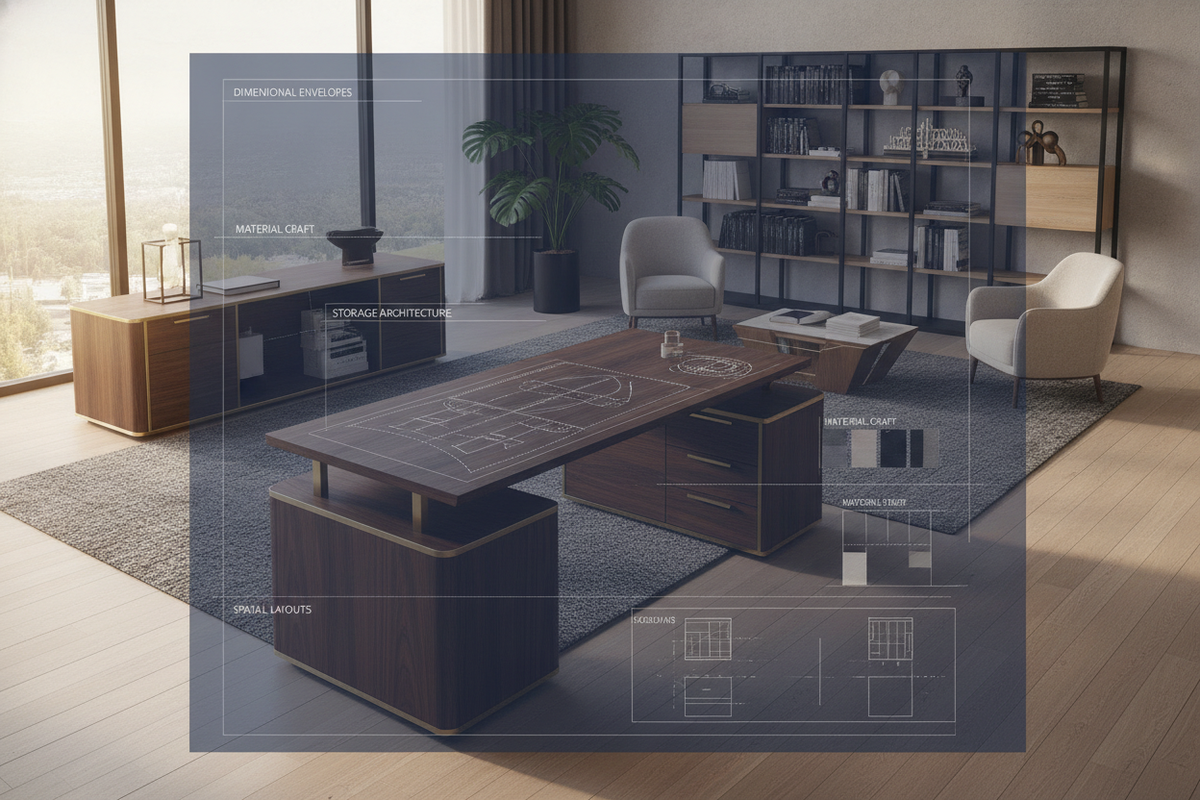
- L-Shaped and Corner Desks: A corner workstation, such as a spacious office desk product, establishes distinct functional wings. You can dedicate one side exclusively to computer monitors and primary inputs while keeping the adjoining wing open for paperwork, arm stretches, and standing peripheral movement.
- Credenza Desk Combinations: Units with side storage credenzas keep the primary footwell completely hollow and clear, ensuring unhindered leg extension during lower-body seated exercises.
- Writing and Computer Tables with Minimalist Framing: Desks with slim legs and no lower cross-bracing maximize vertical clearance for foot rockers, balance discs, or small under-desk pedal devices.
By pairing intentional movement routines with ergonomic, well-structured furniture, you create an active office ecosystem that nurtures physical vitality, mental clarity, and sustained everyday productivity.

Leave a comment
This site is protected by hCaptcha and the hCaptcha Privacy Policy and Terms of Service apply.