










The Core Mechanics of Desks for Left Handers
Most mass-produced office workstations follow an assumed right-handed workflow. From fixed right-side storage pedestals to cable pass-through ports clustered on the right, traditional workspaces frequently create physical friction for left-handed individuals. When seeking out dedicated desks for left handers, the primary goal is removing structural barriers that impede the natural arc of the dominant hand.
For a left-handed worker, the left side of the tabletop serves as the primary action hub. This is where writing notebooks, precision mousing pads, graphic tablets, and frequent-reach tools live. If a desk features non-removable drawers on the left, leg clearance can feel pinched during writing postures. Conversely, if storage is fixed rigidly to the right, retrieving stationery or files requires constant cross-body twisting. Evaluating a desk for left-handed person utility requires looking closely at drawer modularity, surface proportions, and uninterrupted arm clearance.
Structural Desk Typologies for Left-Handed Workspaces
Finding functional left-handed desks does not require custom manufacturing. Instead, smart workspace planning relies on selecting adaptable furniture frames built with symmetry or reversible hardware. Consider these primary structural categories:
- Reversible Pedestal Desks: Workstations designed with universal mounting holes allow the drawer unit to bolt to either the left or right leg frame. When configuring a left-handed desk with drawers, placing the storage bank on the non-dominant right side often opens generous legroom on the left for expressive writing postures.
- Open Trestle and Legged Tables: Minimalist open-frame desks offer completely unobstructed lower perimeters. They allow mobile rolling carts to slide into whatever side best complements daily habits.
- Double-Pedestal Desks: Symmetrical desks featuring twin pedestals provide equal utility on both sides, ensuring ample organizational room regardless of hand preference.
For more detailed considerations on integrated storage engineering and framing, consult our contemporary desk drawers guide.
Corner and L-Shaped Layouts for Left-Handed Reach
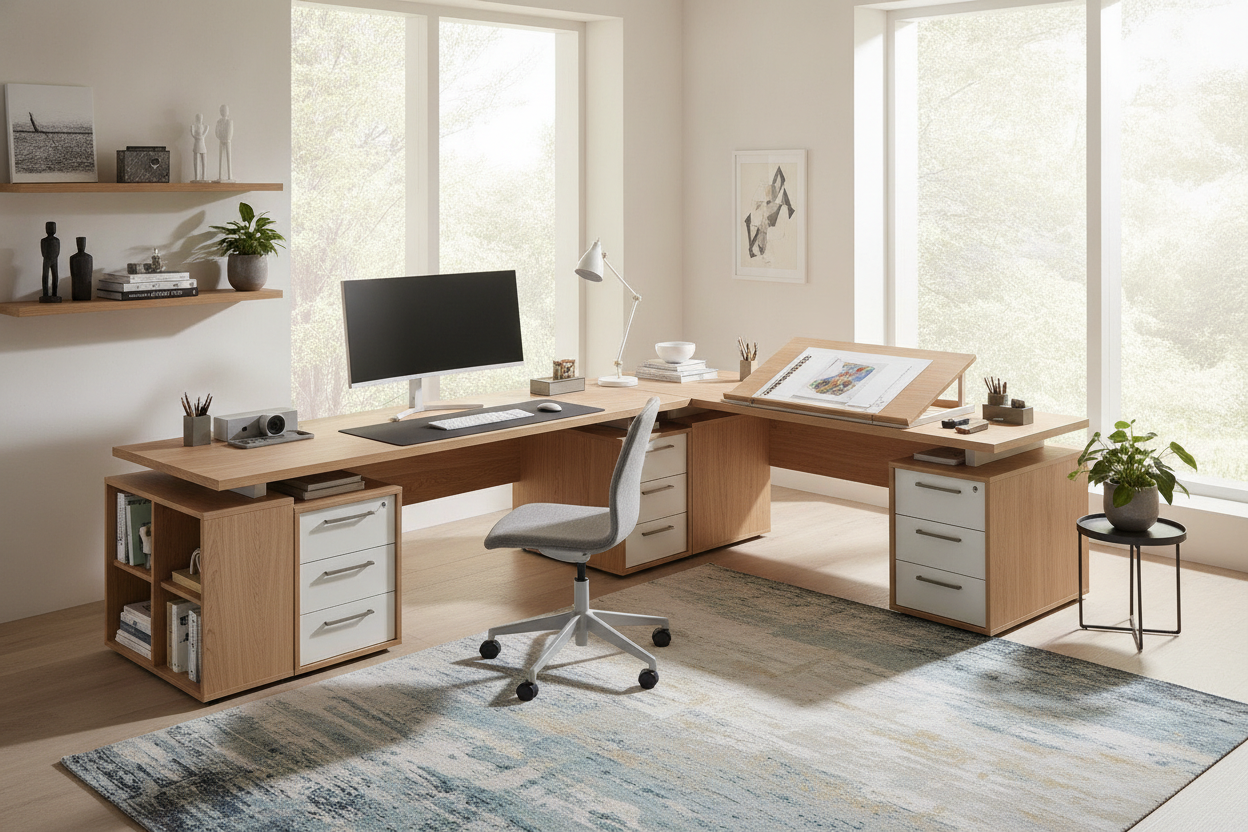
An L-shaped configuration offers expansive surface area, but the orientation of the secondary desk extension—the return—profoundly affects usability. For a left-handed setup, a left handed corner desk design typically means the longer or primary work surface runs along the front, while the secondary surface extends out to the left side.
A left-return configuration creates an enveloping cockpit. It lets a left-handed writer pivot smoothly from a central computer keyboard to a dedicated handwritten drafting station without twisting across a corner seam. When shopping for an adaptable L-shaped piece, such as a brown wood grain corner desk with drawers, prioritize models featuring reversible surfaces so you can assemble the extension on whichever side best suits your room dimensions and dominant reach.
Desktop Surface Zoning and Left-Handed Ergonomics
Arranging your tabletop properly prevents clutter from invading your natural working space. A balanced left-handed desk setup divides the desktop into three distinct operational zones:
- Primary Left Zone (Active Reach): The immediate left arc within elbow-to-hand reach. Reserve this clear space for your mouse, stylus tablet, or primary analog notebook. Keep this area free of vertical organizers, monitor risers, or stacked paper trays.
- Central Zone (Neutral Visual Axis): The direct center line of the desk. Align your primary monitor and keyboard here. Keeping the keyboard slightly shifted to the right can sometimes balance the extra desk space needed for left-side mouse navigation.
- Secondary Right Zone (Support Storage): The right-hand quadrant of the desktop. Use this space for reference monitors, lighting bases, pencil cups, beverage coasters, and auxiliary organizers.
To keep the primary writing area clear, incorporating vertical storage off the desktop is essential. Review our office setup and desk organizer guide for strategies on moving stationary off your main work surface.
Storage Architecture: Balancing Knee Clearance and Left-Side Drawers
One common challenge when arranging a lefty desk involves the placement of integrated pedestals. When writing with the left hand, people naturally angle their torso slightly to the left, which shifts leg placement in that direction. A fixed under-desk filing cabinet directly on the left can lead to uncomfortable leg collisions.
To avoid cramped quarters while maintaining storage access, consider decoupling file storage from the desk frame. Positioning a dedicated piece nearby, such as a standalone corner curio cabinet with drawers, allows you to store paperwork, reference volumes, and tools without sacrificing under-desk knee room. This approach keeps the lower perimeter completely open for unrestricted leg positioning.
Selection Framework: Choosing the Ideal Left-Handed Desk Configuration
When selecting from various left handed desks, use the following checklist to evaluate potential furniture before purchasing:
- Assembly Reversibility: Verify whether the manufacturer provides mirror-image assembly instructions and pre-drilled holes for left-side or right-side component swapping.
- Surface Depth: Ensure the tabletop offers sufficient front-to-back depth so left-handed writing pads can rest comfortably in front of keyboard trays or monitor stands.
- Cable Port Placement: Look for desks with symmetrical grommets or open rear channels so device cords can route cleanly to the left without stretching across the entire desktop.
- Spatial Footprint: For compact corners or dedicated home office nooks, an open-concept structure like a modern minimalist computer corner desk provides flexible surface area that easily adapts to left-handed peripheral placement.
Designing an efficient workspace for a left-handed individual is all about adaptability and clear motion pathways. By selecting modular surfaces, planning logical reach zones, and positioning storage thoughtfully, you can build a clean, comfortable, and productive work environment.


Leave a comment
This site is protected by hCaptcha and the hCaptcha Privacy Policy and Terms of Service apply.