










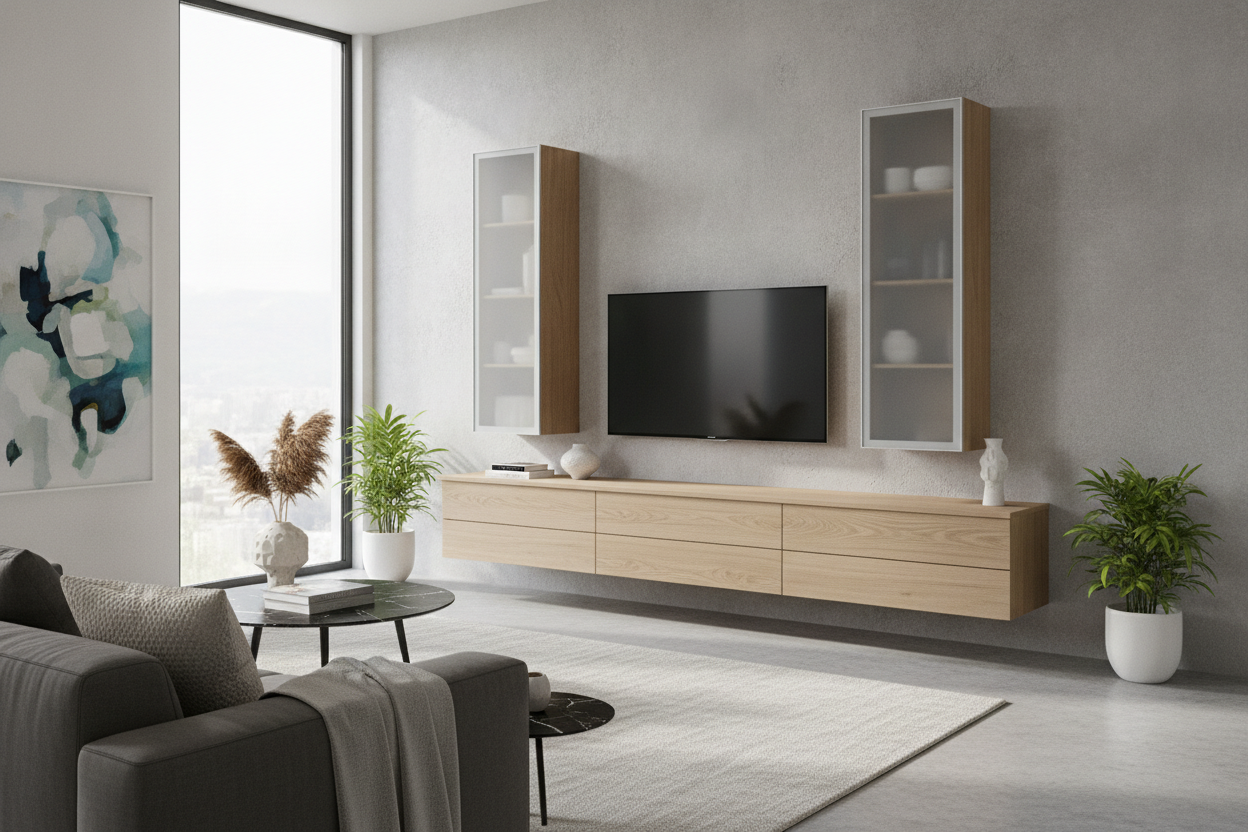
I spent three weeks obsessing over a Pinterest board titled ‘Minimalist Haven’ before I finally pulled the trigger on a wall-mounted shelf. It was a beautiful, 72-inch slab of reclaimed wood that looked like it was defying gravity. For exactly twelve hours, I was a design genius. Then I tried to plug in my Playstation, my router, and my soundbar. Suddenly, my sleek masterpiece looked like a piece of driftwood caught in a web of black plastic vines.
If you are looking at floating entertainment centers, you are likely trying to reclaim your floor space and get that high-end, custom-built look. But there is a massive trap waiting for you: the open-shelf unit. Unless you live in a museum where you never actually use electronics, open shelving is where aesthetic dreams go to die.
Quick Takeaways
- Open shelves turn your tech clutter into the room's main focal point.
- A floating unit with drawers is the only way to hide the 'black box' mess.
- Wall studs are not optional; you need a solid anchor for heavy drawer units.
- Proper mounting height saves your neck and makes vacuuming a breeze.
The 'Hover' Illusion Only Works if the Room is Spotless
The whole point of a floating unit is to create a sense of lightness. By getting the furniture off the floor, you make the room feel larger and more modern. However, the eye is naturally drawn to the gap underneath and the surface itself. If that surface is covered in dusty game controllers, tangled charging cables, and three different remotes, you haven't created a 'look'—you've just mounted your junk at eye level.
I’ve tested units that were nothing more than hollow boxes. They look great in professional photography with one perfectly placed succulent, but in real life, they are magnets for clutter. Every time you sit on the sofa, you’re staring directly at the messy reality of your digital life. If you can see the dust bunnies behind your Xbox, the illusion of luxury is dead on arrival.
Why a Floating Entertainment Center With Drawers is Non-Negotiable
Hidden storage is the secret weapon of every interior designer I know. You need a place to shove the stuff you use every day but don't want to look at. This is why a floating entertainment center with drawers is the only version of this furniture I will ever recommend. Drawers allow you to maintain that sharp, monolithic exterior while housing the chaos inside.
Think about your current setup. Where do the spare batteries go? The HDMI cables you might need someday? The instruction manual for the TV you bought in 2019? I eventually realized that my open shelving was a failure, which is why I gave up and bought an entertainment center with doors and drawers. Having a dedicated spot to hide the 'ugly tech' changed the entire vibe of my living room. It went from looking like a dorm room to looking like a grown-up home overnight.
Weight Limits vs. Your Living Room Junk
Let's talk about the physics of a floating home entertainment center. A unit with drawers is inherently heavier than a simple shelf. You aren't just supporting the weight of the wood; you're supporting the drawer slides, the hardware, and whatever heavy gear you cram inside. If you try to hang an 80-inch unit with cheap plastic drywall anchors, you’re going to be patching a giant hole in your wall by Tuesday.
When you’re shopping, look for units that use a French cleat system or heavy-duty steel brackets. You must—and I mean must—hit at least two studs. If the mounting holes don't line up with your studs, you need to drill new holes in the back of the unit or mount a backer board first. Don't trust the 'rated for 50 lbs' stickers on toggle bolts. When a drawer is pulled out, the leverage changes, and that's when cheap mounts fail.
How High Should You Actually Mount It?
The most common mistake I see is people mounting their TV stands way too high. You aren't a sports bar. You shouldn't be looking up at your TV. Usually, the sweet spot for a floating TV stand entertainment center is between 8 and 12 inches off the floor. This gives you enough clearance for a vacuum or a robot mop to pass underneath without making the TV sit at an awkward, neck-straining height.
Measure your eye level while sitting on your actual sofa. The middle of your TV screen should be at that level. If you mount the floating unit too high, you end up with a weird 'gap' of empty wall that makes the room feel disconnected. Keep it low, keep it sleek, and make sure you have a plan for the wires running inside the wall—otherwise, you're just trading floor clutter for wall clutter.
The Verdict: Is the Drywall Hassle Worth It?
Installing one of these is a pain in the neck. You’ll be sweating over a level, hunting for studs, and probably swearing at a drill bit. But once it’s up? It’s the single best upgrade you can make for a modern living room. The lack of legs makes the floor feel continuous, and the hidden drawers keep your space looking like a curated magazine spread rather than a tech graveyard. It’s worth the extra $200 for a unit with drawers and the two hours of installation frustration.
My Personal Fail
I once bought a cheap, 60-inch floating shelf from a big-box retailer that used those 'invisible' rod brackets. I thought it looked cool until I put my receiver on it. The weight caused the shelf to tilt forward just enough that my Apple TV remote would slowly slide off and hit the floor every single night. I spent a week thinking I had a ghost before I realized the shelf was saging. I replaced it with a solid unit with three deep drawers, and I haven't looked back since.
FAQ
Do floating entertainment centers hide wires?
Only if they have a back panel with cord management holes or if you run the wires through the wall behind the unit. A drawer unit is better because it gives you a 'pocket' to tuck the excess cable slack into so it isn't hanging down.
Can I mount a floating unit on a plaster wall?
Yes, but it's trickier than drywall. You absolutely have to find the lath or the studs. I recommend using a high-end stud finder that can sense deep density changes, or you'll end up with a wall that looks like Swiss cheese.
Are floating units safe for households with kids?
Actually, they can be safer than floor units because they can't be tipped over if they are properly bolted to the studs. Just make sure the corners aren't at 'toddler forehead' height, which is a lesson I learned the hard way with a sharp-edged oak unit.

Leave a comment
This site is protected by hCaptcha and the hCaptcha Privacy Policy and Terms of Service apply.