










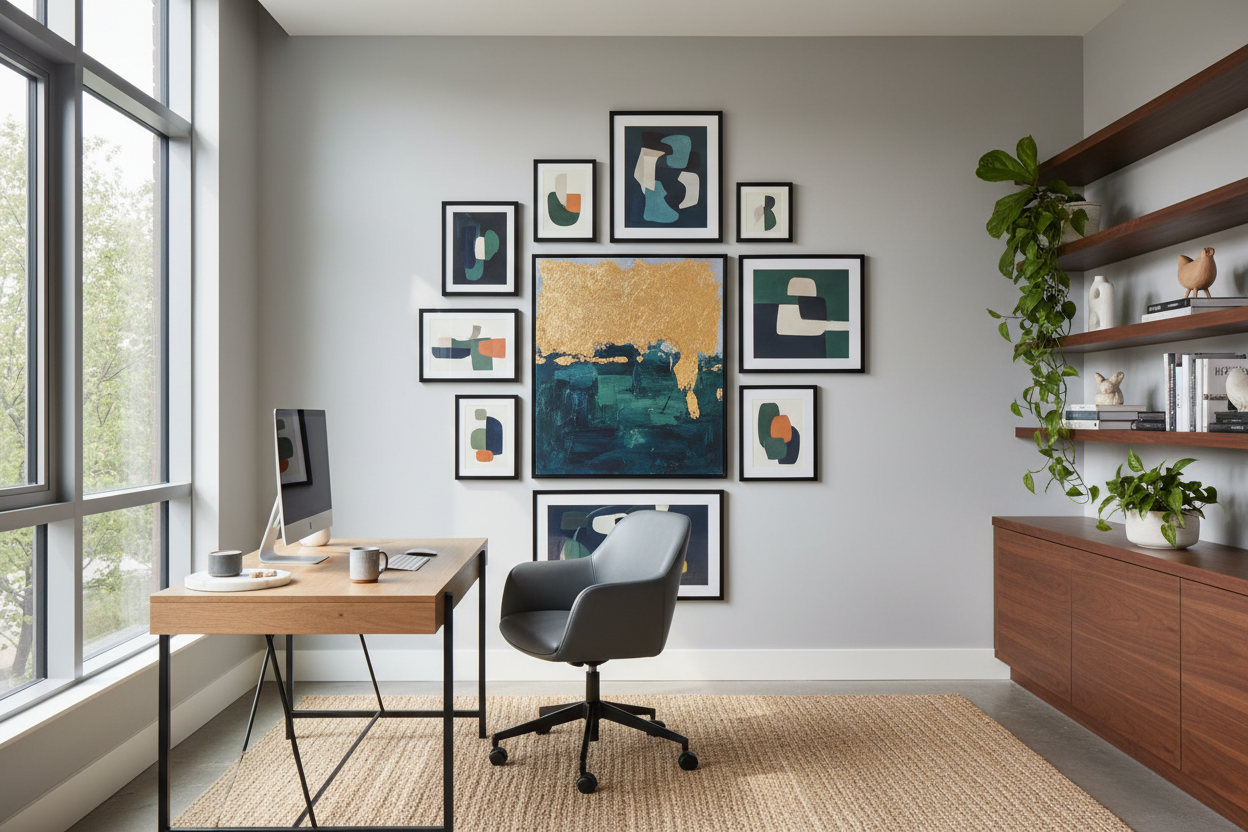
A sterile, blank wall is the silent killer of creativity. In my years designing workspaces, I have seen executives invest heavily in ergonomic seating while leaving their visual field completely neglected. The environment you look at is just as critical as the chair you sit in. Implementing thoughtful art office ideas is not merely about decoration; it is about calibrating the mood, acoustics, and visual weight of the room to support deep work and professionalism.
Key Features to Consider Before Buying
- Scale and Proportion: The artwork should occupy 60% to 75% of the available wall space (minus furniture width) to maintain visual balance.
- Acoustic Properties: In echo-prone rooms, canvas or tapestry absorbs sound, whereas glass-framed prints reflect it.
- Color Psychology: Blues and greens promote focus; warm tones induce energy but can be distracting in high-volume areas.
- Glare Control: Verify lighting angles to determine if you need non-reflective museum glass or matte finishes.
Curating for Context: Corporate vs. Home
The intent behind your selection shifts depending on the location. When I develop corporate office wall art ideas for clients, the focus is on brand alignment and neutrality. We look for abstract pieces or architectural photography that convey stability and innovation without alienating visitors. The goal is to create a backdrop that commands respect but doesn't scream for attention.
Conversely, wall art ideas for home office setups allow for subjective expression. This is where we can introduce personal travels, bolder textures, or mixed-media gallery walls. However, the golden rule remains: if it is visible on a video call, it must look professional. Your background is part of your professional attire.
Material Quality and Framing
As a specialist, I cannot stress this enough: the frame makes the art. You can elevate a modest print with a high-quality, solid wood frame, just as you can ruin a fine art piece with cheap plastic edging.
Choosing the Right Substrate
For high-traffic areas, consider aluminum dibond or acrylic face mounts. These offer a sleek, modern silhouette and are incredibly durable against humidity and sunlight. For a softer, more traditional library feel, heavy-weight cotton rag paper with a deckled edge, floated in a shadow box, adds a layer of sophistication and texture that flat prints lack.
Space Planning and Visual Balance
One of the most frequent errors in wall art office ideas is improper hanging height. The center of the artwork should sit at eye level—roughly 57 to 60 inches from the floor. However, in an office, you are mostly seated. Therefore, I often advise clients to hang art slightly lower than standard gallery height to align with the seated sightline.
When dealing with wall art ideas office layouts involving a gallery wall, treat the entire collection as one single unit. Maintain consistent spacing (2 to 3 inches) between frames to ensure the eye travels smoothly across the arrangement without getting stuck in the negative space.
My Personal Take on Art Office Ideas
I learned a hard lesson early in my career regarding lighting and glazing. I designed a stunning executive suite with a massive, glossy photographic print directly behind the client's desk. It looked incredible in person. However, the first time the client jumped on a Zoom call, the ring light reflected purely off the glass, turning the art into a blinding white flare behind his head.
Since then, I always check the "video call axis." If art is going behind a desk, I insist on canvas, matte finishes, or museum-grade non-reflective glass. It’s a small, technical detail that saves you from looking like an amateur during client presentations. Furthermore, I’ve found that textured art—like woven fiber pieces or impasto paintings—hides dust much better than sleek black frames, which seem to attract fingerprints if you even look at them wrong.
Conclusion
Your office is a machine for working, but it doesn't have to look like one. By selecting the right scale, investing in quality framing, and considering the acoustics of your materials, you can create a space that fosters productivity and signals competence. Don't just fill a space; curate a view.
Frequently Asked Questions
How do I choose art for a small office?
In compact spaces, one large statement piece is often better than many small ones. A single large work expands the room visually, whereas a cluttered collection of small frames can make a small office feel chaotic and shrinking.
Should office art match the furniture?
It should coordinate, not match. If you have heavy mahogany furniture, look for art with lighter visual weight or contrasting colors to break up the heaviness. Avoid matching the dominant color of the art exactly to your chair upholstery; it looks too contrived.
What is the best art for sound dampening?
Textural pieces are best. Wrapped canvas, tapestries, or felt-based acoustic art panels are excellent for reducing echo in minimalist offices with hard flooring.


Leave a comment
This site is protected by hCaptcha and the hCaptcha Privacy Policy and Terms of Service apply.