




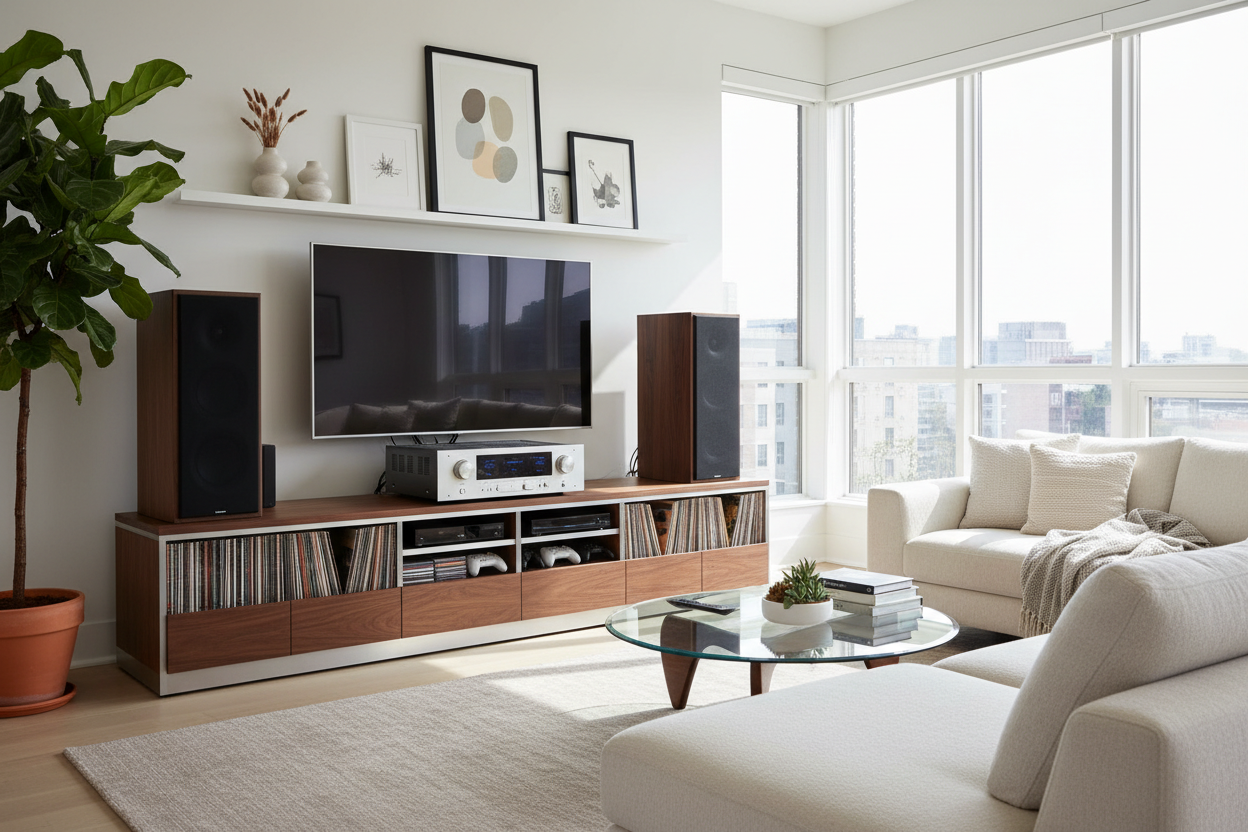
A good audio cabinet for a full-size receiver needs a shelf at least 15 inches deep, an open or removable back for cables, and open air above and around the receiver. A typical AV receiver such as the Yamaha RX-V6A measures 17-1/8" W x 6-3/4" H x 14-7/8" D, and Yamaha asks for 11-3/4 inches of space above it and 7-7/8 inches at the sides and rear, so a closed cubby that is only just big enough is the wrong place for it.
Many TV stands and media consoles, including most in our own range, have shelves 14 to 15 inches deep, which fits the chassis of many receivers but leaves no room for plugs unless the back is open. This guide covers sizes, ventilation, turntables, cables and records, then compares four media consoles from the FUFU&GAGA TV stands collection that work as a stereo stand.
Key takeaways
- Depth: a 15-inch shelf holds a receiver like the 14-7/8-inch-deep Yamaha RX-V6A; plan an open or removable back panel so cables can exit behind the unit.
- Height: measure the receiver, then add the top clearance in its manual. A 6-3/4-inch receiver in an 8-inch cubby will run hot.
- Air: open shelves or slatted doors beat solid doors. Never stack equipment directly on a receiver or amp.
- Turntable: on a level top surface, away from the speakers, on a heavy and stable cabinet.
- Records: stored upright, with dividers, on a shelf rated for the weight, and away from the receiver's heat.
What is an audio cabinet, and how is it different from a TV stand?
An audio cabinet, also called a stereo cabinet or stereo stand, is furniture built to hold a sound system: receiver or amplifier, turntable, streamer or CD player, and the wiring between them. Audio racks are usually open frames with adjustable shelves; living-room stereo cabinets look more like a media console, with open shelves, doors and drawers.
A TV stand can do the same job if its open shelves are deep and tall enough. Many consoles are designed for a slim streaming box and a soundbar, so their media cubbies may be only 7 or 8 inches tall. Before you choose, compare the shelf size in the specs with your equipment, not the overall size of the furniture: a 15.7-inch-deep console may have 14-inch shelves.
How deep should a stereo cabinet be for a receiver?
Measure your receiver's depth first, then add space behind it for the plugs. The RX-V6A and RX-V4A both measure 14-7/8 inches deep on Yamaha's spec page, and HDMI, speaker and power plugs stick out farther at the rear. On a 15-inch-deep shelf, that receiver sits flush with the front only if the cables can pass through an open back, a removable back panel or a large cutout.
So a TV stand deep enough for a receiver is about two numbers: shelf depth and what happens behind it. A 14-inch shelf leaves a receiver of that size sticking out about an inch. Larger home theater receivers and vintage amplifiers can be deeper still, so check your model's spec sheet before you order.
| Equipment | What to measure | Shelf to look for |
|---|---|---|
| Full-size AV receiver | Width, height, depth plus rear plugs; antennas if they stand up (9-5/8" tall on the RX-V6A) | 15" deep or more, open or removable back, generous height above the unit |
| Stereo integrated amplifier | Same as above, plus weight | Open shelf rated for the weight, no gear stacked on top |
| Turntable | Footprint with the dust cover open | Level top surface on a heavy, steady cabinet |
| Streamer, CD player, game console | Height and depth | 7 to 10 inches of shelf height is usually enough |
| 12-inch LPs | Jackets are about 12-3/8" square | Over 12-1/2" tall and about 13" deep inside, with dividers |
How much height and ventilation does a receiver need?
Receivers and amplifiers turn part of their power into heat, and they shed it through the vents on top. Yamaha's safety brochure for the RX-V4A, RX-V6A and related models says not to use the receiver in a confined, poorly ventilated location, not to block its cooling slits, and to leave at least 30 cm (11-3/4 in) on top, 20 cm (7-7/8 in) on the sides and 20 cm (7-7/8 in) on the rear (Yamaha safety brochure). Other brands publish their own figures, so follow the manual for your model.
Very few TV stands give that much space inside a cubby. A 6-3/4-inch receiver plus 11-3/4 inches above it needs about 18-1/2 inches of open height, more than most consoles offer. In practice you can get close by:
- putting the receiver on the tallest open shelf, not behind solid doors;
- using a cabinet with an open or removable back so warm air can escape;
- keeping other equipment, and heat sources such as an electric fireplace insert, off and away from the receiver;
- putting a full-size receiver on the top surface beside the TV when no shelf is tall enough.
Open shelves vs glass doors: which is better for audio equipment?
Open shelves and open audio racks are the safest home for a receiver or amplifier because air moves freely and the remote signal has a clear path. Slatted doors are a good middle ground: they hide the wiring and still let air reach the equipment.
Glass doors, including tempered glass doors, keep dust off a turntable or a record display and let an infrared remote work through clear glass. Without a vented back, though, a glass-front bay traps heat like any closed box, so use it for low-heat equipment such as a streamer or CD player and keep the receiver on an open shelf.
Where should a turntable go in an audio cabinet?
A turntable belongs on a level, solid surface, which usually means the top of the stereo cabinet. Audio-Technica's setup guide says to position the turntable on a level surface, adjust its feet until it sits level, and avoid placing it next to speakers so vibration and acoustic pressure don't reach it (Audio-Technica).
- Use a heavy, steady cabinet. Vibration control starts with the furniture: a light or wobbly stand shakes when someone walks past, and the needle can skip.
- Keep speakers off the same surface. Put them on stands or on the floor; if they must share the top, use isolation feet under the turntable.
- Offset the TV. Place the TV to one side and the turntable on the other, so the cabinet becomes a listening station rather than a pile of electronics.
How do you route cables in a stereo stand?
Look for cable holes or cutouts behind each open shelf, or a removable back panel; either beats threading a dozen wires through one two-inch grommet.
- Place the receiver first, then run speaker wire, HDMI and power to it.
- Keep power cords and signal cables in separate bundles where you can, which helps cut down on hum.
- Leave a loose loop behind each component so you can slide it forward without unplugging everything.
- Put the power strip inside a ventilated bay or behind the cabinet, never under the receiver.
How should you store records in an audio cabinet?
Store vinyl upright, never stacked flat. The Library of Congress recommends storing discs on edge, with sturdy, immovable dividers every 4 to 6 inches, and notes that grooved discs average more than 35 pounds per shelf-foot (Library of Congress). It also advises a cool room and distance from radiators and vents.
For an audio cabinet, that means a closed or open bay more than 12-1/2 inches tall and about 13 inches deep, on a shelf rated for the load. At that rate, a full 28-inch shelf of records weighs about 80 pounds or more, so check the weight capacity in the specs. Keep records in a different bay from the receiver, so they are not sitting in its warm air.
Buying checklist for a stereo cabinet
- Shelf depth: 15 inches or more for a full-size receiver, plus an open or removable back.
- Shelf height and width: the receiver's size plus the clearance in its manual, or as close as the furniture allows; full-size receivers are typically about 17 inches wide (17-1/8" on the RX-V6A). Adjustable shelves make this easier.
- Ventilation: open shelves or slatted doors for heat-producing equipment.
- Weight capacity: total of TV, receiver, turntable, speakers and records, below the cabinet's rating. Solid wood and thick engineered wood both work if shelves don't sag under the load.
- Cable management: cutouts or holes behind every shelf you plan to use.
- Turntable and records: a level, solid top, and upright record bays taller than 12-1/2 inches.
- Anti-tip: a tip-over restraint, especially for a tall unit or a home with kids.
- Finishes and colors: a finish that will match the room, whether that is walnut, natural wood, black or white.
Our picks: audio cabinets and stereo stands
All four consoles below have open or vented shelves that are 14 to 15 inches deep, per their specs. None is a closed audio rack, so plan on open shelves for the receiver.
100" Modern Gray Entertainment Center with Storage Cabinets and Open Shelves

This one-piece entertainment center gives a full sound system its own place: two open media shelves with cable management holes for the receiver and sources, plus four closed cabinets for records and accessories. Its 11.2-inch open shelves are the tallest of these picks and the most comfortable spot for a receiver.
- 78.1" H x 100" W x 15.7" D overall; TV opening 63" W x 39.4" H for TVs up to 65"
- Open media shelves 11.2" H x 28.5" W x 15" D
- Closed cabinets 23" H x 29" W x 15.7" D inside, tall enough for upright LPs
- 240 lb weight capacity; anti-tip feature built in
Best for: a receiver plus a record collection in one wall unit.
78.7" Mid-Century Walnut TV Stand With Slatted Doors, Open Shelves, And Cable Management

The horizontal slatted doors are the reason to pick this stand: they hide the wiring and still let air reach your media devices. Each cabinet bay is 15.8 inches tall, which leaves room above a compact amplifier, and the long top is a stable place for a turntable on one side and the TV on the other.
- 18.8" H x 78.7" W x 15.7" D; 97 lb, solid and manufactured wood (MDF), walnut finish
- Two cabinets 15.8" H x 30.3" W x 14" D inside; open shelves 7" H x 30.3" W x 14" D
- Built-in cable management holes; 120 lb weight capacity
- Tip-over restraint not included
At 14 inches deep, the bays suit compact stereo equipment best; a 14-7/8-inch receiver would stick out slightly.
Best for: a turntable setup with a compact amp or streamer behind vented doors.
133.9" Modern White/Black TV Console Cabinet with Adjustable Length, Drawers and Legs

This long, low console extends from about 95 to 133.9 inches, enough for a TV, a turntable and speakers in one line. Its removable back panel is what makes it work for a receiver: plugs exit behind the 15-inch shelf and warm air has a way out.
- 13.1" H x 133.9" W (fully extended) x 15.7" D; 3.1" legs
- Open shelves 10" H x 23.5" W x 15" D, adjustable interior shelves and four drawers
- Cable management, sound bar shelf, removable back panel
- 120 lb weight capacity; TVs up to 78"; white or black; tip-over restraint not included
Best for: a long wall where you want easy access to the back of the equipment.
70" Symmetric Natural Wood L-Shaped TV Stand Media Console with Gold Trim
A smaller stand with a 25.7-inch open center shelf and a cable hole for a streamer, slim amplifier or game console, plus two side cabinets with interior shelves. It has the highest weight rating of these picks.
- 18.3" H x 70" W x 15.1" D; natural woodgrain with gold trim and fluted detailing
- Open center shelf 8.4" H x 25.7" W x 15" D; side cabinets 18" H x 15" D inside
- Center drawer on full-extension metal glides; 300 lb weight capacity; TVs up to 75"
- Tip-over restraint not included
The 8.4-inch center shelf is too tight for a full-size receiver; use it for low-profile equipment.
Best for: a compact stereo system in a living room or bedroom.
Picks at a glance
| Product | Size (W x D x H) | Open shelf for equipment | Best for |
|---|---|---|---|
| 100" entertainment center | 100" x 15.7" x 78.1" | 11.2" H x 28.5" W x 15" D | Receiver plus records |
| 78.7" slatted walnut stand | 78.7" x 15.7" x 18.8" | Vented bays 15.8" H x 14" D | Turntable and compact amp |
| Adjustable-length console | Up to 133.9" x 15.7" x 13.1" | 10" H x 23.5" W x 15" D, removable back | Long wall, easy rear access |
| 70" symmetric stand | 70" x 15.1" x 18.3" | 8.4" H x 25.7" W x 15" D | Compact system |
For a taller wall unit with more extra shelves, see our entertainment center and wall unit buying guide, or browse every size in the TV stands and stereo stands collection. FUFU&GAGA ships free to the 48 contiguous states, with 35-day returns on unused, unassembled items.
FAQ
Can you put a stereo receiver in a cabinet?
Yes, if it has room to breathe. Use an open or slatted bay rather than a closed box, keep nothing on top of the receiver, and give it as much of the clearance in its manual as you can. Yamaha, for example, asks for 11-3/4 inches above and 7-7/8 inches at the sides and rear of its RX-V6A.
How deep should a TV stand be for a receiver?
Look for shelves at least 15 inches deep. A receiver like Yamaha's RX-V6A is 14-7/8 inches deep before you add plugs, so the stand also needs an open back, cable cutouts or a removable back panel. A 14-inch shelf suits compact amplifiers, streamers and players.
What is the best way to store audio equipment?
Give each component its own shelf, with the receiver or amplifier on the most open one. Route cables through cutouts, and keep records and the turntable away from heat and speaker vibration.
What is the best material for an audio stand?
Solid wood or thick engineered wood on a stable base both work. What matters more is a weight rating above your total load, shelves that don't sag under a heavy amplifier, and a frame steady enough that a turntable on top doesn't skip when someone walks by.


Leave a comment
This site is protected by hCaptcha and the hCaptcha Privacy Policy and Terms of Service apply.