










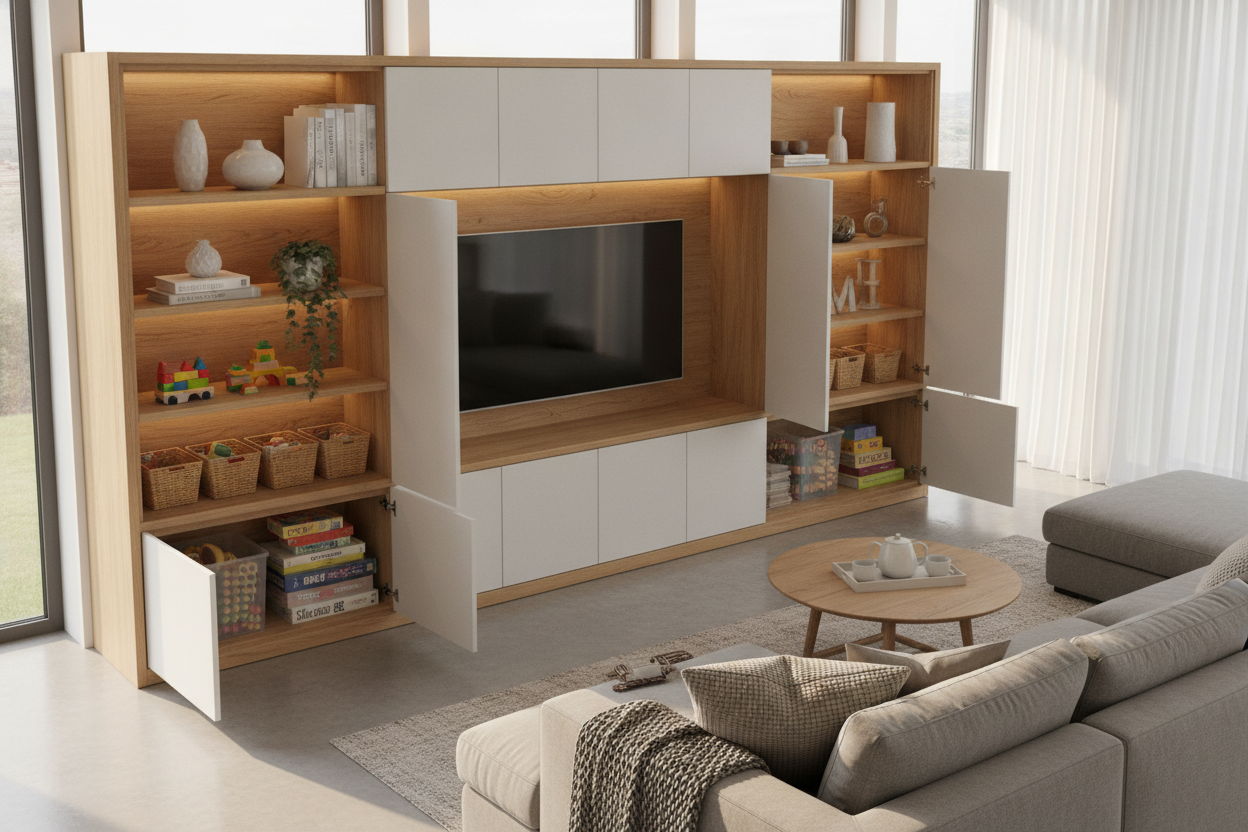
I spent three years staring at a pile of tangled Nintendo Switch cords and a half-finished Lego police station that lived permanently under my television. Every time I sat down to watch a movie after the kids went to bed, I wasn't looking at the screen; I was looking at the visual noise of a family of four living in a space designed for a minimalist bachelor. I finally hit my breaking point and realized I needed a massive tv entertainment storage unit to swallow the chaos whole.
The transition from a 'sleek' console to a full-blown media wall wasn't just a furniture upgrade—it was a mental health intervention. If you are currently tripping over board games while trying to reach the remote, this is for you.
Quick Takeaways
- Open shelving is a lie for anyone with children or hobbies.
- Deep lower cabinets (at least 15-18 inches) are mandatory for board game boxes.
- Cord management isn't a luxury; it's the difference between a 'look' and a mess.
- Go for a unit with a mix of closed doors and a few open top shelves for personality.
The Problem With 'Minimalist' Media Consoles in a Family Home
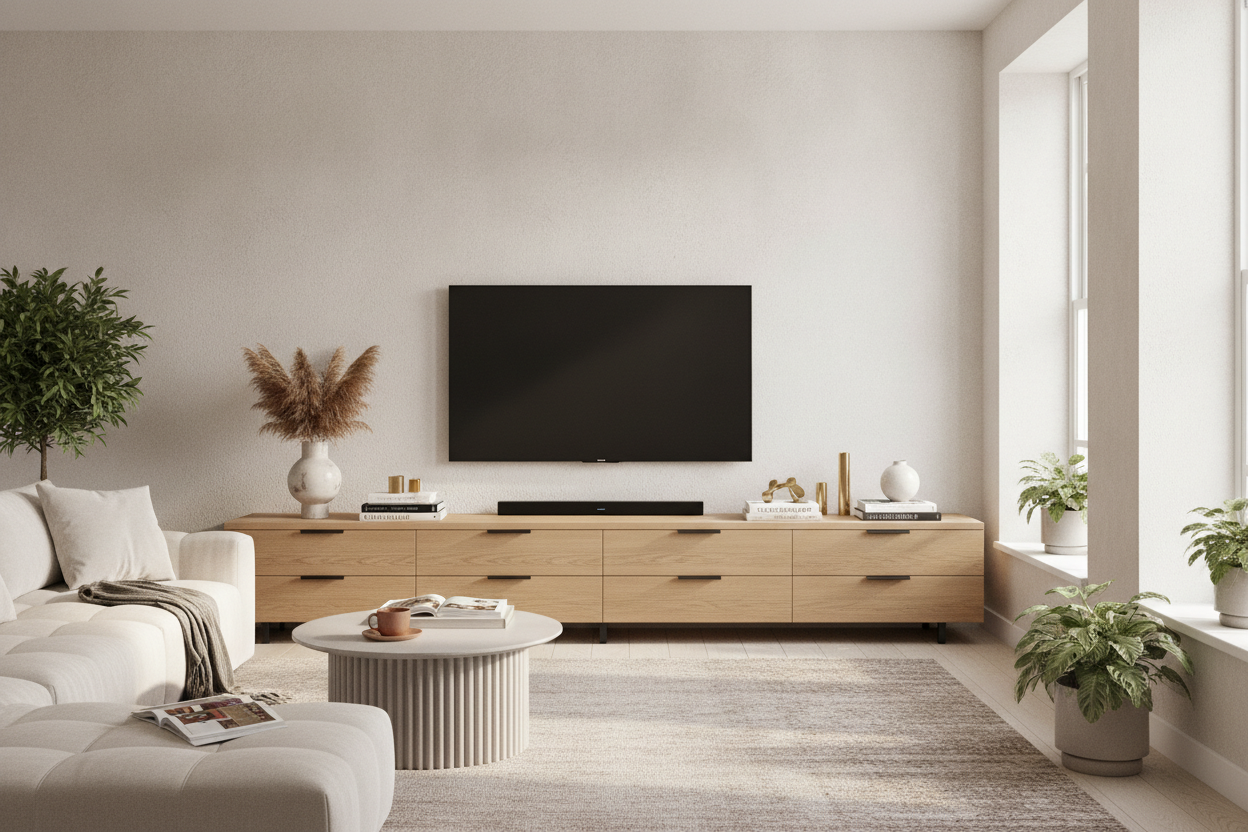
I fell for the trend. I bought a stylish black tv stand that looked incredible in the staged showroom. It was low-profile, had those thin mid-century legs, and exactly zero places to hide a plastic bin of Hot Wheels. In a showroom, that stand holds one beautiful ceramic vase and a single, wireless speaker. In my house, it became a dust-gathering platform for stray socks and half-empty juice boxes.
Minimalist furniture works when you have nothing to minimize. But when you have a 6-year-old, 'minimalism' just means 'nowhere to put the stuff.' I realized that by trying to keep the room feeling 'airy,' I was actually making it look cluttered because every single item we owned was on full display. Those open shelves are basically a high-visibility display case for your failures as an organizer.
Why a TV Entertainment Storage Unit Was the Only Fix
I eventually stopped fighting the 'big furniture' fear and bought a massive entertainment center with storage cabinets. I’m talking about a piece that actually anchors the wall, rather than just floating awkwardly in the middle of it. It’s a 100-inch beast with solid doors on the bottom and adjustable shelving inside.
The shift was immediate. Suddenly, the TV wasn't just a black rectangle on a wall; it was part of a cohesive design. A substantial entertainment storage unit gives the room a focal point that feels intentional. It’s the difference between a college dorm setup and a grown-up living room. Plus, the sheer weight of it means I don't have to worry about the TV wobbling when the kids start wrestling nearby.
What Makes an Entertainment Unit With Storage Actually Useful?
Don't just buy the first big box you see. You need opaque doors—glass doors are just windows into your mess. Look for units with adjustable interior shelving because board game boxes are never a standard size. And for the love of your sanity, check for pre-drilled cord management holes in every single compartment, not just the middle one. If you have to break out the power drill to run a power strip, the designers failed you.
The Art of Hiding Non-TV Things (Like Toys and Board Games)
The secret to my sanity is that the bottom 24 inches of my media wall have absolutely nothing to do with media. I’ve repurposed those cabinets to be a stealthy toy box. One side is for the 'loud' toys, the other is for the board games we actually play. By using dedicated storage furniture that looks like a high-end built-in, I’ve reclaimed the adult aesthetic of my living room.
At 8:00 PM, we do a 'sweep.' Everything goes behind the doors. The doors close with a satisfying magnetic click, and suddenly, I’m in a room that looks like adults live there. You wouldn't believe how much stress melts away when you aren't staring at a bright yellow Tonka truck while trying to enjoy a glass of wine.
Making the Most of Your Entertainment Storage Space
Inside the cabinets, don't just throw things in loose. Use clear acrylic bins for controllers and cables, and felt baskets for the toys. This prevents the 'avalanche effect' where you open the door and a mountain of Paw Patrol characters spills onto your feet. I also use a label maker on the inside of the door so the kids (theoretically) know where their stuff goes.
How to Keep a Massive Wall Unit From Feeling Heavy
The biggest hesitation people have is that a large unit will swallow the room. To avoid the 1990s 'oak monster' look, I chose a unit with a lighter wood finish and kept the top third of the unit open. By leaving some negative space or using the top shelves for a few curated books and a trailing Pothos plant, the piece feels like part of the architecture rather than a bulky intruder.
If you're worried about the visual weight, listen to what designers actually think about these units: they often suggest painting the wall behind the unit a similar shade to make it recede. I didn't go that far, but choosing a unit with some 'legs' or a recessed base can also help keep the floor line visible, which tricks the eye into thinking the room is larger than it is.
FAQ
Will a 100-inch unit make my small living room look smaller?
Counter-intuitively, no. One large, organized piece often makes a room look bigger and cleaner than five small, cluttered pieces of furniture scattered around.
Is assembly a nightmare on these large units?
If it's flat-packed, yes, it's a two-person job and will take about three hours. Buy the 'expert assembly' if you value your weekend. If it's solid wood, it usually ships in two or three large pieces that just bolt together.
How do I stop the electronics from overheating inside closed cabinets?
Check for ventilation gaps or 'breathable' back panels. If your unit is tight, I recommend a cheap USB-powered cooling fan that you can mount to the back to pull hot air out of the cabinet.

Leave a comment
This site is protected by hCaptcha and the hCaptcha Privacy Policy and Terms of Service apply.