










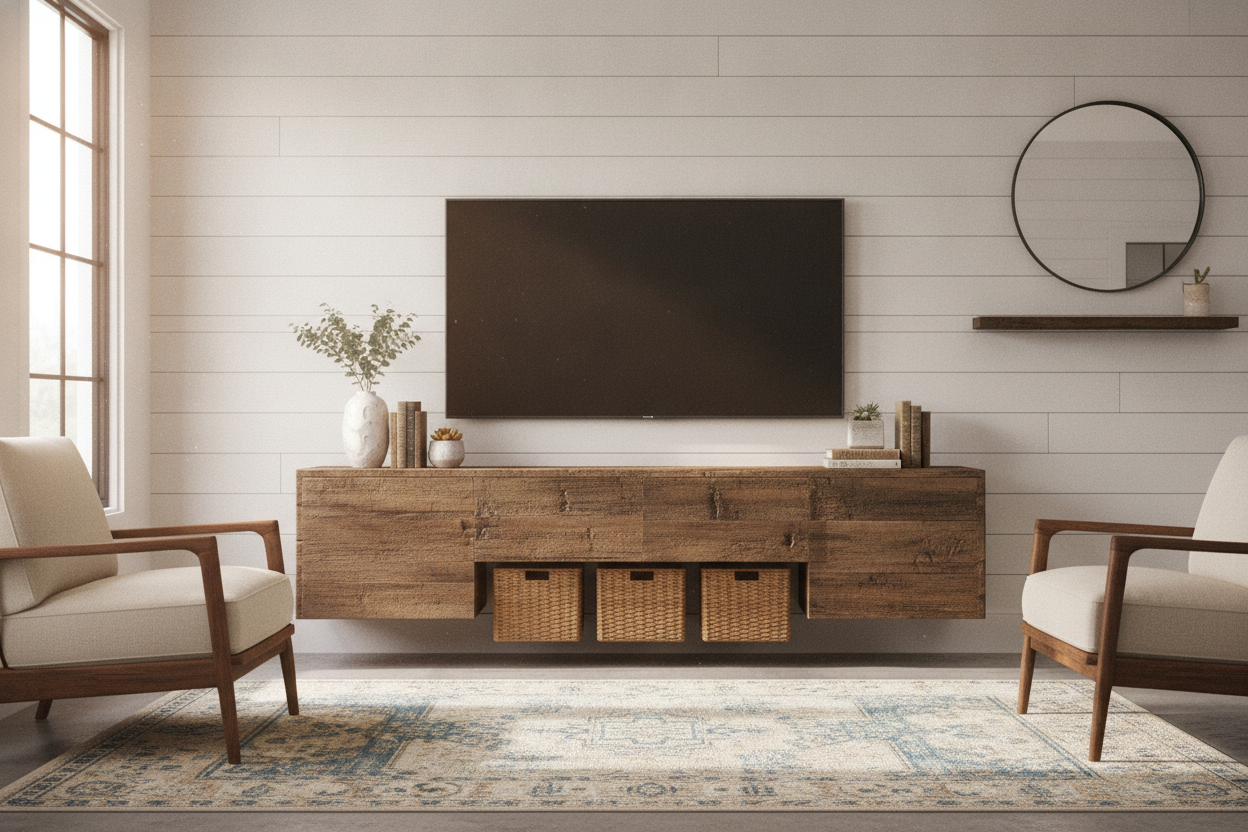
I spent three hours staring at my stud finder like it was a Geiger counter. The box for my new modern farmhouse floating tv stand was sitting in the hallway, weighing roughly as much as a small pony, and I was convinced my drywall would simply crumble the second I let go of the drill. We have all been there—staring at a beautiful piece of furniture online, hitting 'buy,' and then realizing that mounting 70 pounds of solid wood to a vertical surface is actually a terrifying engineering project.
- Studs are non-negotiable for any unit over 40 pounds.
- Throw away the cheap plastic anchors that come in the box immediately.
- Aim for a mounting height that keeps the center of your TV at eye level.
- Cable management is the difference between a 'designer' look and a mess of black spaghetti.
The Terrifying Reality of Hanging Heavy Furniture
Let’s be real: most floating furniture is designed for the 'minimalist' look, which usually means lightweight materials. But when you read about floating rustic TV stands, you realize the appeal is exactly the opposite. You want that chunky, lived-in feel, but that weight has to go somewhere. If you are mounting a farmhouse floating tv console, you aren't just hanging a picture frame; you are hanging a structural element.
Drywall is essentially just chalk sandwiched between paper. It is great for insulation and privacy, but it is terrible at holding up heavy objects. The anxiety you feel is your survival instinct telling you that gravity is a real thing.
Why I Chose a Farmhouse Floating TV Console Anyway
I live in a space where every square inch of floor is precious. When I looked at traditional floor-standing Tv Stands, they felt like anchors. They cut the room in half and made my 12-foot living room feel like a closet. Lifting that weight off the floor changes the entire energy of the room.
By choosing a floating farmhouse entertainment center, I gained back those few inches of floor visibility. It makes the room feel twice as large. Plus, my robot vacuum can actually clean under the TV now, which is a small victory I celebrate every single Tuesday morning.
The Physics of a Farmhouse Rustic Wood Floating TV Stand
A standard farmhouse rustic wood floating tv stand is usually made of solid pine, reclaimed wood, or high-density MDF with a thick veneer. These materials are dense. A 60-inch unit can easily weigh 60 to 80 pounds before you even put a TV on top of it. Most drywall anchors are rated for 'shear' weight (pulling down), but they fail at 'tension' (pulling out from the wall).
You absolutely must locate your studs. In most modern homes, these are 16 inches apart. If your console doesn't line up perfectly with your studs, you may need to mount a 'cleat' or a piece of plywood to the studs first, then mount the console to that. It sounds like extra work because it is, but it beats a hole in your floor and a broken TV.
Toggle Bolts vs. Studs: Don't Risk It
If you absolutely cannot hit a stud on both ends of the unit, do not use those little plastic ribbed anchors. They will pull out. Use 1/4-inch toggle bolts (the ones with the metal wings). They grip the back of the drywall and distribute the weight. However, for a farmhouse unit, at least 75% of your screws should be buried two inches deep into a wooden stud.
Getting the Height Right for a Floating Farmhouse Entertainment Center
The biggest mistake people make is mounting their floating console way too high. You aren't a sports bar. You want the bottom of the unit to be about 10 to 12 inches off the floor. This leaves enough room for your baseboards and cleaning, but keeps the TV at a comfortable viewing height.
Sit on your sofa and look at the wall. Your eyes should naturally hit the middle of the TV screen. If you're tilting your head back, you've gone too high. A floating unit that is too high looks like it is trying to escape the room.
Cable Management When You Don't Have Legs to Hide Behind
The 'floating' magic is instantly ruined the second a cluster of black HDMI cables starts dangling toward the outlet. Since you don't have legs to hide behind, you have two choices: go behind the wall or use a cord cover. I prefer the paintable plastic raceways that stick to the wall—they are cheap and disappear if you match your wall paint.
If you are trying to carry this look through the rest of the house, consider how a farmhouse beige 3 drawer nightstand might complement the wood tones in an adjacent bedroom. Keeping the rustic wood and beige palette consistent makes the whole 'floating' experiment feel like a deliberate design choice rather than a random DIY project.
FAQ
Can I mount a floating TV stand on metal studs?
Yes, but you need specialized 'snap toggles.' Standard wood screws won't grip the thin metal of a commercial-grade stud. If you're in a modern high-rise, check your stud type first.
How much weight can a floating TV stand actually hold?
If mounted into at least two studs with 3-inch lag bolts, most units can safely hold 100-150 pounds. Always check the manufacturer's specific rating, as the cabinet joints themselves might be the weak point.
Do I need a second person to help?
100% yes. One person needs to hold the unit level while the other marks the holes. Doing this solo is a recipe for a crooked console and a very frustrated afternoon.

Leave a comment
This site is protected by hCaptcha and the hCaptcha Privacy Policy and Terms of Service apply.