










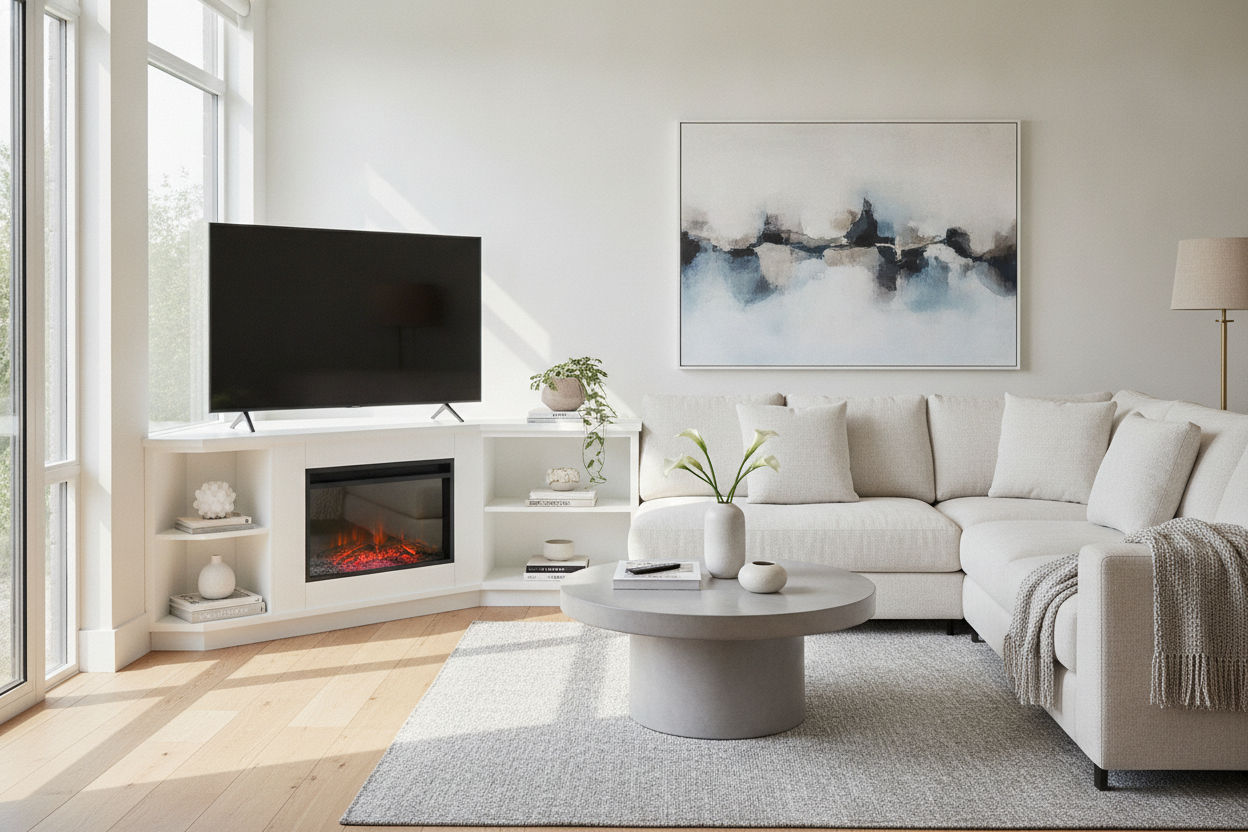
I once lived in a 1920s apartment where the living room had six openings: two doors, three windows, and a radiator that hissed like a caffeinated cat. I spent three months moving my sofa like a Tetris block, only to realize my TV was basically blocking a fire exit. It was a mess. I finally stopped trying to fight the architecture and bought a white corner tv stand fireplace. It was the only way to make the room feel like a home instead of a transit hub.
Quick Takeaways
- Corner units reclaim 'dead' square footage that usually goes to waste.
- White finishes prevent the 'heavy furniture' look in tight, window-heavy rooms.
- Integrated heaters provide supplemental warmth without the footprint of a space heater.
- A corner hearth creates a focal point in rooms that lack a natural center.
The 'Dead Corner' Dilemma (And Why Standard Consoles Fail)
Most standard TV stands assume you have a long, uninterrupted wall. They are built for big suburban basements or modern open-concept lofts. But if you live in a place with a radiator or a window every four feet, those flat consoles are your enemy. They stick out into the walking path, or worse, they sit at a weird 45-degree angle with a massive, dusty triangle of wasted space behind them.
Trying to force a flat unit into a corner makes the room feel cramped and unfinished. I’ve seen people try to DIY it with floating shelves, but unless you’re a master carpenter, it usually looks like a temporary fix. A dedicated corner unit is built with a clipped back that sits flush against both walls. It stops the 'furniture drift' that happens when your layout doesn't quite make sense.
Why This Specific Furniture Combo Fixes the Vibe
So why go with white? In a tight corner, dark wood is a black hole. It absorbs what little natural light you have and makes the ceiling feel lower. By using a corner TV stand in white, you are essentially pushing the visual boundaries of the room back. It blends into the baseboards and keeps the corner from feeling heavy.
Then there is the fireplace element. A white corner tv stand with fireplace isn't just a media console; it’s a piece of faux-architecture. Most awkward rooms feel awkward because they don't have a 'soul'—there is no fireplace to gather around. Adding a hearth, even an electric one, gives the room a purpose. It tells your eyes exactly where to land when you walk in.
Does a Faux Flame Look Weird Tucked in a Corner?
I used to be a total fireplace snob. I thought if it didn't involve chopping wood, it wasn't real. I was wrong. A white corner electric fireplace tv stand provides a specific kind of ambient light that a floor lamp just cannot mimic. When it’s tucked into a corner, the glow reflects off two walls instead of one, creating a cozy, immersive nook.
I’ve written before about how TV stand with fireplace white setups actually look high-end if you choose the right model. You want an insert with a realistic log set and adjustable brightness. Modern LED flames have come a long way from the 'spinning orange ribbon' look of the 90s. In a corner, the depth of the unit actually helps the 3D effect of the flames, making it look more like a recessed masonry hearth.
The 3 Measurements You Cannot Ignore Before Buying
Before you hit 'buy,' grab a tape measure. First, measure the wall depth from the corner out to the nearest obstacle (like a window frame or door casing). If your stand is 24 inches deep but you only have 20 inches of wall before a window starts, the unit will overlap the glass and look like a mistake. I’ve made this blunder, and looking at a 4-inch gap of particle board through my window for a year was soul-crushing.
Second, check the TV overhang. A 65-inch TV on a 48-inch stand looks top-heavy and precarious. You want at least 2-3 inches of mantel on either side of the TV base. Third, check your outlet placement. These units draw a lot of power for the heater. You don't want to run an ugly orange extension cord across your floor. Ideally, your outlet is directly behind the unit. If you’re looking for a specific insert size, a 30 inch electronic fireplace is usually the gold standard for corner units—it’s big enough to be impactful but small enough to leave room for storage cabinets.
Personal Experience: My MDF Mistake
I once bought a cheap, unbranded corner unit that used 15mm particle board. Within six months, the weight of my (admittedly heavy) old plasma TV caused the top mantel to bow. It looked like a Pringles chip. If you're buying a white unit, look for at least 18mm thickness or, better yet, a solid wood or high-grade MDF frame. It costs more upfront, but it won't sag when you add a soundbar and a stack of books.
FAQ
Does the heater actually work?
Most units are rated for 4,600 BTUs, which can heat a 400-square-foot room comfortably. It’s perfect for taking the chill off a basement or a drafty rental without turning up the whole-house thermostat.
Is a white finish hard to keep clean?
Actually, white shows less dust than black or espresso finishes. A quick wipe with a damp microfiber cloth once a week keeps it looking sharp. Just avoid direct sunlight if it isn't UV-coated, as some cheap lacquers can yellow over five or ten years.
Can I put a real TV on it or is it just for looks?
They are specifically engineered for TVs. Just check the weight capacity—most top out around 75 to 100 lbs, which is plenty for a modern LED screen.

Leave a comment
This site is protected by hCaptcha and the hCaptcha Privacy Policy and Terms of Service apply.