










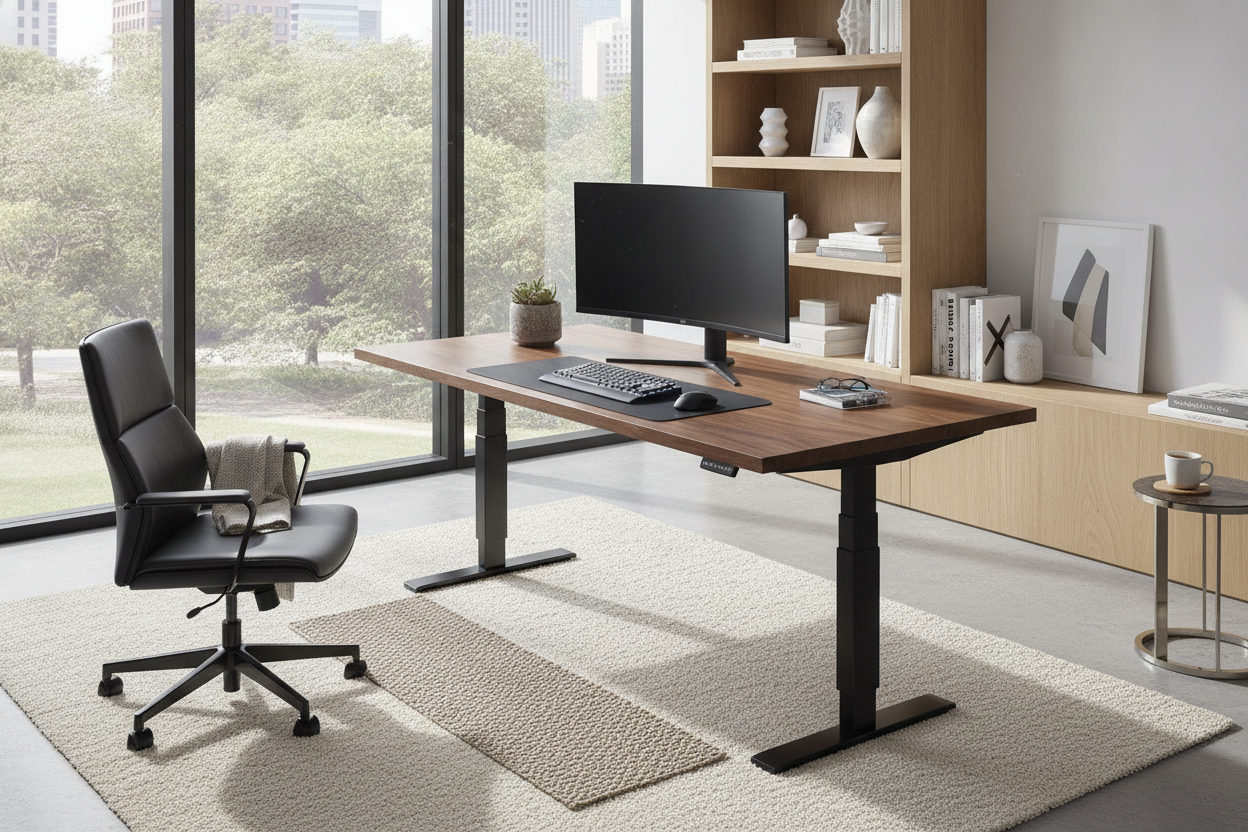
I remember being mid-sentence on a high-stakes Zoom call with my VP when my cat jumped onto my desk. My dual-monitor setup started oscillating like a bobblehead convention, and for a second, it looked like I was broadcasting from the epicenter of a minor earthquake. It was the moment I realized that my career had outgrown my furniture. My $200 'startup special' standing frame was fine when I was just a freelancer with a laptop, but as a senior lead with a heavy-duty workstation, it was literally buckling under the pressure.
Upgrading to a heavy-duty electric height adjustable executive desk isn't just about showing off; it's about physics. When you spend eight hours a day at a station, you notice every micro-wobble and every millimeter of sag. I finally ditched the flimsy laminate for something with actual mass, and the difference in my daily focus was immediate.
Quick Takeaways
- Stability is king: Executive models use thicker steel and dual motors to eliminate the 'monitor shake.'
- Depth matters: Look for at least 30 inches of depth to keep your eyes from straining against large screens.
- Weight capacity: These desks can often lift 300+ lbs without sounding like a dying blender.
- Assembly is a two-person job: Do not attempt to flip a 150-pound desktop by yourself.
The Wobbly Reality of Standard Standing Desks
Most entry-level standing desks are basically just a thin piece of particle board sitting on two telescopic straws. They’re fine if you’re using a 13-inch MacBook and a latte, but the second you add a dual-monitor arm or a heavy desktop tower, the center of gravity shifts. Every time I typed with any sort of vigor, my screens would shimmy. It’s a subtle distraction that wears you down by 3 PM.
When you compare these to a standard writing computer desk, the lack of a crossbar or a heavy top becomes painfully obvious. The 'earthquake effect' isn't just annoying; it’s a sign that your motor is straining. If your desk is vibrating while it moves, it’s only a matter of time before that single, overworked motor gives up the ghost and leaves your workspace stuck at an awkward 38-inch height forever.
What Makes a Desk 'Executive' Anyway?
In the world of office furniture, 'executive' usually implies two things: scale and substance. An adjustable height executive office desk isn't just a bigger version of a budget desk. It usually features dual motors—one in each leg—which allows for a much smoother, quieter lift. You aren't listening to a mechanical screech every time you want to stand up; it's more of a sophisticated hum.
These desks also tend to include integrated cable management and modesty panels that actually hide the 'spaghetti' of wires hanging from your PC. For instance, an electric height adjustable desk with dual storage provides the structural integrity of a traditional desk with the modern necessity of movement. You get thick, 1-inch (or more) tops that won't bow in the middle after six months of holding up your ultrawide monitor.
The Ergonomics of a Massive Workspace
We talk a lot about height, but we don't talk enough about depth. Most cheap desks are 24 inches deep. That puts your 27-inch monitors way too close to your face. An executive-tier desk usually bumps that depth to 30 or 36 inches. This extra breathing room allows you to push your screens back, resting your forearms fully on the desk surface rather than dangling your elbows in the air.
I see so many people upgrade their gear only to find their adjustable height office desk is set to the wrong height because they're trying to compensate for a cramped surface. Having a wider, deeper footprint means you can actually spread out your notebooks, your tablet, and your coffee without feeling like you're working on an airplane tray table. It changes your posture because you aren't subconsciously pulling your shoulders in to fit into a tiny 'work zone.'
The Unspoken Reality of Assembly and Delivery
Let's be real: shipping an executive desk is an event. This isn't a flat-pack box that the mail carrier is going to gently lean against your door. This is a freight delivery. My desk arrived on a wooden pallet, and the desktop alone weighed nearly 90 pounds. If you live in a third-floor walk-up, start bribing your strongest friends now.
The assembly is straightforward—usually just bolting the legs to the frame—but the 'flip' is where things get dangerous. You build these desks upside down. Once those heavy-duty legs are attached, you have a 150-pound awkward rectangle that needs to be rotated. Do not be a hero. If you try to flip it alone, you’ll likely snap a leg bracket or, worse, put a hole in your drywall. Get a second person, grab the frame (not the top), and move in unison.
My Final Verdict: Who Should Make the Upgrade?
If you're still in the 'laptop and a dream' phase of your career, a basic frame is fine. But if you’ve reached the point where your home office is your primary cockpit, the investment pays for itself in sheer lack of frustration. There is a psychological shift that happens when you sit behind a piece of furniture that feels permanent. It commands a certain level of professional respect—even if you're wearing sweatpants under the desk.
For those ready to move past the wobbly entry-level stuff, a high-quality standing desk with electric lift system offers the reliability you need for a 40-plus hour work week. It’s about buying the last desk you’ll need for the next decade, rather than the cheapest one that gets you through the next year. My monitors haven't shaken once since I made the switch, and my Zoom calls have never looked more stable.
FAQ
Are dual motors really better than single motors?
Yes. Dual motors distribute the weight more evenly, run quieter, and generally last much longer because neither motor is being pushed to its absolute limit every time you hit the 'up' button.
Will an executive desk fit in a small bedroom?
Probably not. These have a larger footprint (usually 60-72 inches wide). Measure your floor space twice. If you're cramped, you might lose the ergonomic benefits because you'll be hitting walls or doors.
Do I need a special floor mat?
If you plan on standing for more than 20 minutes at a time, absolutely. A thick anti-fatigue mat is the mandatory partner to any high-end standing desk. Your knees will thank you by Thursday.

Leave a comment
This site is protected by hCaptcha and the hCaptcha Privacy Policy and Terms of Service apply.