





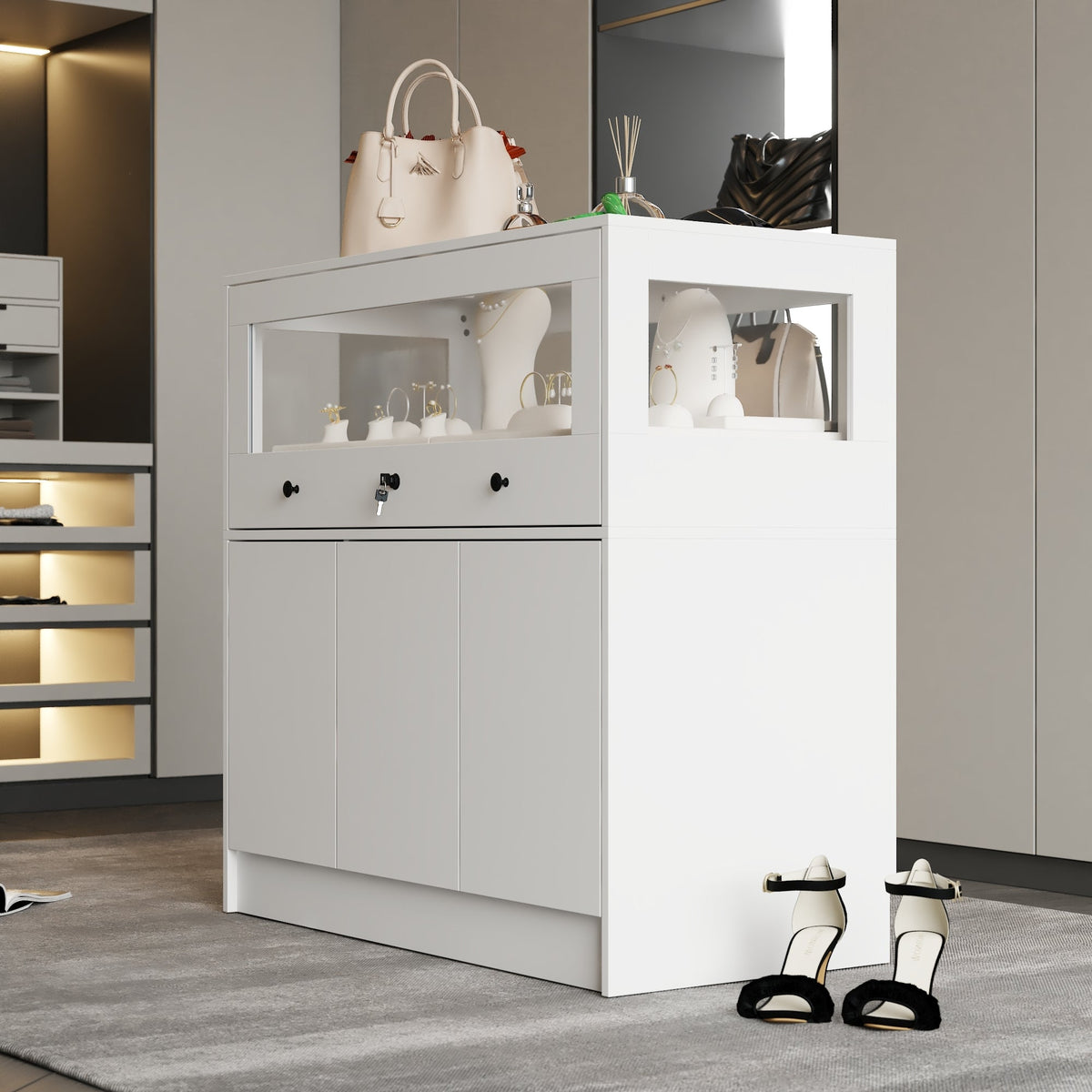
A jewelry display cabinet is a piece of furniture that shows rings, earrings, necklaces and watches under glass, so you can see and reach what you wear while the glass keeps dust and hands off it. For a home, the most practical design pairs a glass top or glass front with a drawer that locks and closed storage below. That lock keeps curious children and guests out, but a lock on a display cabinet is not a safe: glass can break, and the FDIC notes that even a home safe is not as secure as a bank safe deposit box. Keep everyday pieces on display and store high-value or irreplaceable pieces in a safe or a safe deposit box.
Placement matters as much as the cabinet: keep it out of direct sun and away from heat and damp. Below we cover glass, locks, light, trays, placement and anchoring, then look closely at the glass-top jewelry cabinet in our beauty and jewelry storage collection.
Key takeaways
- Display, not vault: a cabinet lock deters casual access. Pieces you could not replace belong in a safe or a bank box.
- Tempered glass is safer, not unbreakable: it is about four times stronger than ordinary glass and breaks into small pieces, but it still breaks.
- Light and heat: no window spot, no hot lamps. Opals, pearls, amethyst and kunzite are among the stones that react.
- Humidity: silver tarnishes faster in damp air. Skip the bathroom and keep silica gel and anti-tarnish cloth inside.
- Anchor it: a cabinet with drawers and doors should be strapped to the wall, even a waist-high one.
What is a jewelry display cabinet, and how is it different from a jewelry armoire?
A jewelry display cabinet puts jewelry on view, usually through a glass top, front or sides over a shallow display area with trays or stands. A jewelry armoire does the opposite: a tall, narrow cabinet that hides jewelry behind solid doors and drawers, often with necklace hooks and a mirror.
| Type | What it is | Suits | Watch out for |
|---|---|---|---|
| Glass-top display cabinet | Waist-high cabinet with a glass top or glass-fronted drawer, closed storage below | A dressing room or bedroom where you choose pieces each morning | Shallow display drawers; check interior height |
| Countertop glass showcase | A glass box that sits on a dresser or counter | A small collection, watches | Needs a sturdy surface; easy to carry off |
| Tall glass curio or vitrine | Upright cabinet with glass doors and shelves | Jewelry boxes, perfume bottles, larger pieces seen at eye level | Must be anchored; rings get lost on deep shelves |
| Jewelry armoire | Tall cabinet with solid doors, drawers, hooks and often a mirror | Large collections you want hidden | Nothing is on show; usually narrow and tall |
| Wall-mounted jewelry cabinet | Shallow cabinet on the wall, often behind a mirror door | Small rooms with no floor space | Very shallow; must go into studs or proper anchors |
If you mainly want glass shelves for ornaments, perfume bottles and boxed pieces, a tall lit cabinet may suit you better; our dust proof display cabinet guide explains what keeps dust out of glass-door cabinets and compares several.
Is a jewelry display cabinet with a lock secure enough for valuables?
For everyday pieces, yes. For pieces that are valuable or irreplaceable, no. A small cabinet lock stops a child, a guest or a visitor from opening the drawer. It is not built to resist someone determined to get in, and the glass that makes it a display cabinet can be broken.
The FDIC's consumer guide to safe deposit boxes, home safes and your valuables lists family keepsakes and valuable collections among the things to consider keeping in a safe deposit box, says home safes "are not as secure as safe deposit boxes," and points out that box contents are not covered by FDIC deposit insurance and that banks generally do not insure them either. It suggests asking your home or renter's insurance agent about coverage.
Insurance is the other half of the plan. The National Association of Insurance Commissioners' consumer guide to homeowners and renters insurance notes that policies have a maximum limit for the combined value of all your jewelry, that an endorsement can extend it, and that secure storage may affect your policy. It suggests asking about discounts for a home safe, an alarm system or a safe deposit box, and keeping photos and appraisals in your home inventory.
| Where to keep it | Good for | Limits |
|---|---|---|
| Locking display cabinet | Pieces you wear often, costume and fashion jewelry, watches in daily rotation | Deters casual access only; glass can break |
| Home safe | Valuables you need to reach quickly | The FDIC says less secure than a safe deposit box |
| Bank safe deposit box | Keepsakes and valuable pieces you rarely wear | Not FDIC insured; banks generally do not insure contents |
A simple rule: the display cabinet holds what you wear this season, and anything you would claim on insurance goes into the safe or bank box between wears.
Tempered glass: what it does and doesn't do
According to a technical note from AGC Glass Company North America on tempered glass breakage, fully tempered glass is four times stronger than annealed glass of the same type and thickness, and when it breaks it fractures into many small particles instead of long shards. The same note warns that it is a misconception to think tempered glass is unbreakable, and that glass damaged during handling, use or improper cleaning can break weeks or months later.
So choose tempered glass in a home with children or pets, and check that the listing for the exact model says "tempered." Don't count on it for security, and clean it gently with a soft cloth, no abrasive pads and nothing heavy dropped on the top.
Where should a jewelry display cabinet go? Sun, heat and humidity
Keep it out of direct sun and away from heat
A gemstone durability article in GIA's journal Gems and Gemology explains that some stones react to the heat a display case builds up from sunlight or lamps. Opals can dehydrate and crack, so they are best kept away from case lights and direct sunlight. Stones that fade easily, such as most kunzite, should not sit in sunny windows or brightly lit cases, and some amethyst fades under strong direct light over time. Pearls and opals should also be stored away from prolonged heat.
In practice: pick a wall out of direct sun, away from radiators, vents and fireplaces, and keep hot lamps off the glass top.
Keep it out of damp rooms
The Canadian Conservation Institute's guide to how silver tarnishes explains that tarnish forms when silver meets sulfur-containing gases in the air, that silver tarnishes faster as relative humidity climbs, and that it is best stored below 50 percent relative humidity. Its list of materials that give off those gases includes wool felt, rubber bands and some paints, and it warns that a sealed case may not protect silver if it is made from the wrong materials.
So skip the bathroom for silver. CCI's care note on silver suggests silica gel to keep humidity low and activated charcoal or a suitable commercial product to absorb tarnishing gases, and it says tarnish-inhibiting cloths can help, with cloths embedded with tiny silver particles working best. Don't over-dry everything, though: GIA's article notes that pearls and opals are subject to dehydration.
| Piece | Main risk in a display | What the sources advise |
|---|---|---|
| Silver | Tarnish from sulfur gases, faster in damp air | Below 50 percent humidity; silica gel, charcoal or anti-tarnish cloth (CCI) |
| Opals | Dehydration, cracking | Away from case lights, direct sun and prolonged heat; stored apart from other stones (GIA) |
| Pearls | Dehydration, abrasion, chemicals | Away from prolonged heat; a soft silk pouch rather than loose in a box (GIA) |
| Kunzite, some amethyst | Fading | Not in sunny windows or brightly lit cases; out of light when not worn (GIA) |
Should a jewelry display cabinet have lights?
Lights make jewelry sparkle, but they are optional, and for some stones less is better. GIA's article advises keeping opals away from case lights and fade-prone stones out of brightly lit cases. If you add lighting, use LEDs, keep them low or on a timer, and point them at the pieces you want to show rather than at everything at once. Our display cabinet lighting guide covers LED strips and pucks, battery versus plug-in power and color temperature.
The cabinet we cover below lists no built-in lights, so it relies on room light through the glass top; a lamp beside it, not on it, is often enough.
How to organize jewelry in a display drawer
- Measure the drawer before you buy trays. Interior height decides what fits. Flat ring and earring trays fit almost any drawer, but necklace busts and watch pillows need more height. Then check the floor area: a drawer 37 by 15.7 inches, like the one in our pick below, has about 580 square inches (37 x 15.7 = 580.9), so lay your trays out on paper at that size first.
- Give each piece its own slot. GIA's article recommends storing pearls in a soft silk pouch rather than loose in a jewelry box and keeping opals apart from other stones that could scratch them.
- Lay chains flat. A divided tray with long channels keeps necklaces from knotting; put daily pieces at the front.
- Check linings for silver. Wool felt is on CCI's list of materials that give off sulfur gases, so for silver choose a different lining or add an anti-tarnish cloth.
- Treat the glass top gently. Set things down on it softly and keep heavy or sharp-edged objects off it, since damaged tempered glass can fail later.
Anchoring and safety
The U.S. Consumer Product Safety Commission's Anchor It campaign says that anchoring all furniture with drawers, doors and shelves to the wall prevents tip-over injuries and deaths. A waist-high jewelry cabinet is low, but it has a drawer and doors, and a child may pull on it or climb it to see what's under the glass.
Not every piece comes with a kit, and Anchor It suggests checking whether yours did before you buy one. Its what you'll need page explains that a kit has brackets for the furniture and the wall joined by a strap of heavy nylon or braided steel, and that you should read the kit's specifications to make sure it holds more pounds than your furniture weighs. Our guide on how to anchor a bookcase to the wall walks through the same steps for a cabinet.
Jewelry display cabinet buying checklist
- Size: overall width, depth and height fit the wall, with room in front to pull the drawer out and stand at it.
- Display interior: drawer or case interior height clears your tallest tray, stand or watch box.
- Glass: the listing says tempered for that exact model.
- Lock: you know which part locks (drawer, door or both), and you have a plan for pieces that need more than a cabinet lock.
- Capacity: the drawer weight rating covers your trays and jewelry together.
- Light: built-in lights only if you want them, and none that heat the case.
- Placement: a wall away from sunny windows, vents and bathrooms.
- Anchoring: a tip-restraint kit included, or one bought separately and rated for more than the cabinet's weight.
Our pick: a glass-top jewelry display cabinet for home
One cabinet in our range is built for exactly this job: a waist-high cabinet with a glass display area, a locking drawer and closed storage below. Here is what its listing says, and who should look elsewhere.
39.4" Modern Minimalist White Jewelry Display Cabinet With Lock And Tempered Glass

This white cabinet measures 39.4" W x 19.7" D x 39.4" H, so the glass display area sits at about waist height, where you look down onto rings, earrings, necklaces and watches. The listing describes a clear tempered glass display area up top and a wide pull-out drawer that locks; the specs list one locking drawer. The drawer interior is 3.1" H x 37" W x 15.7" D, holds 11 lb, and runs on metal slides with a safety stop.
Below the drawer, a storage cabinet takes larger items such as handbags and boxes, with an interior 18.5" high and 16.4" deep and a 25.1" x 16.4" shelf. It is built from solid and manufactured wood (MDF) with a finished back, has black knobs, weighs 113.96 lb and needs a screwdriver for assembly. The listing also says it suits displaying merchandise in a boutique as well as home use.

Best for: a dressing room or bedroom where you want everyday jewelry on show under glass, with a locking drawer for rings and watches and hidden storage for bags below.
Skip it if: you want built-in lights (none are listed), you need tall busts or watch boxes inside the drawer (its interior is 3.1" high), or you want every compartment locked: the listing names the drawer lock but does not say the lower doors lock. Its tipover restraint field reads "No," so plan on a separate anchoring kit rated for more than 113.96 lb plus contents. Like any display cabinet lock, this one is not a substitute for a safe.
| Feature | As listed |
|---|---|
| Overall size (W x D x H) | 39.4" x 19.7" x 39.4" |
| Glass | Clear tempered glass display area up top |
| Lock | 1 locking drawer |
| Display drawer interior | 3.1" H x 37" W x 15.7" D, holds 11 lb, metal slides with safety stop |
| Lower cabinet | Interior 18.5" H x 16.4" D; shelf 25.1" W x 16.4" D |
| Lights | None listed |
| Material and finish | Solid and manufactured wood (MDF), glass; white with black knobs; finished back |
| Weight | 113.96 lb |
| Tip restraint included | No |
Keep any tray low enough to clear the 3.1" drawer interior. The listing calls for wiping the cabinet clean with a dry cloth. Since it arrives flat-packed, our flat-pack assembly guide is worth a look before you start.
FAQ
Is a jewelry display cabinet with a lock safe for expensive jewelry?
Not on its own. A cabinet lock deters casual access, but glass can break and the cabinet is furniture, not a safe. Keep everyday pieces on display, put valuable or irreplaceable pieces in a safe or bank box, and ask your insurer about jewelry limits.
What is the difference between a jewelry armoire and a jewelry display cabinet?
An armoire hides jewelry behind solid doors and drawers, usually in a tall, narrow cabinet with hooks and often a mirror. A display cabinet shows it under glass, so you can see pieces without opening anything. Choose an armoire for a large hidden collection and a display cabinet for pieces you pick from daily.
How do I keep silver jewelry from tarnishing in a display cabinet?
Keep the air dry, below 50 percent relative humidity in CCI's guidance, add silica gel and a tarnish-inhibiting cloth, and avoid wool felt linings.
Can I use a home jewelry display cabinet in a small shop?
The cabinet in this guide is listed for home use and for displaying merchandise in a boutique. Check that the lock covers what customers can reach, keep high-value stock in a safe after hours, and anchor it as you would at home.
Compare more jewelry and beauty storage in the FUFU&GAGA beauty and jewelry storage collection.

Leave a comment
This site is protected by hCaptcha and the hCaptcha Privacy Policy and Terms of Service apply.