





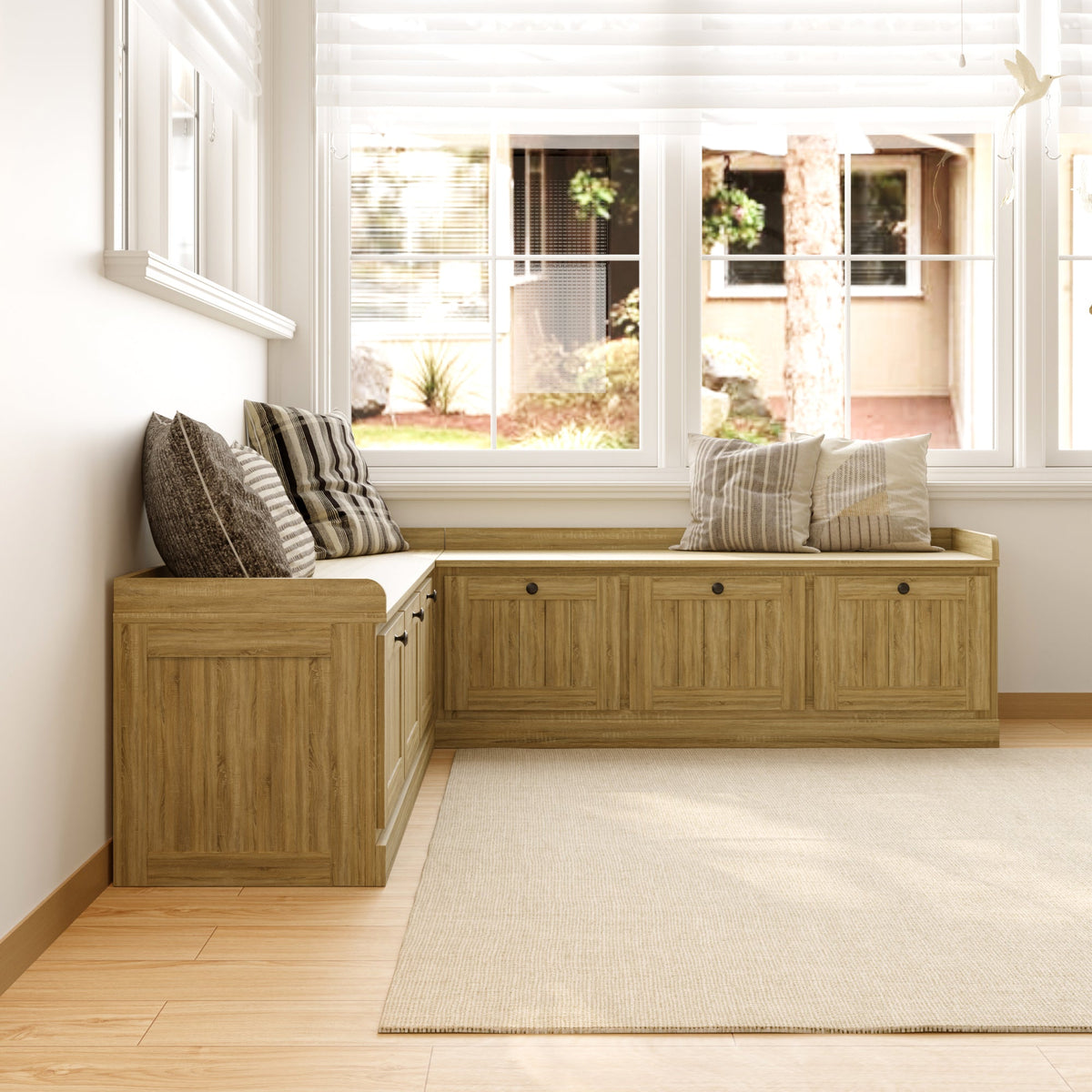
A corner storage bench is an L-shaped seat that runs along two walls where they meet, with storage under the seat: open cubbies, a lift-up lid or doors. It turns a dead corner into seating and shoe storage for an entryway, mudroom, breakfast nook or window corner. Before you buy, check three things: both arm lengths against both walls, a seat height of about 18 to 20 inches with a usable depth, and, on a lift-top bench, a lid that stays open by itself instead of dropping.
Below: how to measure a corner, how many people really fit, entryway versus dining nook use, what the U.S. Consumer Product Safety Commission says about storage bench lids, then two corner benches and two straight alternatives from the FUFU&GAGA shoe cabinet and storage bench collection.
Key takeaways
- Measure both walls from the corner to the first door trim, vent or radiator. Each arm must fit its wall.
- Seat height is typically 18 to 20 inches, cushion included; depth 15 to 20 inches.
- Count the front edge, not the arm lengths: the arms share a corner, so fewer people fit than the lengths suggest.
- Lift-top lids should stay open at any angle. The CPSC names storage benches among chests with lid hazards.
What is a corner storage bench?
It is two bench arms joined at a right angle, usually with a square section where they meet, and storage in the base. Most have no back: the walls do that job, and pillows soften them. The storage type decides how you use the bench every day.
| Storage type | How you reach it | Good for | Watch for |
|---|---|---|---|
| Open cubbies | From the front, even while seated | Everyday shoes by the door | Dust and visual clutter |
| Lift-top lid | Stand up, clear the seat, lift | Hidden shoes, seasonal items, a nook | Lid support, fingers, children climbing in |
| Doors (straight benches) | From the front | Hidden storage, nothing to lift | Floor space for the doors to swing |
How do you measure a corner for an L-shaped bench?
- Measure each wall from the corner to the first obstacle: door trim, a floor vent, a radiator, an outlet you need, or a window edge. These are the longest arms you can use.
- Measure low and at seat height. Baseboards push a bench out by their thickness, and a chair rail or deep sill can stick out at seat level.
- Check the corner is square. Mark 3 feet along one wall and 4 feet along the other; the diagonal between the marks should be 5 feet. If not, one arm will stand off the wall at its far end.
- Look up. A lift-up lid rises about as far as it is deep, so a low sill, plants or coat hooks above the seat can stop it opening.
- Tape it out on the floor and leave a path people can walk without turning sideways.
If your walls are unequal, a bench with unequal arms may fit better. Check which side the short arm can go on before ordering.
What seat height and depth should a corner bench have?
Dimensions.com states that "the height of a bench is typically between 18 and 20 inches (46-51 cm)" and that benches "can have a depth anywhere from 15-20 inches", with dining benches about 17.5 inches deep and deeper seats less comfortable for most people (Dimensions.com). This Old House, in its corner bench building guide, puts the depth "typically 12 to 18 inches" (This Old House).
Seat height is measured to the top of what you sit on. On a lift-top bench the lid is the seat, so overall height and seat height are about the same, and a cushion adds to it: a 2-inch cushion on a 17.7-inch bench gives 17.7 + 2 = 19.7 inches, still inside the 18 to 20 inch band.
For a dining nook, Hunker gives a bench height of "about 18 inches" and a table "approximately 30 inches tall", which leaves 30 - 18 = 12 inches between seat and tabletop. It adds that bench depth "should not exceed 20 inches" (Hunker). Shallow arms of 12 to 15 inches suit an entry, where the walkway matters; 17 to 20 inches suits a nook where people lean back on pillows, which take their own thickness off the seat.
How many people fit on a corner bench?
Fewer than the two arm lengths suggest, because knees collide at the corner. Hunker says place settings should be "a minimum of 24 inches wide, though 30 inches is ideal," and Dimensions.com says a 42 to 50 inch bench seats two. To estimate, take the front edge: arm A + arm B - 2 x seat depth. The examples assume a 17.5-inch depth; listings often leave depth out, so measure.
| Arms | Front edge at 17.5 in deep | Adults at 30 in | Adults at 24 in |
|---|---|---|---|
| 63 x 63 in | 63 + 63 - 35 = 91 in | 3 | 3 (91 / 24 = 3.8) |
| 63 x 47.2 in | 63 + 47.2 - 35 = 75.2 in | 2 (75.2 / 30 = 2.5) | 3 (75.2 / 24 = 3.1) |
One more person can perch in the corner square at an angle. So when a listing says a corner bench seats four or five, read it as a count for children, a squeeze, or a minute spent changing shoes, not a full adult dinner.
Entryway, dining nook or window corner?
Entryway and mudroom. By the door, access matters most. Open cubbies let you reach shoes while seated; a lift-top hides them, but you have to stand, move bags and cushions, and lift the lid each time. Wet boots belong on a tray, not inside a closed box. For door-swing and hallway arithmetic, see our 24 inch bench guide.
Breakfast or dining nook. An L-shaped bench seats people along two walls and leaves the open sides for chairs. Choose a pedestal or trestle table so no leg ends up in someone's knees at the corner. A lift-top suits a nook, since table linens or seasonal dishes inside are rarely needed.
Window corner. Check the sill against seat height plus cushion, and the lid clearance. If children use the room, the CPSC advises: "Keep furniture away from windows to discourage children from climbing near windows," and to "install window stops so that windows open no more than four inches" (CPSC). A bench under a window that opens is a step up to it.
Are lift-top storage bench lids safe?
A heavy hinged lid can drop on a child, and a closed box can trap one who climbs in. The CPSC's warning on chests names the types with these hazards: toy chests, cedar chests and boxes, and "hope chests, blanket chests, storage benches, and storage trunks" (CPSC). The advice was written with toy chests in mind, but it names storage benches, and the same logic applies to any lid that lifts. In the CPSC's words:
- "Storage and toy chest incidents have occurred when children climbed into chests to hide or sleep."
- "Other children were strangled while reaching for items in a chest and the lid fell onto them," with their necks caught between the walls of the chest and its lid.
- "If the lid support does not keep the lid open in every position, you should remove the lid’s support" or "replace it with a spring-loaded lid support that will keep the lid open in any position."
- For chests with an automatic latch or lock: "disable or remove the lock."
- And: "all toy chests should have ventilation holes that are not blocked by the floor or against the wall."

To apply it, lift the lid partway and let go. A lid that stays where you leave it has a working support; one that stays only when fully open, or leaning on a wall or window, does not, and a bump can bring it down. A lid should never latch itself shut. If the listing mentions no lid stay or slow-close hinge, assume there is none; you can fit a spring-loaded support rated for the lid's size and weight, or keep toys in open cubbies instead.
How many shoes fit in a corner shoe bench?
Use the listed pair count and compare it with the pairs your household wears in a week. Our two corner benches each list about 12 pairs; the straight benches below list at least 8 and about 6. Measure your tallest boots against the openings, and in a deep lift-top box use low bins so pairs do not pile up. For larger collections, our shoe cabinet buying guide sizes a cabinet from your pair count.
Cushions and pillows
A wood-look seat wipes clean by the door; a cushion makes a nook comfortable. On a lift-top, use a separate cushion for each lid so one arm opens without clearing the other. Pick ties or a non-slip backing, washable or water-resistant covers near the door, and remember that a cushion raises the seat toward the table and sill.
Is a corner bench stable, and does it need anchoring?
A corner bench is low and wide, not top-heavy like a hall tree. Both corner benches here are listed as freestanding, and neither listing includes a tip restraint. Stability comes from assembly: fit the arms tight into the corner, level them on uneven floors, and re-tighten connections after a few weeks. Do not stand on a lid to reach a curtain rod. Both corner benches are two-person builds; our flat-pack assembly guide covers sorting parts and checking square.
Can two straight benches make a corner?
Yes. Set one along the first wall and butt the second against its front edge along the second wall, which then needs the first bench's depth plus the second bench's width. With the straight picks below, the 35.8-inch bench takes one wall and the second wall needs 13.7 + 24 = 37.7 inches. The seats differ by 21.2 - 18.1 = 3.1 inches, but two benches fit corners that are not square and can be split up later.
Buying checklist
- Each wall, measured from the corner to the first obstacle, is at least as long as its arm.
- The corner passes the 3-4-5 test, or you have allowed for a gap.
- Seat height with cushion is about 18 to 20 inches; depth 12 to 15 inches for an entry, up to 20 for a nook.
- The front edge gives 24 to 30 inches per adult.
- A lift-top lid stays open at every angle, has no latch, and clears sills and hooks.
- The listed pair count covers the shoes worn each week, and your tallest pair fits.
Our picks: two corner benches and two straight alternatives
The two L-shaped benches come first; the straight benches suit a single wall, or a corner built from both. Sizes are W x D x H in inches, from the listings.
63" oak corner shoe storage bench with flip-top lid
Both arms are 63 inches, so it fills a square corner: 63" W x 63" D x 17.7" H. The seat lifts on metal hinges to hidden storage for about 12 pairs of shoes, plus leashes and seasonal accessories. The paneled fronts with knobs are decorative; storage opens from the top, and the photos show a lid on each arm with a fixed corner section. It is manufactured wood and metal with an oak wood-grain finish, weighs 118 lb, and is a two-person assembly with a screwdriver. The listing says it seats up to five, but it names no lid stay, weight capacity or seat depth.
Best for: a square corner with at least 63 inches of clear wall each way, such as a breakfast nook or window corner, where clutter should be out of sight.
Skip it if: young children use the room and you will not fit a lid support, you want to grab shoes while seated, you need a listed weight capacity, or either wall is shorter than 63 inches.
63" oak corner wooden bench with open storage compartments
This L has unequal arms, 63 inches and 47.2 inches, at a 17.7" seat height. Storage is open cubbies with no lid, holding about 12 pairs in view; the listed shelf is 22.7" W x 15" D. It is solid and manufactured wood in a medium oak tone, 76.2 lb, assembled by two people with a screwdriver. The listing says it seats up to four and also works as a breakfast bench.

Best for: an entry or mudroom corner where one wall is shorter and everyday shoes should be in reach while you sit.
Skip it if: you want shoes hidden and dust-free, need a listed weight capacity, or want two equal arms.
35.8" white shoe storage bench with cushion and 2 doors
A straight, low bench: 35.8" W x 13.7" D x 18.1" H, and 43 lb. Two doors open onto adjustable shelves for at least 8 pairs of shoes, under a thick padded cushion. With no lid, nothing has to be cleared to reach the shoes. It is solid and manufactured wood in white.

Best for: one wall of a corner, or a hallway where shoes stay behind doors.
Skip it if: you need a listed weight capacity or seat height (the listing gives neither), or there is no floor in front for the doors to swing.
24" shoe storage bench with upholstered pad
The smallest piece: 24" W x 12" D x 21.2" H, and 27.94 lb. Two open shelves hold about 6 pairs, and the padded PU leather seat lifts on a metal hinge to a hidden compartment for keys and umbrellas. It comes in white or brown, and one person can assemble it.
Best for: the short side of a corner next to a longer bench, or a narrow strip beside a door.
Skip it if: you need a listed weight capacity or seat height, store tall boots, or young children would use the hinged seat, since no lid stay is listed.
Compare the picks
| Pick | W x D x H (in) | Shape | Storage access | Shoes (listed) |
|---|---|---|---|---|
| Corner bench, flip-top lid | 63 x 63 x 17.7 | L, equal arms | Lift-up lid | About 12 pairs |
| Corner bench, open cubbies | 63 x 47.2 x 17.7 | L, unequal arms | Open cubbies | About 12 pairs |
| 35.8" bench with doors | 35.8 x 13.7 x 18.1 | Straight | 2 doors | At least 8 pairs |
| 24" bench with pad | 24 x 12 x 21.2 | Straight | Shelves, hinged seat | About 6 pairs |
If you also need coat hooks above the seat, our hall tree buying guide compares benches with hooks by wall width. To see every bench and shoe cabinet side by side, browse the FUFU&GAGA shoe cabinets collection.
FAQ
What size corner bench do I need?
Measure each wall from the corner to the first obstacle, such as door trim or a vent; each arm must fit its wall. Then check the front edge, arm A plus arm B minus twice the seat depth, against 24 to 30 inches per adult.
What is a good seat height for a corner bench?
About 18 to 20 inches from the floor to the top of the seat, cushion included. At a 30-inch dining table, an 18-inch seat leaves a 12-inch gap.
Are lift-top storage benches safe for kids?
Only with a lid that stays open at any angle and no latch. The CPSC lists storage benches among chests where children have been hurt by falling lids or trapped inside, and advises a spring-loaded lid support. Open cubbies or doors avoid the issue.
Can a corner storage bench work as a breakfast nook?
Yes. Pair it with a table about 30 inches high, ideally on a pedestal so no leg sits at the corner, and plan on 24 to 30 inches of seat edge per adult.

Leave a comment
This site is protected by hCaptcha and the hCaptcha Privacy Policy and Terms of Service apply.