










There is a distinct frustration that comes from placing a stunning mahogany executive desk into a room, only to realize the chair bumps the wall every time you try to stand up. This isn't a failure of style; it is a failure of spatial planning. Whether you are designing a corporate headquarters or a dedicated corner in your home, the difference between a cramped cubicle and a productive haven lies in the numbers. A precise office plan layout with dimension is the backbone of any successful interior project, ensuring that aesthetic choices are supported by ergonomic realities.
Quick Decision Guide: Critical Clearances
Before selecting furniture, memorize these non-negotiable measurements to ensure your office schematic functions correctly:
- Primary Circulation Paths: Allow at least 36 to 48 inches for main walkways. If two people need to pass each other comfortably, aim for 60 inches.
- Desk Chair Clearance: You need a minimum of 42 inches behind a desk to slide back and stand up without hitting a credenza or wall.
- Monitor Distance: Position screens 20 to 30 inches away from the user's eyes to reduce strain.
- Filing Cabinet Swing: Factor in the full depth of an open drawer (usually 18-24 inches) plus 30 inches for the person standing in front of it.
- Zone Spacing: In an open plan, keep quiet zones at least 6 to 8 feet away from high-traffic collaboration areas to manage acoustics.
The Blueprint: Moving Beyond the Sketch
Many clients come to me with a rough sketch, but an effective office space blueprint requires exactitude. When drafting your plan, you must account for the "negative space"—the empty air around the furniture. This is where the flow happens. For a standard office suite layout, we generally look at a grid system. By aligning the core heavy pieces (desks, storage towers) with the architectural grid (windows, columns), we create a sense of order and permanence.
Zoning the Office Lobby and Reception
First impressions are spatial. An office lobby floor plan should not just be a waiting area; it is a transition zone. The reception desk needs to command the room without blocking the flow. I typically specify a 42-inch high counter for transaction privacy, dropping to 30 inches for ADA accessibility. Ensure there is a 5-foot turning radius in front of the desk to accommodate all visitors comfortably.
Structuring the Work Zones
When looking at best office floor plans, the trend has shifted from rigid rows to organic clusters, but the math remains the same. In a small office building layout, every square inch counts. Here, I often recommend benching systems (shared long desks) which reduce the footprint per person to about 48 inches wide, compared to the traditional 72-inch private desk.
The Executive and Private Suites
For office suite floor plans, the focus shifts to hierarchy and privacy. A standard executive office usually requires a 12x15 foot footprint to comfortably house a bow-front desk, a credenza, and a small meeting table. If you are working with an office floor plan pdf or software, double-check that door swings do not intrude into the seating area of guest chairs.
Residential Integration: The Bedroom Office
The bedroom office floor plan presents unique challenges regarding visual noise. You do not want to stare at your work while trying to sleep. Here, dimensions are critical for separation. I advise using a console desk (typically 18-20 inches deep) rather than a full office desk. Position it so the sightline from the bed does not land directly on the computer screen. If space allows, a 30-inch clearance between the foot of the bed and the desk chair is tight but manageable in urban apartments.
Materiality and Visual Weight
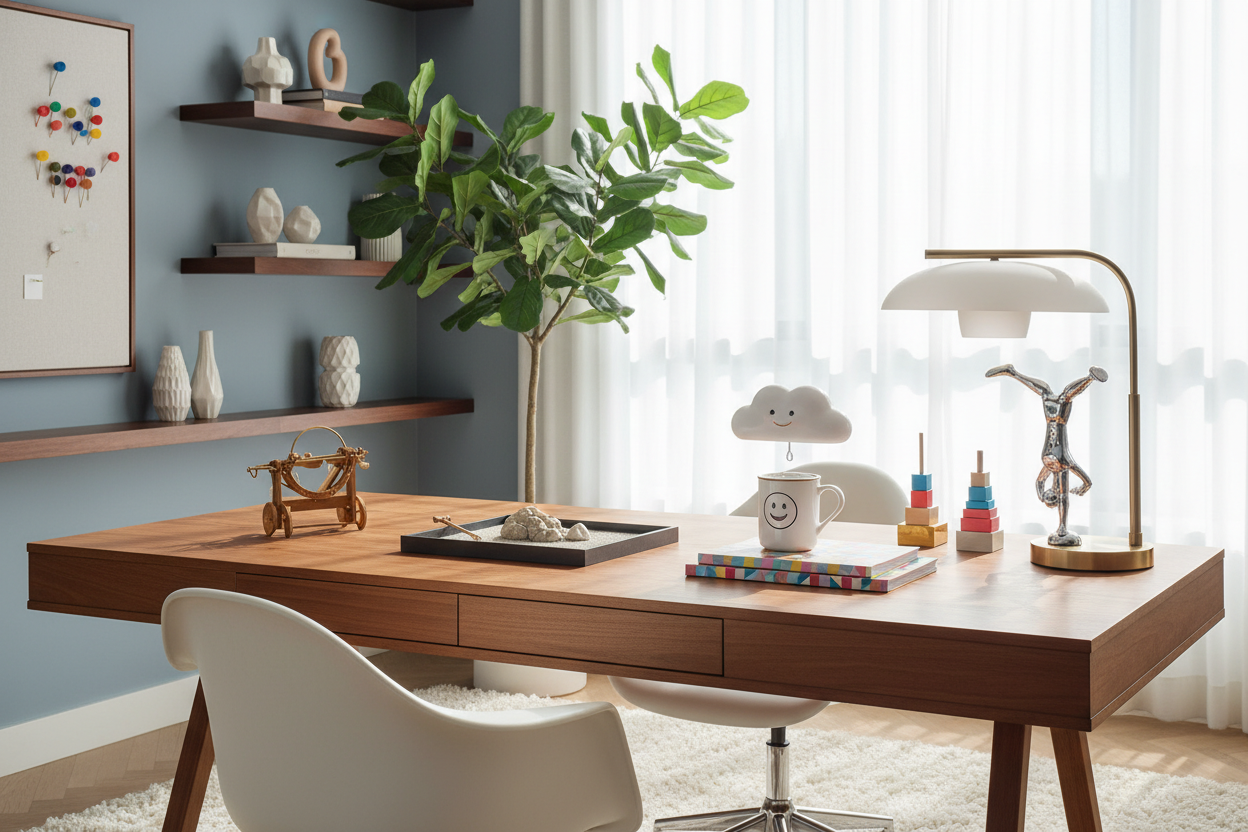
While an office interior design floor plan deals with 2D space, the 3D reality depends on materials. A solid walnut desk has more "visual weight" than a glass top desk of the exact same dimensions. In smaller office space floor plan ideas, opting for legs rather than solid pedestals can make the room feel 20% larger because you can see the floor stretching underneath the furniture.
My Personal Take on Office Plan Layouts
I learned the hard way that "standard dimensions" are often a trap. Early in my career, I designed a boutique creative agency using a rigid office schematic based on textbook ergonomics. I allowed exactly 36 inches for the walkway behind the designers' chairs.
On paper, it was perfect. In reality, it was a disaster. Why? Because I hadn't accounted for the "dynamic lounge." Creative teams don't sit upright; they lean back, they stretch, they roll over to show a colleague a screen. That 36 inches instantly shrank to 12 inches whenever someone reclined, blocking the main artery of the office. Now, I always add a "human factor" buffer of an extra 10% to any circulation path I draw. I also physically tape out the floor layouts on site before ordering furniture. You would be surprised how often a column is two inches wider than the architectural drawings claim, which can throw off an entire row of millwork.
Conclusion
Whether you are downloading an office floor plan pdf or hiring a firm to draft custom blueprints, remember that dimensions are the language of comfort. A well-planned office disappears around you, allowing you to focus entirely on your work. Measure twice, buy once, and always respect the negative space.
Frequently Asked Questions
What is the ideal desk size for a standard office layout?
For a standalone private office, a 60" x 30" desk is the industry gold standard. It provides enough surface area for a dual-monitor setup and paperwork without dominating the room. For tighter spaces, you can drop to 48" x 24", but you will sacrifice under-desk legroom if the unit has drawers.
How do I visualize my office layout before buying furniture?
I recommend using blue painter's tape to outline the furniture dimensions on the floor. This physical representation helps you understand the flow better than a 2D drawing. Alternatively, there are many accessible apps that allow you to create an office floor plan pdf to test different configurations.
What is the minimum size for a functional small office?
For a fully enclosed, private office, 100 square feet (10x10) is considered the comfortable minimum to house a desk, chair, and guest seating. However, a functional workstation can be integrated into a larger room with a footprint as small as 25 square feet (5x5) if storage is vertical.


Leave a comment
This site is protected by hCaptcha and the hCaptcha Privacy Policy and Terms of Service apply.