







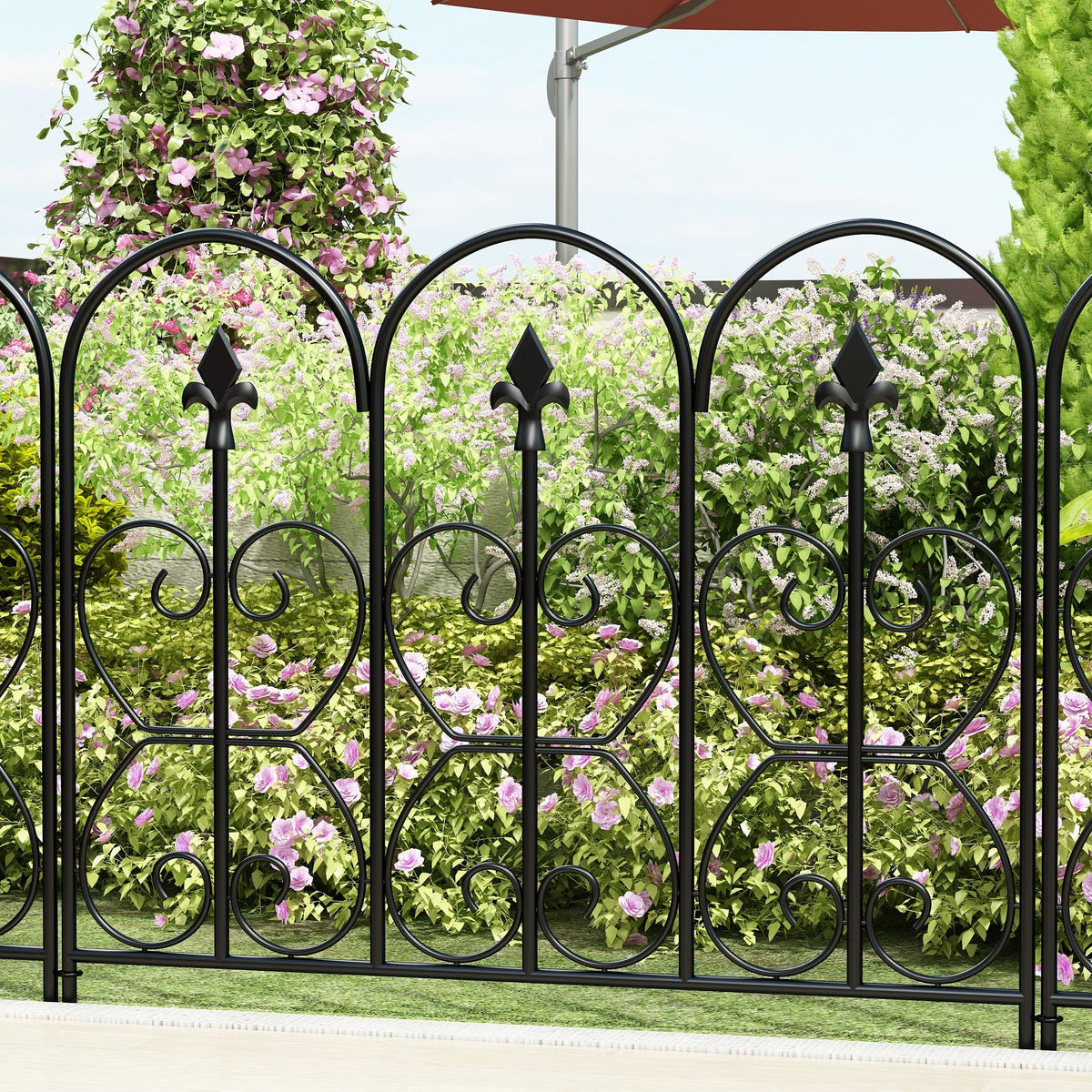
A metal garden fence made of short decorative panels, like our 32-inch set, is for edging flower beds, vegetable plots and paths, and it can discourage pets and small animals from wandering through. It is not a security fence, it will not hold in a large dog, and it is not a pool barrier: pool guidelines call for at least 48 inches, tight gaps and a self-latching gate. Before you buy, check the panel height and width, how the stakes go into the soil, the coating that keeps rust off, and the local rules, starting with a free call to 811.
Below: what a short metal fence can and cannot do, how many panels a run needs, no-dig installation, rust care, pets and wildlife, and black arched panels from the FUFU&GAGA outdoor collection.
Key takeaways
- Job first: decorative panels edge beds and paths; they do not secure a yard or contain a large dog.
- Count in feet: divide the run length by the panel width (2 feet for our 24-inch panels) and round up.
- No-dig still needs 811: 811 says every digging project, regardless of depth, needs a call a few days ahead.
- Pests need mesh: University of Georgia Extension recommends 1-inch chicken wire for rabbits and 6 to 8 feet for deer.
- Pools are separate: CPSC guidelines start at 48 inches, with self-closing, self-latching gates.
What is a metal garden fence for?
A metal garden fence is a low, open fence of steel or iron panels that frames planting areas, lines a walkway and keeps feet, balls and curious pets out of the beds. Many decorative sets link together and push into the soil on spiked feet, so they can be moved, reshaped or lifted out for winter. A black powder-coated finish gives the look of wrought iron and recedes against foliage.
The trade-off for a light, no-dig fence is strength. With no posts set in the ground, the panels rely on how far their feet go into the soil and on the links between them. That is plenty for a border or a support that keeps floppy perennials upright, but not enough to stop a determined animal, a person or a child. The table sets common goals against published guidance.
| Goal | What the guidance asks for | Will a 32-inch decorative panel do it? |
|---|---|---|
| Edge a flower bed or path | A clear, continuous line | Yes, this is its job |
| Keep rabbits out | 2-foot chicken wire, 1-inch mesh, 12-inch buried apron (UGA) | Not alone: back it with mesh |
| Keep stray dogs and cats out | 3-foot wire fence, 24-inch apron (UGA) | Partly: lower and more open |
| Keep deer out | At least 6 to 8 feet (UGA) | No |
| Keep raccoons and opossums out | 60 to 72 inches, 24-inch buried apron (UGA) | No |
| Contain a large dog | Picket fences are not tall enough (AKC) | No |
| Fence a pool, spa or hot tub | At least 48 inches, self-latching gate (CPSC) | No, never |
Sources: University of Georgia Extension, Garden Fencing (C 1027-9); American Kennel Club, What Type of Dog Fence Should I Have?; CPSC, Safety Barrier Guidelines for Residential Pools.
How tall should a metal garden fence be?
For edging, height is about scale: a fence roughly as tall as the plants behind it frames them without hiding them. When animals are the reason, let the animal set the height. UGA Extension recommends 2 feet of 1-inch chicken wire for rabbits, a 3-foot wire fence for dogs and cats, and at least 6 to 8 feet for deer, which can jump very high and will go under a fence if they can. A 32-inch decorative fence sits between the rabbit and dog figures, but height only counts if the gaps are small too, and scrollwork is open.
Also check whether the listed height includes the spiked feet. Our listing gives 32 inches and no spike length, so expect a little less above the soil once the feet are pushed in.
How many fence panels do I need?
Measure the run in feet along the line the fence will follow and divide by the panel width. Each 24-inch panel covers 2 feet, so panels = run length in feet / 2, rounded up. For a curved border, lay a hose or string along the curve and measure that; the straight-line distance comes up short.
| Layout | Run length | Panels at 24 inches |
|---|---|---|
| Straight path edge | 10 ft | 10 / 2 = 5 |
| 3 x 6 ft bed against a wall (three open sides) | 3 + 6 + 3 = 12 ft | 12 / 2 = 6 |
| Curved border measured with a hose | 15 ft | 15 / 2 = 7.5, so 8 |
| 4 x 8 ft raised bed with a 1 ft strip on every side (6 x 10 ft) | 2 x (6 + 10) = 32 ft | 32 / 2 = 16 |
| Both sides of a 25 ft front walk | 2 x 25 = 50 ft | 50 / 2 = 25 |
Closed shapes close neatly when each side is a whole multiple of 2 feet; otherwise round each side up. Plan the entrance too: our panels have no gate, so you unhook a panel to get in, which suits a bed you visit weekly better than a plot you harvest daily. Our listing is not consistent about how many panels come in one set, so confirm the count with customer service before ordering for an exact run.

How do you install a no-dig metal garden fence?
No-dig means no post holes, not no ground disturbance. 811, the free national before-you-dig service, says to contact it a few business days before any digging, including installing fences and planting, because some utilities can be buried just inches below the surface. Then wait a few days for utilities to mark their lines with paint or flags (811 Before You Dig).
- Call 811 or file an online request and wait for the marks.
- Mark the line with string or a hose and work out the panel count.
- Clear the line of stones and roots that would stop the feet going in straight.
- Link the panels on the ground first with the side rings, so spacing is set.
- Push the feet in evenly so each panel stands plumb and the bottom rail sits level, folding at the rings for corners.
- Walk the run after the first heavy rain or wind and press back any panel that leans.
Soil and stakes: what holds a no-dig fence up
A no-dig fence is held by friction between its feet and the soil. In loose, freshly dug or sandy soil the feet have less to grip, and hard, dry or rocky ground can stop them before they are fully in. If a run wobbles, firm the soil around each foot. The feet need soil, so set the fence in the planting strip beside a patio or path rather than on the paving, as in the photos of our panels. Along a lawn, leave room for the mower or trim that edge by hand.
Because nothing is concreted in, the fence can be lifted out and stored, which suits renters and seasonal beds.
How do I stop a metal garden fence from rusting?
The coating is what keeps rust away, and rust starts where it is broken. Care is about keeping the finish clean and intact.
- Clean regularly. A maintenance note from coatings maker Dulux says airborne chemicals and dust left on coated surfaces can etch powder coatings, and suggests routine cleaning about every three months, six at most, and more often in marine or polluted settings (Dulux Protective Coatings).
- Be gentle. The same note says to use a soft-bristle brush, no abrasive tools, and a fresh-water rinse. Our panels' listed care is a hose-down.
- Fix chips quickly. Dulux says mechanical damage to a coating must be promptly repaired to restore protection. Our panels are listed as not paintable, so ask customer service what to use on a chip.
- Watch the feet. The parts in damp soil and near sprinkler spray stay wet longest; check them each spring, and keep trimmer line off the finish.
Is a metal garden fence good for dogs?
A short metal fence works as a visual boundary for a small, calm dog while you are outside with it, and keeps a dog off a flower bed. It is not containment. The American Kennel Club notes that picket fences are not tall enough to contain large dogs or those determined to get over, that small dogs can wiggle out between the bars of wrought-iron fences, and that some dogs need a high fence with bottom barriers. To stop digging under a fence, it suggests strips of metal, cement or large rocks one to two feet below the fence line.
Use decorative panels to steer a supervised dog away from beds, and rely on a permanent fence, dog run or exercise pen when the dog is alone. If you are making a dog-friendly patch inside the fence, our artificial turf panels vs rolls guide covers drainage and cleanup.
Keeping rabbits, deer and other wildlife out
UGA Extension's trick for diggers is to buy a roll taller than the fence and bend the extra outward along the ground as an apron, buried several inches deep: a 3-foot roll for a 2-foot rabbit fence with a 12-inch apron, a 5-foot roll for a 3-foot dog and cat fence with a 24-inch apron. A decorative fence and a wire barrier can share a line: set 1-inch chicken wire just inside the panels, bury its apron, and let the black panels carry the looks. For deer, no garden-height fence will do; UGA suggests consulting a wildlife expert when the problem is serious.
Using a garden fence to edge a raised bed
A fence around a low raised bed keeps pets and balls off the soil and gives the bed a finished edge. Leave a working strip between bed and fence and count panels on that larger outline, as in the 6 x 10 ft example above. Our raised garden bed height guide covers bed heights, path widths and soil volume. Once bed walls are 2 to 3 feet high, a 32-inch fence adds little, and a bed with its own mesh guard does the pest job more directly, which is why our second pick is a raised bed.
Whether a garden border needs approval depends on your city or county and any homeowner association, so check before fencing a front garden, and keep the fence on your side of the boundary.
Never use a decorative fence around a pool
The CPSC Safety Barrier Guidelines for Residential Pools say the top of a pool barrier should be at least 48 inches above grade, and that some states, counties or municipalities require 60 inches. Openings should not let a 4-inch sphere through, spacing between vertical members should not exceed 1 3/4 inches, the gap underneath should be no more than 4 inches over a hard surface and 2 inches over grass, and gates should be self-closing and self-latching. The guidelines are not mandatory, but some states and localities build them into their codes.
A 32-inch decorative fence with open scrollwork and no gate meets none of that. Do not use garden fence panels around a pool, spa or hot tub; ask your local building department what your barrier must meet.
Metal garden fence buying checklist
- Purpose: edging only, or animal control using the UGA heights and mesh sizes.
- Height: the listed height, and whether it includes the spiked feet.
- Count: run length in feet divided by panel width in feet, rounded up.
- Gaps: 1-inch mesh for rabbits; scrollwork needs a mesh backing.
- Install: soil for the feet, and an 811 call a few days before.
- Access: corners that pivot, and how you get in without a gate.
- Finish: coated metal with care you can keep up.
Our picks
Facts come from each listing; assembly guides are in the User Manual tab on each product page.
Modern Classic Black Metal Garden Fence Panels, 24 x 32 inches

Decorative no-dig panels in black, each 24 inches wide, 32 inches tall and 1 inch deep, for bordering flower beds, vegetables and paths. No tools: push the spiked feet into the soil, link the panels with the rings on their sides, and arrange them in a straight line, an L, an O or a zigzag. They pull out to move and fold flat for storage. The listing describes welded iron with a powder-coated finish, rated water-, UV-, rust- and stain-resistant, not paintable; care is a hose-down. Not included: posts, anchor brackets, caps or a gate. The listing says the panels help keep plants from being blown down and can serve as a temporary border for pets. It gives no spike length or gap size.
Best for: edging beds and walkways in soil, fencing a low bed off from pets and foot traffic, and layouts you want to move or store.
Skip it if: you need to keep in a large dog or one left alone, keep out rabbits without adding mesh, keep out deer, fence a pool, spa or hot tub, or secure a property. Also skip it for a deck or patio with no soil, or a plot you enter daily, since there is no gate.
Natural Cedar Raised Garden Bed with Galvanized Pest Mesh

If the fence was meant to keep critters off vegetables, a tall bed with its own mesh can be the more direct answer. These handcrafted solid cedar planter boxes stand 34 inches tall, 95 inches wide and 33 inches deep overall, with a galvanized steel mesh liner included to keep critters away; in the photos the mesh forms panels around the upper part of each box. The boxes join with mortise-and-tenon panels that snap together without tools and can be arranged in five layouts. Listed as mold, mildew, UV and weather resistant; hose down to clean; no wheels. The listing gives no soil depth and does not say whether the boxes have a floor.
Best for: growing vegetables standing up with a pest mesh built in, on lawn or gravel where the bed can stay put.
Skip it if: you garden from a wheelchair or with small children, since it is taller than the wheelchair heights in our raised bed guide and its solid sides leave no knee space, or if deer are the problem.
Picks compared
| Pick | Size (as listed) | Install | Best for |
|---|---|---|---|
| Black metal garden fence panels | Each panel 24 W x 32 H x 1 D in | No-dig spiked feet, ring links | Edging beds and paths |
| Cedar raised garden bed | 95 W x 33 D x 34 H in overall | Snap-together, no tools | Vegetables at standing height |
Browse more garden and patio pieces in our outdoor collection.
FAQ
Do I need to call 811 for a no-dig garden fence?
Yes. 811 says every digging project, regardless of depth, needs a call a few days in advance, including installing fences, because some utilities are buried just inches below the surface. The service is free; wait for the marks before pushing the stakes in.
Will a metal garden fence keep my dog in?
Only a small, calm dog, and only while you watch. The AKC says picket fences are not tall enough to contain large dogs and that small dogs can wiggle between the bars of wrought-iron fences. Use a garden fence to mark beds and a permanent fence or exercise pen for containment.
What garden fence keeps rabbits out?
UGA Extension recommends a 2-foot chicken-wire fence with 1-inch hexagonal mesh, cut from a 3-foot roll so a 12-inch apron can be bent outward and buried. Decorative panels can stand in front of the wire for looks, but their scrollwork will not stop rabbits alone.
Can decorative fence panels be used around a pool?
No. CPSC guidelines put a pool barrier at least 48 inches above grade, with openings that will not pass a 4-inch sphere and self-closing, self-latching gates; some localities require 60 inches. Check your local pool barrier code.

Leave a comment
This site is protected by hCaptcha and the hCaptcha Privacy Policy and Terms of Service apply.