










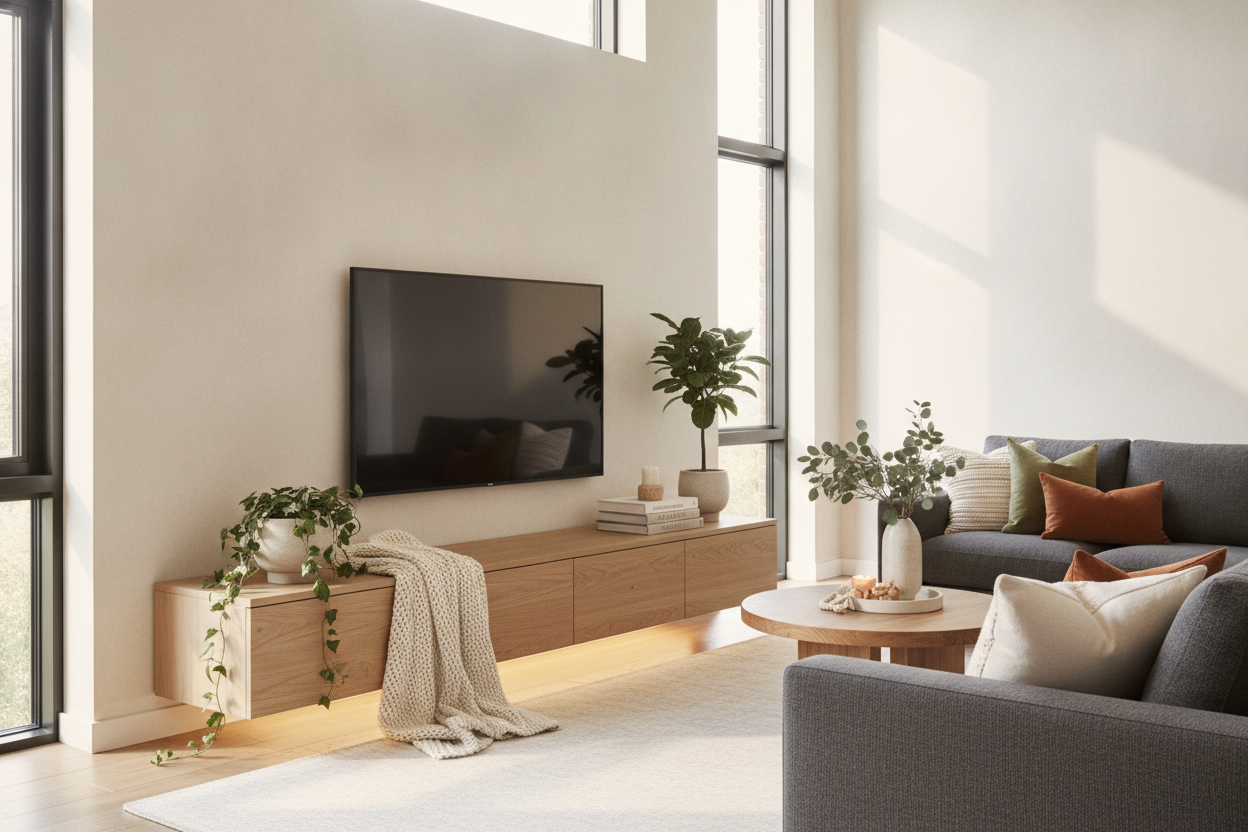
I recently spent four hours staring at 47 open browser tabs of all modern tv stands at 1 AM. It is a specific kind of torture. You find a piece that looks like a sculpture in a minimalist loft, but then you look at your own living room—complete with a half-eaten bag of chips and a cat—and realize that sleek console might just look like a cold, floating spaceship in your house.
Buying contemporary furniture is easy; making it feel like it belongs in a home where people actually live is the hard part. I've bought the high-gloss units that showed every fingerprint and the ultra-low profiles that made my TV look like it was sitting on the floor. Here is how I finally figured out how to bridge the gap and keep my sanity.
- Layer in organic textures to offset flat, manufactured surfaces.
- Use asymmetrical styling to avoid the 'altar to the TV' look.
- Prioritize warm wood grains over high-gloss lacquers.
- Switch to low, ambient lighting to kill harsh reflections.
Why Your Sleek Console Looks Like a Spaceship
Showrooms are designed to trick you. They have 20-foot ceilings, industrial track lighting, and zero clutter. When you browse various TV stands online, you are seeing them in a vacuum. Once that sharp-edged, matte black allmodern tv console arrives in your 12x14 living room, the contrast can be jarring.
The problem is usually a lack of context. Modern design relies on clean lines, but without 'weight' around it, those lines just feel sharp and unwelcoming. You need to anchor the piece so it looks like a choice, not a mistake delivered by a futuristic moving company. It's about grounding the piece within the context of your existing life, not trying to live inside a catalog.
Texture is the Ultimate Antidote to 'Sterile'
If your allmodern media console is made of metal, glass, or smooth MDF, you have to bring in the dirt—metaphorically. I am talking about organic materials that have soul. Think matte-finish ceramics, a hand-woven wooden bowl, or a stack of vintage books with slightly frayed edges. The goal is to create a visual friction between the perfect furniture and the imperfect decor.
I learned this the hard way after swapping my mid-century piece for a post-modern TV stand. My old walnut unit did all the heavy lifting for me because wood is inherently warm. The new, sleeker piece felt like a hospital wing until I added a trailing Pothos plant. The messy, organic shape of the vines draped over the sharp corner of the console immediately made the room feel breathable again. Don't be afraid to let a little nature mess up those clean lines.
Stop Centering Everything Perfectly
Symmetry is the enemy of a lived-in feel. If you put your TV exactly in the middle and two identical speakers on either side, you have built a shrine, not a living room. This is especially true if you have a massive 78-inch 4-drawer TV stand. That much horizontal surface area needs to be broken up or it looks like a landing strip.
Try the 'Rule of Thirds.' Shift your TV slightly to one side—if your viewing angle allows—and balance the other side with a tall lamp or a cluster of objects at varying heights. This asymmetry creates a sense of movement. It makes the console look like a piece of furniture that holds things you love, rather than just a pedestal for a screen. It feels more like a collection and less like an electronics display at a big-box store.
The 'Wood Tone Hack' for Contemporary Pieces
You don't have to go full 'IKEA-minimalist' to have a modern home. My favorite middle ground is finding pieces that use a contemporary silhouette but keep the warmth of real wood grain. It grounds the room and hides the dust that inevitably settles on flat surfaces. I've found that a bit of grain goes a long way in making a 70-inch piece of furniture feel less intimidating.
A modern TV console cabinet with adjustable length is a great example of this. It gives you the flexibility to fit your space perfectly while the wood texture prevents it from feeling like a cold slab. It is that balance of new and natural that makes a room feel finished rather than just furnished. If you can see the rings of the tree, the piece feels like it has a history, even if it just came out of a box.
The Lighting Mistake That Ruins Everything
Nothing kills the vibe of a nice media setup faster than a 'boob light' on the ceiling reflecting off your screen. Modern furniture often has flat, reflective surfaces that catch every bit of harsh overhead glare. It emphasizes the sterile vibe you are trying to avoid and makes the whole room feel flat and uninviting.
When people talk about modern long tv console mistakes, lighting is usually at the top of the list. Swap the overheads for a small, warm-toned table lamp sitting right on the console. Or, use an LED bias strip behind the TV. It softens the edges of the furniture and creates a glow that makes the whole setup feel like a cozy nook instead of a tech lab. Low lighting hides the dust and highlights the silhouette.
Personal Experience: My High-Gloss Disaster
A few years ago, I bought a high-gloss white TV stand because I thought it looked expensive. It was a nightmare. Every single fingerprint from my nephew and every hair from my cat was magnified by the shiny finish. It never felt cozy; it felt like something I had to constantly polish. Now, I stick to matte finishes or natural wood. If you can't touch your furniture without needing a microfiber cloth, it is not a home—it's a museum.
FAQ
How high should my TV stand be?
Ideally, the center of your TV should be at eye level when you are sitting. For most sofas, that means a console height of 22 to 28 inches. Don't mount it too high unless you like visiting the chiropractor.
Can I mix different wood tones?
Yes, but keep the undertones the same. If your TV stand is a cool-toned oak, don't pair it with a red-toned cherry. Stick to all cool or all warm tones to keep the room cohesive.
Should the TV stand be wider than the TV?
Always. Your stand should be at least 6 to 10 inches wider than the TV on both sides. A TV that overhangs the edges looks top-heavy and makes the whole room feel unstable.

Leave a comment
This site is protected by hCaptcha and the hCaptcha Privacy Policy and Terms of Service apply.