











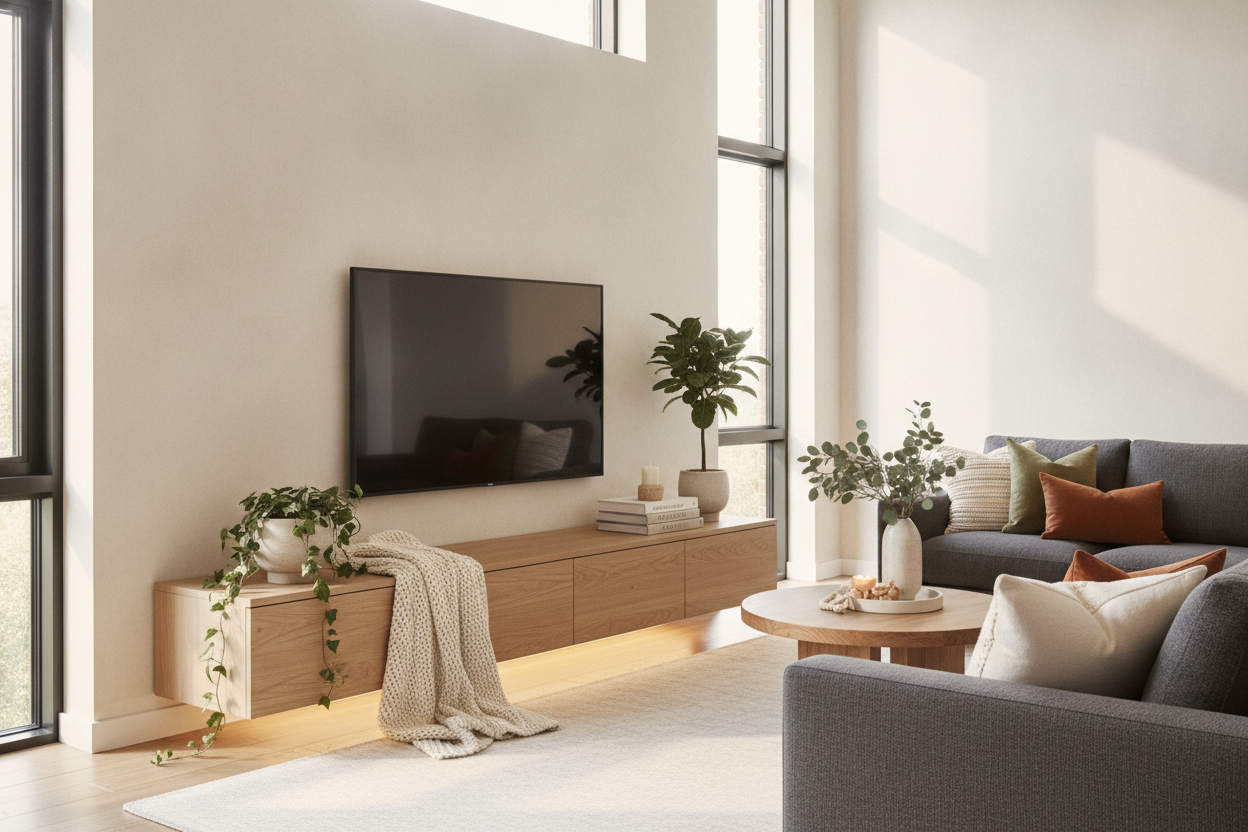
I used to sit in my 400-square-foot studio and stare at my floor with genuine resentment. Every square inch was occupied by something—a lumpy sofa, a coffee table I constantly tripped over, and a bulky media cabinet that looked like a giant wooden block anchored to the rug. The room felt heavy, cluttered, and about half its actual size. That was before I decided to commit to a floating tv stand wall mount and reclaim the six square feet of floor space that was currently being held hostage.
- Seeing the floor underneath your furniture makes a room feel instantly larger.
- You absolutely must use a stud finder; drywall anchors are not enough for this weight.
- Cable management is the difference between a high-end look and a mess of black spaghetti.
- Floating units are best for slim tech like routers and consoles, not chunky vintage receivers.
The Floor Space Illusion I Desperately Needed
Living in a tiny apartment is a constant battle against visual weight. When I had one of those traditional floor-based TV stands, it acted like a literal anchor, dragging the whole room down. It didn't matter how much I cleaned; the room always felt suffocated because the floorboards were hidden. The beauty of a wall-mounted setup is the 'hover' effect. By exposing the baseboards and the rug underneath the unit, your brain perceives the room as being wider than it actually is.
I’ll be honest: I was skeptical that a piece of furniture could actually change the psychology of a room. But the moment I cleared out that old credenza, the air in the apartment felt different. It’s the ultimate floor-space cheat code. You aren't actually gaining more square footage, but you’re gaining the illusion of it, which is almost as good when you’re living in a shoebox.
Yes, You Have to Find a Stud (But It's Not That Scary)
I spent three days staring at my drill in total terror. The idea of a 50-pound wall mounted media console ripping a hole in my rental's drywall kept me up at night. But here is the reality: if you can find a stud, you can do this. Most modern homes have studs spaced 16 inches apart, and a $15 stud finder from the hardware store makes locating them foolproof. Don't even think about using those plastic 'self-drilling' drywall anchors for a project this heavy—they will fail, and your TV setup will end up on the floor.
I learned the hard way that you need a level. Not just a 'phone app' level, but a real 24-inch bubble level. If your bracket is even an eighth of an inch off, the entire console will look crooked against the horizontal line of your floor. Once the bracket is bolted into the wood studs with heavy-duty lag bolts, that unit isn't going anywhere. I’ve had mine up for two years, and it hasn't budged a millimeter.
How I Handled the Dreaded Cord Situation
The biggest downside of lifting your furniture off the floor is that you suddenly expose the 'guts' of your home theater. All those black power cables and HDMI cords that used to hide behind the cabinet are now dangling in mid-air. When I previously faked a floating screen in a rental using a floor stand, the wires were a nightmare. For a true floating tv stand with mount setup, you have to be intentional.
I used a paintable cord channel that sticks to the wall. I painted it the exact shade of 'Landlord White' as my walls, and it practically disappeared. If you’re feeling brave and own the place, you can run the wires behind the drywall, but for most of us, a slim cover is the way to go. It keeps the minimalist aesthetic intact without requiring a major renovation. Just make sure you buy longer cables than you think you need; that extra distance to the wall and down to the unit adds up quickly.
Does a Floater Mount TV Stand Actually Hold Anything?
Don't expect to store your entire 4K Blu-ray collection or a 1990s-era stereo receiver in a floater mount tv stand. These things are designed for the modern, digital age. My unit holds a Nintendo Switch, a slim mesh router, and a few remotes. That’s about it. If you try to cram a massive AV receiver into a slim floating shelf, it’s going to stick out like a sore thumb or, worse, overheat because there's zero airflow.
If you have a massive wall and actually need to hide a lot of gear, you’re better off looking at something like a freely arranged TV stand with LED. It gives you that same floating look but offers way more internal real estate. For my tiny space, though, the slim profile was exactly what I needed. It forced me to declutter my tech, getting rid of old cables and boxes I hadn't touched since 2018.
How high should I mount my floating TV stand?
The sweet spot is usually 8 to 12 inches off the floor. You want it high enough to see the floor underneath, but low enough that your TV stays at eye level when you're sitting on the sofa. Avoid the 'TV too high' trap at all costs.
Can I install this on a brick wall?
Yes, but you'll need a masonry bit and concrete anchors instead of standard wood screws. It’s actually more secure than drywall once it's in, though it’s a bit more work to drill the holes.
Will it hold the weight of a soundbar?
Most floating consoles can easily handle a soundbar. Just check the weight capacity of the specific unit. Most are rated for 50-75 pounds, which is plenty for a soundbar and a few small peripherals.


Leave a comment
This site is protected by hCaptcha and the hCaptcha Privacy Policy and Terms of Service apply.