










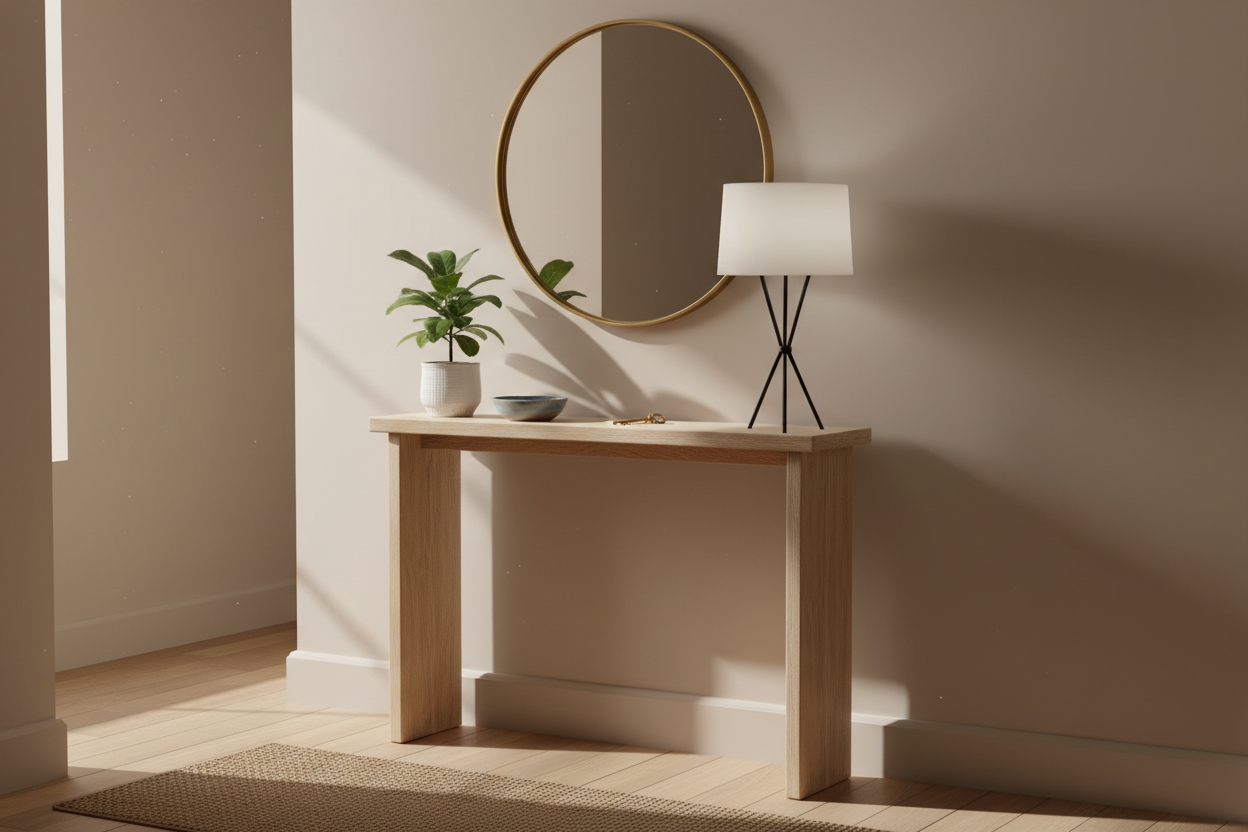
Hallways and entryways are often the most neglected spaces in a home, yet they shoulder the heavy burden of first impressions and daily organization. The solution to a cluttered corridor isn't just more discipline; it's better furniture. Specifically, a narrow console with drawers acts as the ultimate architectural hack for tight spaces. It provides a dedicated surface for keys and mail while hiding unsightly clutter, all without encroaching on your walking path. If you are tripping over shoes or losing your wallet daily, this specific piece of furniture is likely the missing link in your home’s design.
Defining "Narrow" in Interior Design
When we talk about standard console tables, most manufacturers aim for a depth of 14 to 18 inches. In a spacious suburban foyer, that works perfectly. However, in an urban apartment or a corridor that connects high-traffic rooms, 14 inches is simply too deep. You need to look for pieces specifically categorized as "slim" or "skinny."
True narrow tables generally fall between 8 and 12 inches in depth. This measurement is critical. You generally need at least 36 inches of clearance for a comfortable walkway. If your hallway is 48 inches wide, a standard table kills your flow. A thin table with drawers that is only 10 inches deep, however, leaves you with plenty of breathing room while still offering the utility of storage. Always account for the handle depth as well; protruding knobs can catch on pockets as you walk by, so recessed handles or push-to-open mechanisms are superior choices for tight squeezes.
A Personal Lesson in Space Management
I learned the value of vertical over horizontal space in my first studio apartment. The "entryway" was essentially a patch of floor directly behind the front door, which swung open to reveal the entire living space. For months, I tossed my keys on the kitchen counter and my mail on the sofa. It looked messy and felt chaotic.
I eventually hunted down a vintage medical cabinet—essentially a metal slim table with drawers—that was only 9 inches deep. It looked impossibly unstable, but once anchored to the wall, it changed everything. The drawers were shallow, barely fitting more than a few envelopes and a spare set of keys, but that was all I needed. That tiny footprint forced me to be intentional about what I kept by the door, and the visual clutter vanished instantly. It taught me that storage capacity isn't always about volume; it's about having a specific place for specific things.
Selecting the Right Material for Visual Weight
In small spaces, physics is only half the battle; perception is the other half. A solid oak cabinet might physically fit in your hallway, but it can make the area feel closed off and heavy. This is where the concept of visual weight comes into play.
If your goal is to keep the area feeling open, look for designs with long, slender legs or open bases. Materials like acrylic, glass, or thin metal frames allow light to pass through, tricking the eye into thinking the space is larger than it is. Conversely, if you want the table to act as a focal point or anchor a floating sofa, a solid wood piece with a closed base works better.
The finish matters, too. High-gloss finishes reflect light, which is beneficial in windowless hallways. Matte finishes in dark colors absorb light but hide fingerprints and dust better, which is a practical consideration if the table is in a high-traffic zone near the front door.
The Functionality of Shallow Drawers
One might wonder how useful a drawer can be if the table is less than a foot deep. The reality is that hallway storage doesn't need to hold bulky items. You aren't storing winter blankets here. You are storing the debris of daily life: charging cables, sunglasses, dog leashes, and takeout menus.
When shopping for a narrow console with drawers, check the internal height of the drawer box. Some sleek designs compromise on height to maintain a modern aesthetic, leaving you with a drawer that can't even hold a standard stapler. Ideally, you want an internal clearance of at least three inches. This accommodates the "junk drawer" essentials without jamming every time you try to open it.
Also, pay attention to the drawer slides. On very inexpensive furniture, drawers often lack metal runners and simply slide wood-on-wood. While this saves money, these drawers can become difficult to open during humid months when the wood swells. For a piece of furniture you might access multiple times a day, smooth-gliding metal runners are worth the extra investment.
Styling Without Crowding
Once you have your thin table with drawers in place, the temptation is to fill the surface. Resist this urge. The beauty of a slim profile is its minimalism. Overcrowding the top defeats the purpose of buying a space-saving table.
Use the "triangle rule" for styling. Place a tall item (like a slender lamp or a vase with tall branches) on one side, a medium item (like a framed photo leaning against the wall) in the middle, and a small catch-all tray on the other side. This guides the eye naturally. Since the table lacks depth, use the vertical space above it. A large mirror is the classic choice because it reflects light and widens the hallway, but a gallery wall of small art pieces can also add personality without protruding into the walking path.
Don't forget the space underneath. If your console has high legs, you have prime real estate for baskets. This is a great spot to hide shoes or umbrellas, keeping them accessible but out of the main line of sight.
Beyond the Hallway: Alternative Placements
While we usually associate these pieces with entryways, a slim table with drawers is surprisingly versatile throughout the home. In a small bedroom, it can serve as a vanity. A standard desk is often too deep for a small room, but a 12-inch console with a wall-mounted mirror provides enough space for makeup and jewelry storage without blocking the bed.
Another excellent application is behind a floating sofa in an open-concept living room. If you don't have room for a full sofa table, a skinny console acts as a barrier between the back of the couch and the rest of the room. It finishes the look of the furniture arrangement and offers a surface for a reading lamp, allowing you to float the sofa away from the wall even if you only have a few inches to spare.
Frequently Asked Questions
How do I stop a narrow table from wobbling on carpet?
Narrow tables have a high center of gravity and can be unstable, especially on plush carpet. It is highly recommended to anchor the table to the wall using a simple L-bracket or a furniture strap. This stabilizes the piece and prevents tipping, which is crucial if you have children or pets.
Can I put a lamp on a table that is only 8 inches deep?
Yes, but you need to choose the lamp carefully. Look for "buffet lamps" which typically have smaller bases and taller, slender profiles. Alternatively, use a wall sconce above the table to free up surface space entirely.
What is the minimum walkway width I should maintain next to the table?
Interior design standards suggest a minimum of 36 inches for a comfortable walkway. In very tight pinch points, you might get away with 30-32 inches, but anything less will feel claustrophobic and you will likely bump into the furniture.

Leave a comment
This site is protected by hCaptcha and the hCaptcha Privacy Policy and Terms of Service apply.