











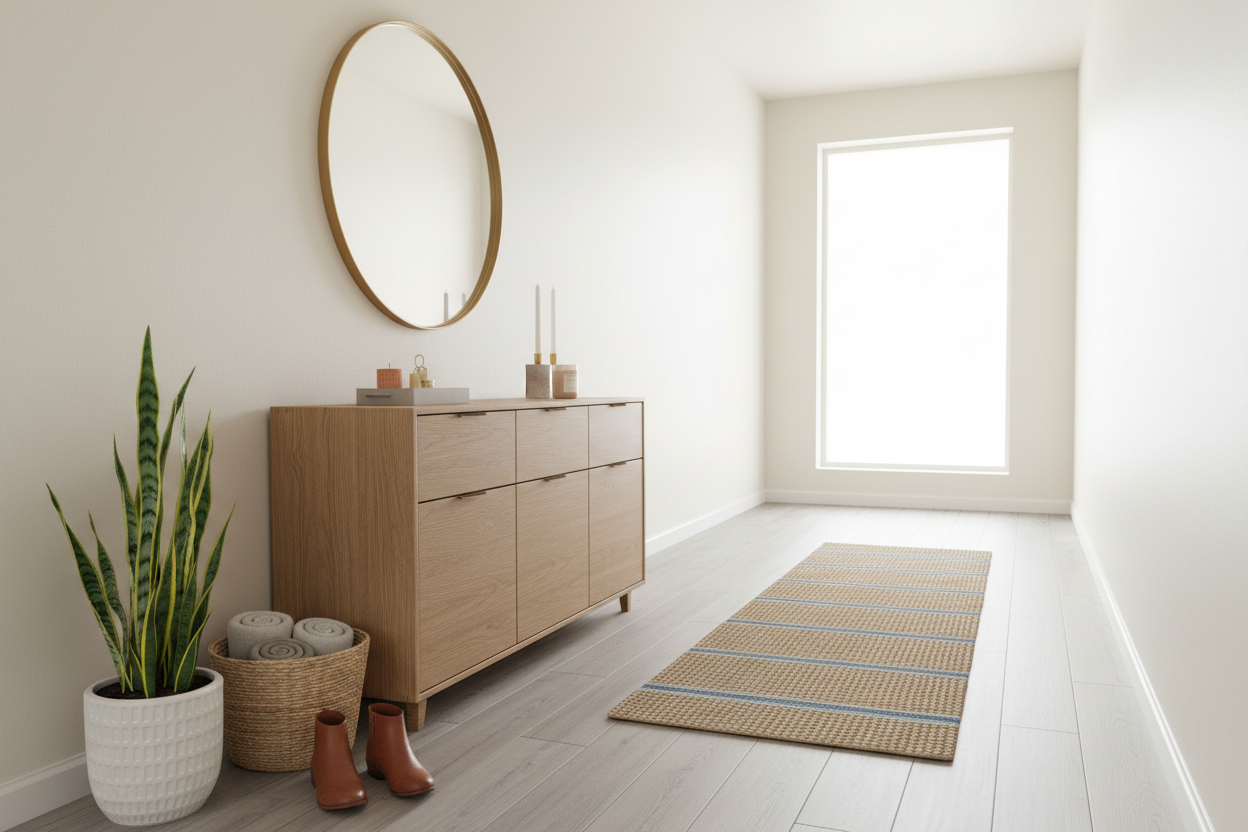
Your front door opens, and immediately you are greeted by a navigational hazard: a pile of shoes, a scattered assortment of mail, and keys that never seem to have a home. If your hallway feels more like an obstacle course than a welcoming entrance, the solution isn't necessarily a renovation, but rather the strategic placement of a narrow entryway cabinet. Finding furniture that provides substantial storage without encroaching on walking space is a specific challenge, but once solved, it transforms the entire flow of your home.
Most standard consoles are between 16 and 20 inches deep. In a tight corridor, that depth eats up valuable square footage, making the space feel claustrophobic. A dedicated slim entryway cabinet, however, typically clocks in between 10 to 13 inches in depth. This subtle difference creates a visual and physical clearance that makes your foyer feel open while still swallowing up the clutter that accumulates at the door.
The Reality of Living with Tight Spaces
I learned the value of inches the hard way. My first apartment had a hallway that was barely wide enough for two people to pass each other. I made the mistake of buying a standard depth dresser to hold winter gear. For two years, I walked into that apartment and immediately turned my shoulder sideways to avoid hip-checking the corner of the furniture. It was a daily annoyance that I didn't realize was optional until I swapped it for a specifically designed thin entryway cabinet. The new piece was a tipping shoe cabinet, only 9 inches deep. Suddenly, the hallway felt twice as wide. That experience taught me that in small spaces, geometry matters more than aesthetics.
Defining Dimensions: Shallow vs. Skinny
When shopping, terminology can get confusing. You might be looking for a narrow cabinet for entryway usage, but "narrow" can mean two things. It can refer to the width (from left to right) or the depth (from front to back). For most people struggling with hallway clearance, a shallow entryway cabinet is the priority. These units hug the wall tightly. If you have a short wall segment between two doorways, however, you are looking for a skinny entryway cabinet—something with a small footprint width-wise.
For the tightest squeezes, a very narrow entryway cabinet is your best bet. These are often custom-built or specialized units that utilize vertical tilting drawers. Because the shoes are stored at an angle rather than flat, the cabinet only needs to be deep enough to accommodate the angle of the shoe, often reducing the profile to under 10 inches.
Functionality: Doors, Drawers, and Tippers
The internal configuration of your furniture dictates what you can hide. A narrow entryway cabinet with doors typically offers adjustable shelving. This is versatile for storing items of varying heights, like boots or dog walking gear, but requires swing space. You have to ensure that when the cabinet doors are open, they don't block the front door or the path to the living room.
Alternatively, a narrow entryway cabinet with drawers at the top is invaluable for the "drop zone" items. This is where sunglasses, wallets, and keys live. If you opt for a unit that is purely shelves, you will end up with clutter on the surface. A small cabinet for entryway organization should ideally have at least one drawer or a designated basket on top to catch these small, loose objects.
The Vertical Advantage
When you cannot go out, go up. A tall narrow entryway cabinet maximizes storage volume without expanding the footprint. These units can extend five or six feet high, offering double the storage capacity of a standard console. They are particularly effective for families where everyone needs a designated shelf.
However, tall units in narrow spaces can feel imposing if you aren't careful with the design. To keep a tall narrow entryway storage cabinet from feeling like a monolith, look for legs that lift the unit off the floor. Seeing the floorboard underneath the cabinet tricks the eye into thinking the room is larger than it is. Additionally, lighter colors or mirrored fronts on a narrow foyer cabinet can reflect light and help the piece blend into the wall.
Styling a Small Foyer Cabinet
Just because the furniture is utilitarian doesn't mean it has to be boring. A small entryway cabinet serves as the first impression of your interior design style. Since the surface area is limited on thin entryway storage, you have to be intentional with decor. A mirror hung directly above the cabinet is a classic move for a reason: it allows for a last-minute outfit check and bounces light around a dark hall.
Avoid overcrowding the top of a small foyer cabinet. A simple tray for keys, a small plant for life, and perhaps a lamp if you have an outlet nearby are sufficient. If your cabinet is extremely shallow, ensure your lamp base is small enough to sit stable without tipping over.
Safety and Installation
There is a critical safety aspect to thin entryway storage that often goes overlooked. Because these cabinets are tall and shallow, their center of gravity is higher and less stable than deep furniture. If you open all the drawers of a narrow entryway storage cabinet at once, the weight shifts forward.
Anchoring these units to the wall is not optional; it is a requirement. Most narrow entryway cabinets come with anti-tip hardware. If you have baseboards that prevent the cabinet from sitting flush against the wall, you may need to use shims or specialized mounting brackets to ensure a rigid connection. This is especially true for a narrow entryway cabinet with drawers that hold heavy items.
Choosing the Right Material
High-traffic areas take a beating. Your narrow cabinet for entryway use will be bumped by grocery bags, kicked by wet shoes, and leaned on. Solid wood or metal offers the best durability. Particleboard is common for affordable, very narrow entryway cabinet options, but pay attention to the finish. A melamine or laminate finish is easier to wipe down than painted MDF, which might chip if struck by a heavy backpack.
Metal cabinets have gained popularity recently for an industrial look. They are incredibly durable and often come with magnetic closures, which keeps a narrow foyer cabinet looking tidy. Regardless of the material, check the hardware. Low-profile handles or push-to-open mechanisms are superior in tight spaces because they won't snag your coat pocket as you walk by.
Ultimately, the goal is to stop thinking about your hallway. When you have the right narrow entryway cabinet, the clutter disappears, the path is clear, and coming home becomes the peaceful experience it is supposed to be.
Frequently Asked Questions
What is the minimum depth for a functional entryway cabinet?
For a standard shelf cabinet, you typically need at least 13 inches to store shoes flat. However, if you choose a cabinet with tipping drawers (where shoes are stored at an angle), you can find functional units as shallow as 7 to 9 inches deep.
Can I use a shoe cabinet for general storage?
Absolutely. The tipping compartments in a slim entryway cabinet are perfect for storing scarves, gloves, folded reusable grocery bags, and mail. You aren't limited to footwear; any item that can be folded or slotted in will fit well.
How do I handle baseboards when installing a wall-anchored cabinet?
If your cabinet has legs, the back legs often clear the baseboard. If the unit sits flat on the floor, you have two options: cut a notch in the back of the cabinet to fit over the baseboard, or use a mounting batten (a piece of wood) on the wall to bridge the gap between the wall and the cabinet back.

Leave a comment
This site is protected by hCaptcha and the hCaptcha Privacy Policy and Terms of Service apply.