










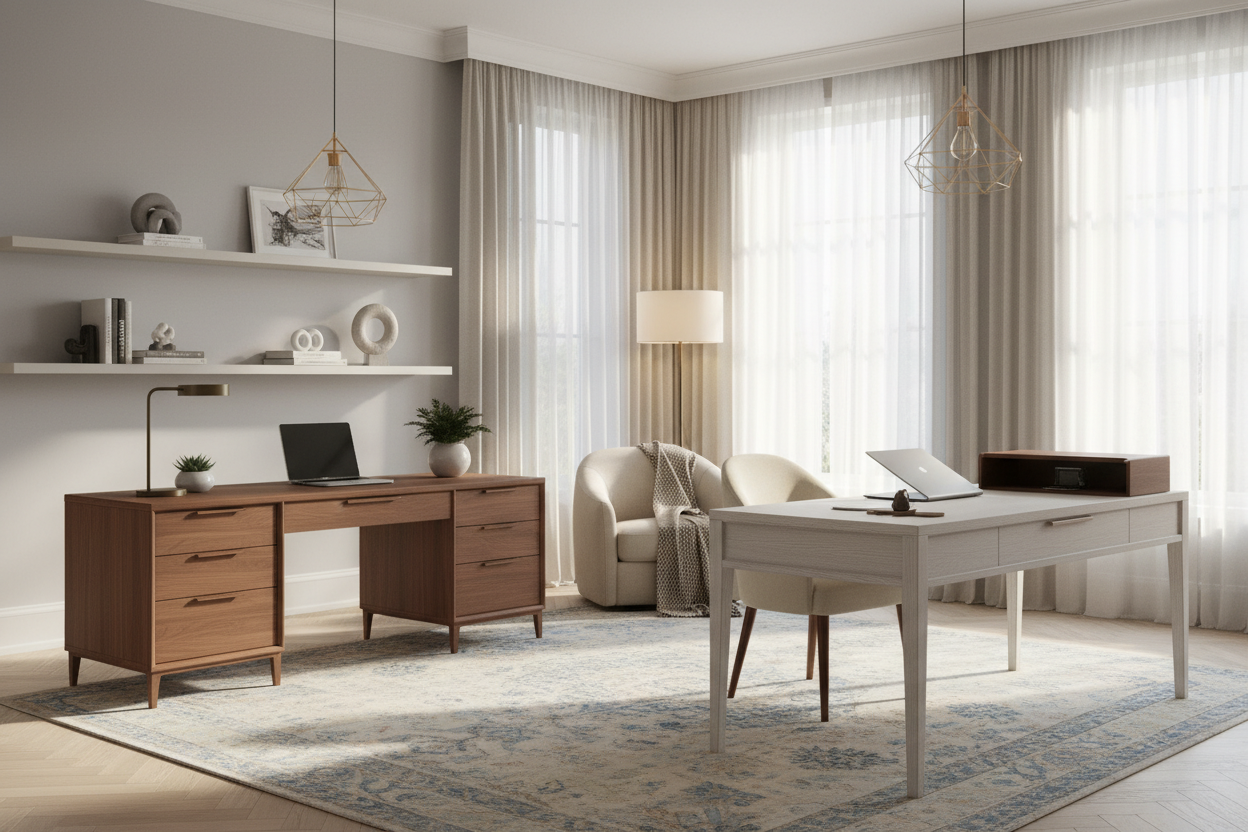
The era of the dedicated, closed-door home office is fading. For many of my clients, the workspace has migrated into the living room, the primary suite, or a multi-functional guest room. The design dilemma here is obvious: standard office equipment is aesthetically intrusive. It feels cold, mechanical, and corporate. The solution lies in selecting desks that look like furniture—pieces that prioritize silhouette and materiality over utilitarian plastics, allowing your workspace to disappear into the decor when the laptop closes.
Key Features to Look For
Before committing to a purchase, review this checklist to ensure the piece functions as a workstation while reading as high-end decor:
- Finished Backs: Essential if floating the desk in the center of a room; the back should look as polished as the front.
- Discreet Cable Management: Look for hidden compartments or hollow legs, as furniture-style desks rarely have standard grommets.
- Apron Height: Ensure the decorative wood panel under the drawer allows enough clearance for your legs and office chair.
- Material Warmth: Opt for solid wood, veneers, or mixed metals that match your existing casegoods (bookshelves, media consoles).
- Convertible Design: Secretary desks or drop-front consoles allow you to physically hide the clutter.
Defining the Aesthetic: Materiality and Form
When I walk a client through a showroom, I tell them to stop thinking about "work surfaces" and start thinking about "tables." A desk that mimics furniture often masquerades as a console table, a library table, or even a vanity. The success of this look hangs entirely on the finish.
Solid Wood vs. Veneer
For a true heirloom quality, solid wood (walnut, oak, or mahogany) offers a tactile experience that melamine simply cannot replicate. However, high-quality wood veneers are often more stable in fluctuating humidity. If you are placing the desk near a window, ensure the finish has UV protection to prevent the "shadowing" effect where items left on the desk create uneven fading.
The Leg Silhouette
Standard office desks usually feature T-legs or C-legs for stability. To achieve the "furniture look," seek out turned legs, tapered mid-century styles, or Parsons-style frames. These shapes mimic dining tables and sideboards, helping the eye register the object as part of the living space rather than a foreign invader.
Space Planning and Visual Weight
Integrating a workspace into a living area requires careful management of visual weight. A heavy, double-pedestal executive desk will dominate a room and scream "office."
The Floating Layout
If you have the square footage, floating a writing desk perpendicular to a wall or behind a sofa creates a distinct zone without erecting walls. In this layout, a desk with a finished back is non-negotiable. It should look beautiful from 360 degrees.
The Console Camouflage
For tighter spaces, a console-style desk pushed against a wall serves double duty. When not in use, style it with a lamp and a piece of art leaning against the wall. The monitor can be stored in a nearby cabinet, or you can use a frame TV above it to maintain the residential vibe.
My Personal Take on Desks That Look Like Furniture
I learned a hard lesson about these types of desks during a project in a historic brownstone. We sourced a stunning, antique-reproduction French writing desk for the client's parlor. It was visually perfect—curved legs, gold leaf accents, absolutely sculptural.
However, I overlooked the "apron"—the vertical piece of wood directly beneath the tabletop that connects the legs. While it looked elegant, it reduced the clearance for the user's legs significantly. When the client tried to use a standard ergonomic chair, the armrests banged against the drawer front, and they couldn't cross their legs underneath. We ended up having to swap the chair for a lower, armless slipper chair, which looked great but wasn't ideal for 8-hour workdays. Now, I always carry a tape measure to check the floor-to-apron clearance, not just the total height. Also, be warned: matte wood finishes show oils from your wrists much faster than commercial laminate; expect to use coasters and desk pads religiously.
Conclusion
Your home should feel like a sanctuary, not a satellite office. By choosing a desk that respects the architectural integrity and design language of your home, you create a space that is both productive and peaceful. Look for the details—the joinery, the hardware, and the finish—and invest in a piece that you would love even if you never had to work a day in your life.
Frequently Asked Questions
How do I hide monitor cables on a furniture-style desk?
Since these desks rarely have grommet holes, use adhesive cable clips along the back of the legs to route wires down to the floor. Alternatively, use a "cable sleeve" in a fabric color that matches your wall paint to bundle cords together for a cleaner visual.
Are writing desks deep enough for a computer monitor?
Many decorative writing desks are shallow (around 20-24 inches deep). This can place a large monitor too close to your eyes. If you use a large screen, look for a desk with a depth of at least 28 inches, or mount the monitor on the wall above the desk to save surface area.
Can I use a dining chair with these desks?
Visually, yes, but ergonomically, proceed with caution. Dining chairs lack lumbar support and height adjustability. If you work full-time, consider a high-end office chair upholstered in residential fabrics (like velvet or linen) rather than mesh to maintain the aesthetic without sacrificing your back.

Leave a comment
This site is protected by hCaptcha and the hCaptcha Privacy Policy and Terms of Service apply.