










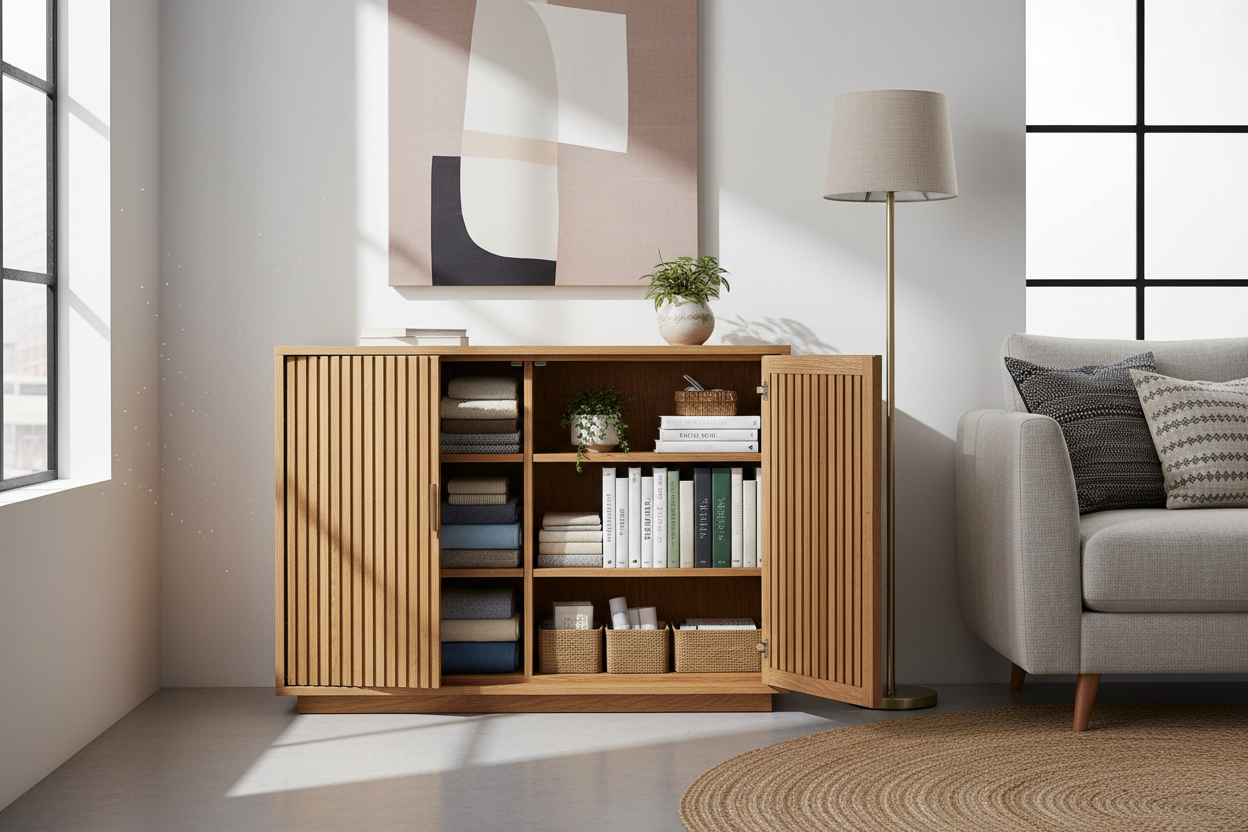
We have all experienced the black hole phenomenon associated with traditional storage trunks. You toss a blanket, a toy, or a photo album into the box, and inevitably, the item you need three months later is crushed at the very bottom. To retrieve it, you have to empty the entire contents onto the floor. A storage chest with doors solves this accessibility nightmare by combining the deep capacity of a trunk with the front-facing accessibility of a cabinet. Instead of stacking items vertically and hoping for the best, front access allows you to organize items on shelves or in distinct piles that can be reached without disturbing the rest of the collection.
The Design Flaw of the Top-Loading Lid
Standard chests have utilized heavy, top-opening lids for centuries. While aesthetically classic, they present a functional paradox in modern homes. If you use a trunk as a coffee table or a bench at the foot of the bed, the surface becomes a magnet for other items. You might place a tray of drinks, a stack of books, or throw pillows on top.
The moment you need something from inside, you have to clear off the surface to lift the lid. This extra step often discourages people from actually using the storage space, turning the chest into a decorative block rather than a functional organizer. A storage chest with doors eliminates this friction. You can keep your lamp and coffee mug on the top surface while swinging open the front panels to grab a throw blanket.
My Battle with the Toy Box
I learned the value of front-access storage the hard way while woodworking a few years ago. I built a classic, heavy-lid toy box for my nephew. It looked beautiful, stained in dark walnut with brass hardware. Within a week, my sister sent me a photo of the playroom. It looked like a bomb had gone off. My nephew was looking for one specific red truck which, naturally, had settled at the bottom of the box. To find it, he had to dump 50 pounds of other toys onto the floor.
That winter, I took the box back to my shop. I cut the front panel out, installed a divider shelf, and reattached the wood as two swinging storage chest doors. The chaos stopped immediately. He could see his toys, grab what he wanted, and the top of the chest became a permanent display area for his Lego creations. That experience shifted how I view furniture utility: accessibility always trumps pure volume.
Choosing the Right Door Mechanism
Not all front-opening chests function the same way. The hardware you choose defines how the piece fits into your room's flow. If you are dealing with a tight hallway or a cramped bedroom, the swing radius of standard doors might be an issue.
Sliding Barn Style
Sliding doors are increasingly popular for rustic and farmhouse aesthetics. They operate on a track system, meaning you never need to account for clearance space in front of the unit. This is ideal for entryway benches where you might be sitting to put on shoes. The downside is that you can only access half the chest at a time. If you are storing large, wide items like tent poles or rolled rugs, the center stile or the door overlap might get in the way.
Hinged Cabinet Doors
This is the standard approach. Using European concealed hinges allows for a clean, modern look where the hardware is invisible when the unit is closed. For a more antique vibe, exposed strap hinges work well. When selecting a storage chest with doors that swing out, ensure you have at least 18 to 24 inches of clearance in front of the piece so you aren't forced to step back awkwardly every time you open it.
Drop-Front Panels
Less common but highly effective, drop-front doors open downward, similar to a secretary desk or a bread box. These are excellent for media consoles. When the door is open, it can serve as a temporary shelf for sorting through items. However, the hinges on these bear significant weight, so they require high-quality hardware to prevent failure over time.
Retrofitting and DIY Options
You might already own a sturdy wooden crate or a blanket box that you love, but you hate the top-loading aspect. Converting an existing piece is possible, though it requires precision. The process involves carefully cutting the front face of the box to create the storage chest doors, then framing out the opening to support hinges.
If you are building from scratch or modifying a piece, pay close attention to the structural integrity of the front face. In a traditional chest, the four walls support the lid and anyone sitting on it. Once you cut into the front panel to add doors, you lose that continuous support. You must reinforce the top rim and the corners to ensure the chest doesn't sag when used as a seat.
Material Selection and Aesthetics
The material dictates both the durability and the style of the chest. Solid wood like oak or cedar is heavy but offers the best longevity, especially if the doors will be opened and closed frequently. Cedar has the added benefit of being naturally moth-repellent, making it the superior choice for storing linens and wool sweaters.
Engineered wood or MDF is common in big-box retail options. While affordable, the screw holding power of MDF is lower than solid wood. Over time, the hinges on storage chest doors attached to particle board can loosen and sag, leading to doors that scrape the bottom or won't close flush. If you buy a composite unit, look for one that uses metal threaded inserts for the hardware rather than wood screws driven directly into the material.
Safety Considerations
If the chest is intended for a child's room or a high-traffic family area, finger safety is paramount. Heavy swinging doors can pinch fingers just as easily as heavy lids. Look for soft-close hinges which use hydraulic resistance to slow the door down just before it shuts. Magnetic catches are also useful to keep the doors firmly closed so they don't drift open due to uneven floors or vibrations.
Ventilation is another often-overlooked factor. If you are storing textiles, shoes, or sports equipment, a completely airtight seal can lead to musty odors. Many storage chests with doors feature slat designs or decorative cutouts (like lattice work) which allow air to circulate, keeping the contents fresh without exposing them to direct dust.
Where to Place Your Front-Opening Chest
The versatility of these units allows them to function in almost any room. In the dining room, a long, low chest with doors acts as a buffet or sideboard, holding table linens and serving platters. In the living room, it replaces the media stand, hiding gaming consoles and routers behind closed doors while the TV sits on top. For the bedroom, placing one at the foot of the bed provides a place to sit while dressing, with immediate access to extra pillows or off-season clothing stored underneath.
FAQ
Can I use a storage chest with doors as a bench?
Yes, most storage chests are designed to support seating weight, but you must check the manufacturer's weight limit. Ensure the top is reinforced, especially if the front face has been cut out for doors, as this can alter the structural support.
Are sliding doors or hinged doors better for small spaces?
Sliding doors are superior for small spaces because they require zero clearance to open. Hinged doors need room to swing outward, which can block walkways or hit other furniture in tight quarters.
How do I keep the doors from swinging open on their own?
If your floors are uneven, doors may drift open. Installing magnetic latches, roller catches, or a simple mechanical slide bolt on the interior of the storage chest doors will keep them securely shut when not in use.

Leave a comment
This site is protected by hCaptcha and the hCaptcha Privacy Policy and Terms of Service apply.