










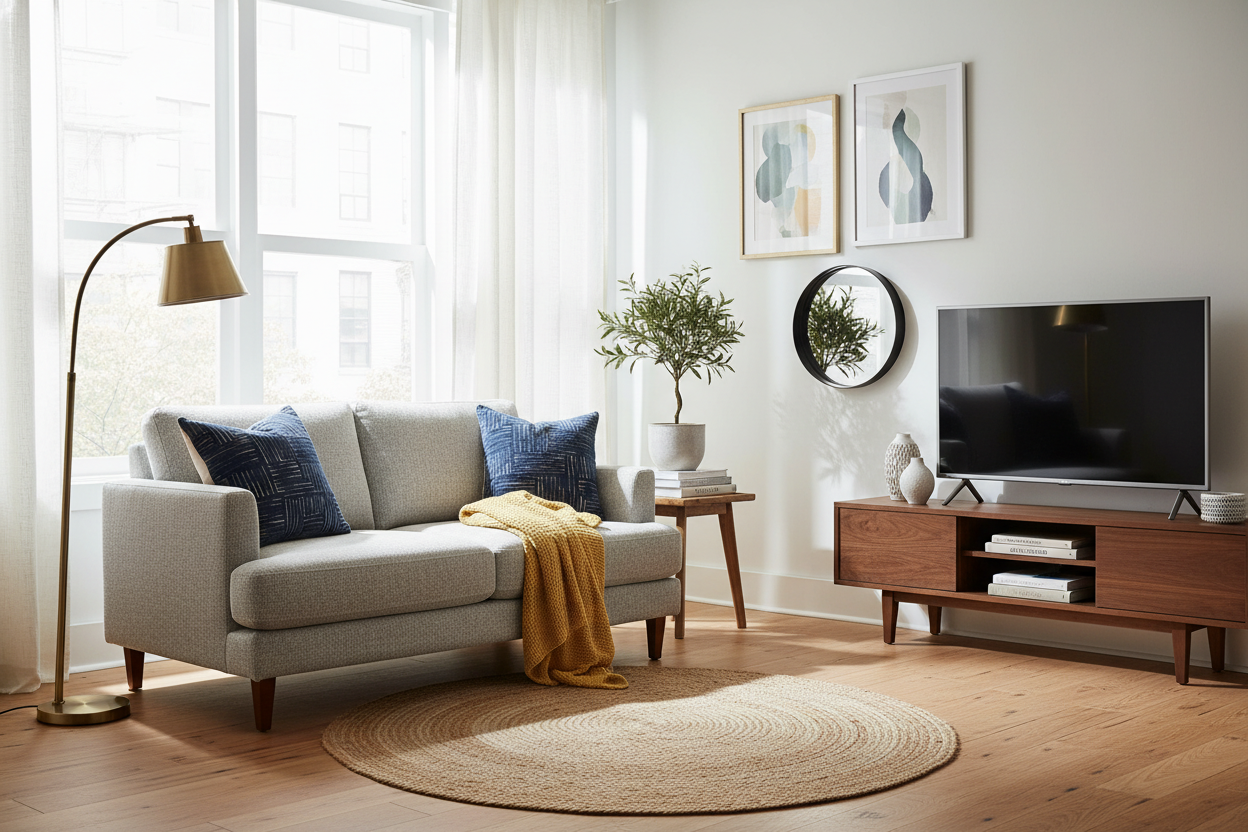
Designing for compact footprints presents a unique architectural challenge: how do you balance functionality with visual flow? Often, a standard sofa overwhelms a room, while an armchair feels too isolated. This is where the 54 inch loveseat serves as the perfect solution. It is the precise bridge between a solitary reading nook and a communal gathering space, offering design versatility without sacrificing precious square footage.
Key Features to Look For
- Arm Profile: Opt for track arms or armless designs to maximize the actual seating width within the 54-inch limit.
- Frame Construction: Look for kiln-dried hardwood frames to ensure longevity, as smaller pieces often endure more concentrated weight.
- Visual Weight: Choose a raised frame with exposed legs to allow light to pass underneath, making the room appear larger.
- Cushion Density: High-resiliency foam wrapped in down provides the best balance of support and 'sink-in' comfort for compact frames.
Mastering Scale and Proportion
When working with a 54 loveseat, the primary objective is maintaining appropriate scale. In a studio apartment or a petite den, a piece of this size acts as an anchor. However, you must be wary of 'visual bulk.' A skirted loveseat that sits flush to the floor can make a small room feel boxy and heavy.
Instead, I always advise clients to select a silhouette with tapered legs. By seeing the floor extend beneath the furniture, the eye perceives the room as having more depth. This is a fundamental trick in spatial planning that prevents the layout from feeling claustrophobic.
Selecting the Right Material
Performance vs. Luxury
Because a 54" loveseat is often a high-traffic spot—used for morning coffee, remote work, and evening relaxation—fabric durability is non-negotiable. For a luxury aesthetic that withstands daily use, a high-performance velvet is exceptional. It offers texture and depth, catching the light in a way that flat weaves do not.
Pattern and Color Strategy
In smaller dimensions, bold patterns can be risky. They tend to dominate the piece and clutter the visual field. Stick to solid, neutral tones or subtle textures (like a boucle or tweed). You can then layer personality through throw pillows or a cashmere throw, which are easier to swap out as trends evolve.
Ergonomics: The Comfort Factor
A common misconception is that smaller furniture is inherently less comfortable. This is false, provided you pay attention to seat depth. With a limited width, you cannot rely on sprawling out sideways. Therefore, the depth becomes the critical comfort metric. A standard depth of 22 to 24 inches is ideal for sitting upright during conversation, while a deeper seat (25 inches+) encourages lounging, though it may require a lumbar pillow for support.
Lessons from My Own Projects
I recall a project in a pre-war walk-up where the hallway turned at a sharp 90-degree angle. We ordered a gorgeous, custom 54 inch loveseat. Even though the dimensions were technically small, the fixed legs made it impossible to pivot through the doorframe. We had to remove the door hinges and actually scrape a bit of the drywall to get it inside.
My takeaway for you is this: Measure the diagonal depth, not just the width. Also, regarding comfort, I've noticed on these smaller frames that if you choose a two-cushion design, the gap between cushions can sometimes feel pronounced because the cushions are narrower. For 54-inch frames, a single 'bench seat' cushion often provides a much more luxurious, uninterrupted seating experience. It prevents that awkward feeling of falling into the crack when you're trying to get cozy.
Conclusion
Integrating a compact loveseat into your home is not about compromising; it is about editing your space for maximum efficiency and style. By focusing on clean lines, appropriate scale, and quality textiles, you can create a vignette that feels intentional and sophisticated. A well-chosen piece will serve you for years, proving that impactful design is not defined by size.
Frequently Asked Questions
Can two adults comfortably sit on a 54 inch loveseat?
Yes, but it is intimate. A 54-inch width typically provides about 40 to 46 inches of interior seating space, depending on the arm width. It is perfect for a couple, but might feel tight for two acquaintances.
What is the best way to style a loveseat in a bedroom?
Place the loveseat at the foot of the bed. Ensure the back of the loveseat is lower than the footboard or mattress height to maintain clear sightlines. This creates a hotel-suite aesthetic and a functional spot for putting on shoes.
How do I measure to ensure it fits my space?
Beyond measuring width and depth, use painter's tape to mark the outline on your floor. This allows you to walk around the taped area and check traffic flow. Ensure you have at least 18 inches of clearance between the loveseat and any coffee table.

Leave a comment
This site is protected by hCaptcha and the hCaptcha Privacy Policy and Terms of Service apply.