










There is a specific kind of visual noise that kills productivity faster than anything else: the clutter of utility. We often crave a minimalist surface, yet the reality of paperwork and peripherals demands storage. This is where the desk with drawer and cabinet becomes the anchor of a functional home office. However, treating this piece like a standard table is where most homeowners falter. A desk with substantial storage has mass and 'visual weight,' meaning it dictates the flow of a room far more aggressively than a parson’s desk or a glass trestle table ever could.
Key Features to Look For
- Knee Clearance Width: Ensure the space between the cabinet and the opposing leg (or drawer bank) is at least 24 inches to allow for chair swivel.
- Drawer Extension: Look for full-extension ball-bearing slides so you can reach the files at the very back of the drawer.
- Wire Management: A cabinet is useless for a CPU or printer if there is no rear grommet or ventilation for heat dissipation.
- Material Density: Solid wood or high-grade plywood resists bowing under weight better than standard particleboard.
Balancing Visual Weight and Scale
When you introduce a desk with drawers and cabinet configurations into a room, you are essentially placing a solid block into the space. Unlike open-leg desks that allow light to pass through, these units ground the eye. To prevent the room from feeling heavy or 'stuffed,' avoid pushing the desk directly into a corner unless you have ample lighting.
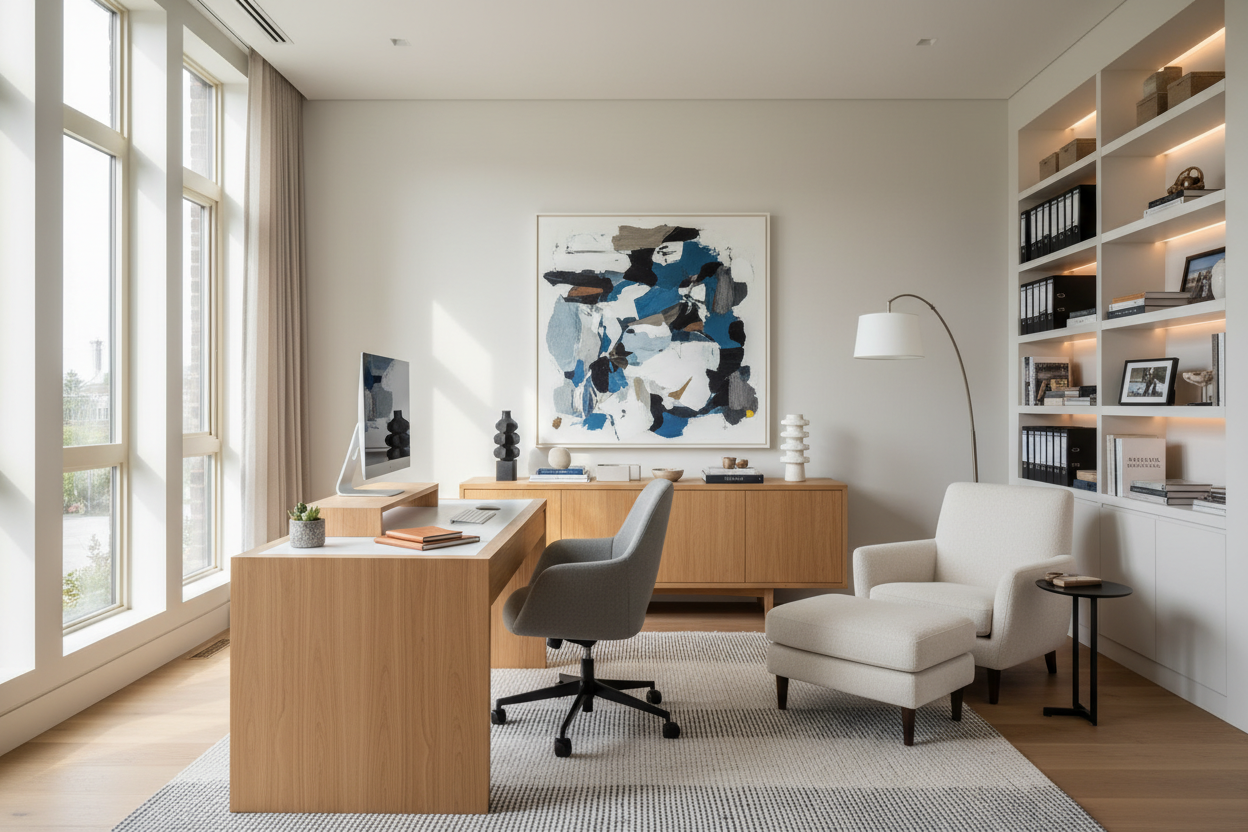
I often advise clients to 'float' these desks. Position the desk facing the door, with the chair behind it. This commands the room and allows the cabinetry to act as a barrier, hiding the inevitable nest of cables that dangle behind your monitor. If you must place it against a wall, balance the heavy bottom silhouette with artwork or open shelving above to draw the eye upward.
Materiality: Beyond the Aesthetic
While the finish determines the style, the core material determines longevity. A desk with cabinet and drawers undergoes significant stress. Drawers are pulled, cabinet doors are swung, and the surface bears the weight of technology.
Solid Wood vs. Veneer
While solid wood is the gold standard for heirlooms, high-quality wood veneers over MDF are often more stable in fluctuating humidity, preventing warping that can cause drawers to stick. However, be wary of 'paper' laminates often found in budget big-box stores. One condensation ring from a water glass can bubble the surface permanently. Look for thermally fused laminate (TFL) or genuine wood veneers sealed with a polyurethane coat.
Ergonomics and The 'Knee-Knock' Factor
The most overlooked aspect of buying a desk with drawers and cabinet is the ergonomic sacrifice. Storage takes up legroom. If you are tall, or if you prefer to cross your legs while working, a desk with a cabinet on the right and drawers on the left can feel claustrophobic.
Check the 'apron' height—the vertical space between the floor and the bottom of the center drawer. Many storage-heavy desks have a shallow center drawer that cuts into thigh clearance. If you use an ergonomic chair with armrests, measure the clearance carefully to ensure the chair can slide fully under the desk when not in use.
Lessons from My Own Projects
I learned a hard lesson about these desks during a project for a client who insisted on a vintage-style executive desk. It looked stunning—mahogany finish, brass hardware, massive storage. But once we installed it, we realized a fatal flaw in the design that you rarely spot in a showroom.
The cabinet door on the right side opened toward the user's knees, not away. Every time the client wanted to access the printer inside, he had to roll his chair backward three feet just to swing the door open. It drove him crazy within a week. Now, whenever I source a desk, I sit in it and simulate the workflow. I check the hinge resistance and the 'thud' sound of the drawer closing. If it sounds hollow or rattles, I walk away. It’s those tactile, unpolished details—like how sharp the metal handles feel against your wrist when typing—that define your daily comfort.
Conclusion
Selecting the right workstation is about marrying the utility of storage with the elegance of design. By paying attention to the joinery, the swing of the doors, and the visual balance of the room, you can secure a piece that elevates your workflow rather than hindering it. Don't settle for clutter; invest in structure.
Frequently Asked Questions
How deep should a desk with a cabinet be?
Ideally, look for a depth of at least 24 to 30 inches. Because the cabinet pushes the user slightly away from the side edges, you need enough depth to keep your monitor at a proper viewing distance without feeling crowded.
Can I change the side of the cabinet?
This depends on whether the desk is 'reversible.' Many modular office systems allow you to assemble the cabinet on either the left or right, but traditional solid wood desks are usually fixed. Always check the assembly manual or product spec sheet before purchasing.
How do I protect the inside of the drawers?
To keep the interior pristine and reduce noise, line the drawer bottoms with felt or a high-quality cork liner. This prevents pens and tools from rolling around and protects the interior finish from ink stains and scratches.

Leave a comment
This site is protected by hCaptcha and the hCaptcha Privacy Policy and Terms of Service apply.