










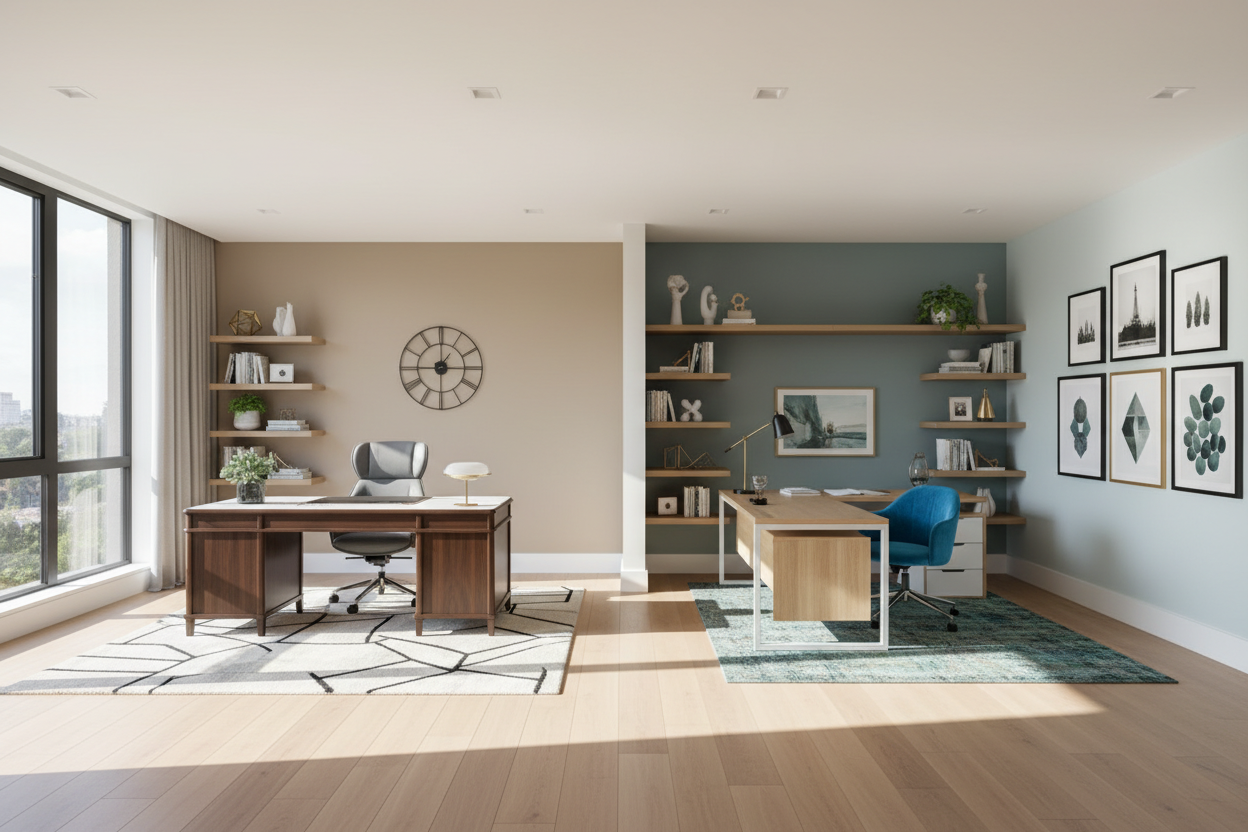
You have likely experienced the frustration of buying a desk that looks proportionate in a showroom, only to have it dominate your room once delivered. This is a classic spatial planning error. Correct home office dimensions are not merely about fitting furniture between four walls; they are about curating a "circulation path" that allows you to think, move, and breathe freely. As a designer, I see homeowners prioritize the aesthetic of the wood grain over the ergonomics of the layout, resulting in a beautiful room that feels claustrophobic the moment you try to roll your chair back.
Quick Decision Guide: Critical Clearances
- The "Active Zone": You need a minimum of 42 to 48 inches of clearance behind your desk to slide your chair back and stand up without hitting a wall or bookshelf.
- Desk Depth: For heavy computer use, aim for a depth of 30 inches to maintain proper focal length; 24 inches is the absolute minimum for laptop-only setups.
- Circulation Paths: Maintain a 36-inch walkway for main entries to ensure the room doesn't feel like an obstacle course.
- Visual Balance: In rooms under 100 square feet, opt for furniture with exposed legs rather than solid block bases to increase the perception of floor space.
Defining the Standard: How Big is a Home Office?
When clients ask, "what is the average size of a home office?" the answer usually lies in the architectural definition of a bedroom. The average square footage of a home office in a dedicated room typically falls between 100 and 150 square feet (roughly 10x10 to 12x12 feet). This standard home office size offers enough volume for a substantial executive desk, shelving units, and perhaps a small seating area for reading.
However, spatial luxury isn't required for function. If you are working with a typical home office size of 120 square feet, you have the flexibility to float the desk in the center of the room, which anchors the space and commands authority. This layout requires precise home office measurements to ensure you can navigate around the perimeter of the desk without brushing against walls.
Small Home Office Dimensions: The Art of the Nook
Not every home has a spare bedroom. When dealing with small home office dimensions, such as a converted closet (cloffice) or a corner of a living room, every inch counts. A functional workspace can be achieved in as little as 30 square feet, provided you respect vertical ergonomics.
The "Cloffice" Challenge
For a small home office size, the depth of the work surface is your limiting factor. Standard closets are often 24 inches deep. If you install a built-in desk at full depth, you must ensure the doors (if you keep them) are bi-fold or sliding. Swing doors will eat into your chair clearance. In these tight quarters, wall-mounted monitors are essential to reclaim desk real estate.
Materiality and Visual Weight
The size of home office furniture must correlate with the room's volume. In a room with generous average square footage of home office space, a heavy walnut desk with a modesty panel adds necessary gravity and texture. Conversely, in a compact space, that same piece will feel monolithic and suffocating.
For smaller footprints, I always recommend materials like glass, acrylic, or lighter wood veneers (white oak or ash). These materials have less "visual weight," making the home office size appear larger than it actually is. The silhouette should be streamlined—think mid-century modern tapered legs rather than heavy shaker-style pedestals.
My Personal Take on Home Office Dimensions
I once designed a study for a client who insisted on a vintage mahogany partners desk he found at an auction. We measured the floor plan meticulously, ensuring the standard office size in home requirements were met. However, I made a rookie mistake: I didn't account for the baseboard heating units and the specific recline arc of his ergonomic chair.
On installation day, we realized that while the desk fit, the moment he reclined, his headrest bumped the bookshelf behind him. It wasn't just tight; it was annoying. We had to swap the bookshelf for floating shelves to gain back those critical 12 inches of depth. Now, I don't just measure the static footprint; I physically tape out the "swivel radius" on the floor. It’s an unpolished, tedious step, but seeing that blue tape on the rug is the only way to guarantee the flow works before the heavy lifting begins.
Conclusion
Whether you are working with the average size of a home office or carving out a niche in a hallway, the success of the design relies on the unseen space—the air between the furniture. By respecting these critical dimensions and clearances, you create a workspace that feels intentional and sophisticated, rather than cluttered and accidental. Measure twice, buy once, and prioritize your movement.
Frequently Asked Questions
How big should a home office be for two people?
For a shared workspace, the average square footage should ideally increase to at least 150-200 square feet. You need a minimum of 60 inches of width per person if sitting side-by-side, or enough room depth to place desks on opposite walls with a 48-inch buffer zone in the center.
What is the average square footage of a home office in new builds?
In modern construction, the average size of a home office is trending slightly smaller, around 90 to 100 square feet, as builders prioritize multi-functional flex spaces over massive dedicated libraries.
What are the minimum small home office dimensions required by code?
While building codes vary, habitable rooms generally need to be at least 70 square feet. However, for a functional workstation nook (not a legal bedroom), you simply need a desk width of 30-36 inches and a depth of 24 inches, plus circulation space.

Leave a comment
This site is protected by hCaptcha and the hCaptcha Privacy Policy and Terms of Service apply.