










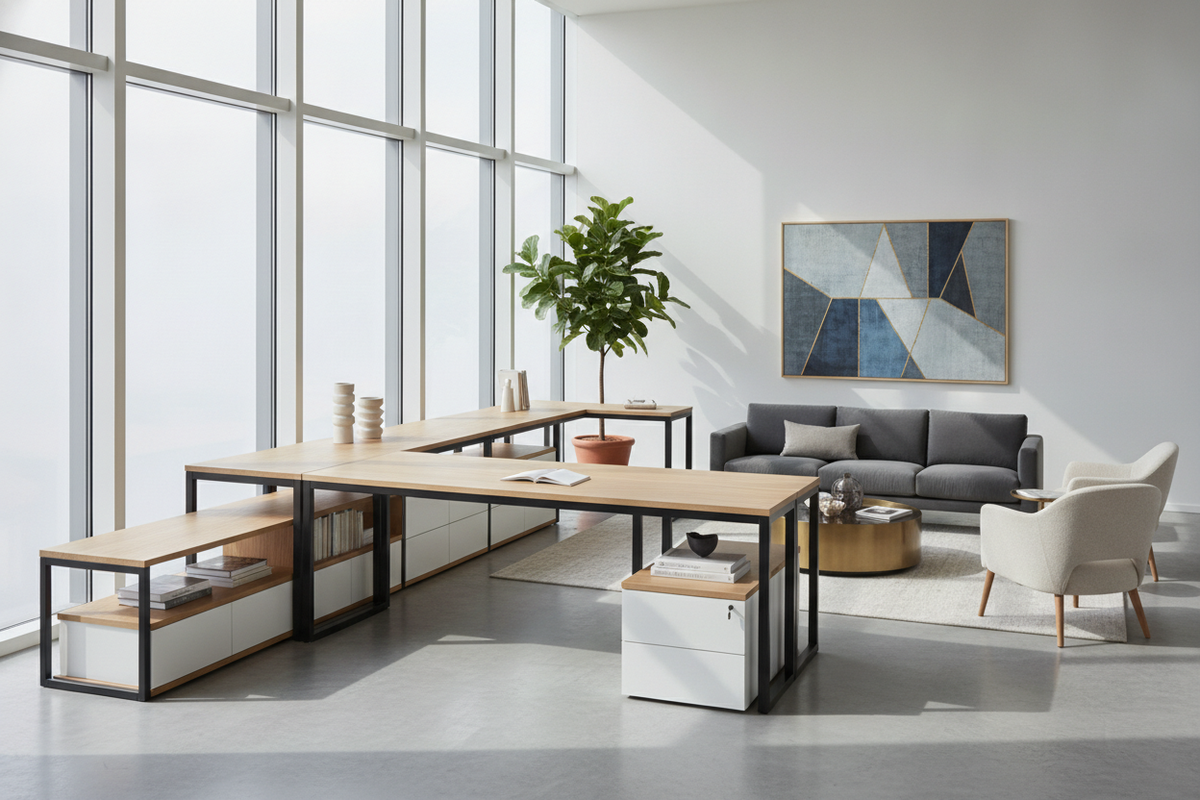
Structural Geometry: Differentiating True Corner Desks and L-Shaped Workstations
Selecting the right desk for an angular room layout requires distinguishing between true corner units and modular L-shaped desks. While both styles maximize spatial efficiency by utilizing room perimeters, their structural geometry, desktop depth, and legroom profiles serve distinctly different workflow demands.
Wedge and Pentagonal Corner Units for Compact Angles
True corner desks typically feature a wedge, triangular, or pentagonal footprint designed to sit snugly into a single ninety-degree corner. The primary work surface is oriented diagonally across the corner angle. This geometry allows the unit to nest flush against two intersecting walls without occupying significant lateral wall length. However, because the user faces directly into the corner junction, usable surface depth narrows toward the front edge, making these designs best suited for single-monitor setups, laptop computing, and compact administrative tasks.
Symmetrical vs. Asymmetrical L-Shaped Desk Configurations
L-shaped desks expand upon the corner concept by joining two distinct rectangular work surfaces at a right angle. These configurations fall into two broad structural categories:
- Symmetrical Designs: Both the primary desk surface and the adjoining return feature equal lengths and depths. This provides balanced dual-zone workstations suitable for dividing tasks such as digital computing and manual drafting or paperwork. Exploring a broader computer desk collection can help clarify how symmetrical desk dimensions compare to standard rectangular footprints.
- Asymmetrical Designs: One side serves as the extended main desk, while the shorter side acts as a secondary return for peripherals, secondary monitors, or integrated shelving. Asymmetrical desks allow users to prioritize primary seating depth while maintaining a lower-profile auxiliary wing along an adjacent wall.
Spatial Footprint Tiers: Matching Desk Proportions to Room Scale
Proper workspace planning requires aligning desk dimensions with available room clearance, door swings, and walking paths. Corner and L-shaped tables generally fall into three structural tiers.
Compact Nook Workstations for Tight Corners
Designed for multi-purpose rooms, studio apartments, and small study alcoves, compact corner workstations prioritize vertical storage over extensive lateral reach. These units frequently incorporate upper hutches or slim open shelving underneath the corner joint. For spaces where a dedicated corner desk might visually dominate the room, comparing these layouts against a concealed computer desk office guide can offer alternative insights into space optimization.
Mid-Scale Systems for Dedicated Home Studies
Mid-scale systems provide sufficient desktop depth along the primary wing for full-size desktop monitors and peripheral equipment, while the return provides dedicated area for organization or secondary hardware. Choosing an adaptable office computer corner product provides a balanced footprint that anchors a dedicated home study without overwhelming standard residential room dimensions.
Expanded Executive and Multi-Monitor Command Centers
Executive-tier L-shaped workstations feature generous desktop depths on both spans, providing ample clearance for multi-display monitor arms, desktop audio equipment, and physical filing systems. These setups require substantial room perimeters to ensure comfortable passage behind the seated user.
Storage Architecture and Ergonomic Clearance
Integrating storage into corner and L-shaped desks involves balancing organizational capacity against open knee-well movement.
Balancing Built-In Pedestals, Shelving, and Leg Movement
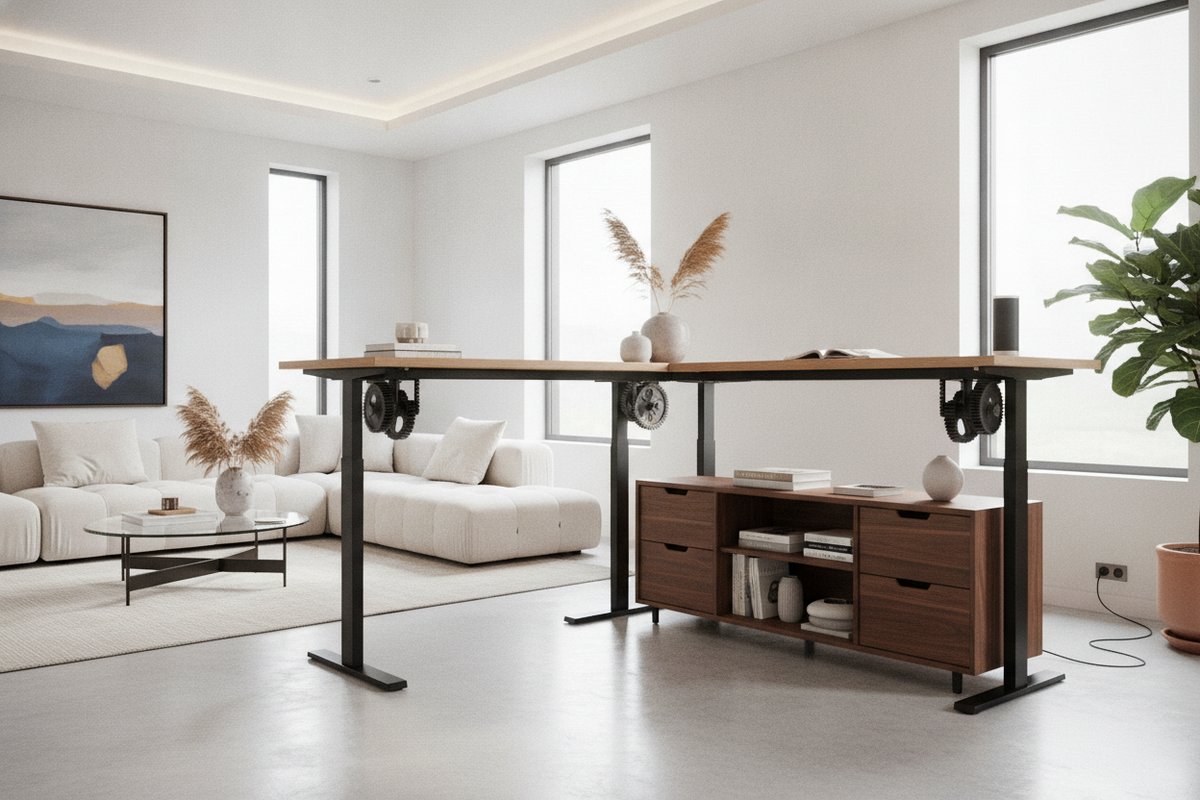
In L-shaped desks, the corner junction is the most critical ergonomic zone. Workstations with center support legs or closed corner panels can restrict diagonal chair rotation. Well-engineered desks position storage pedestals and open shelving on the outer edges of the return rather than the inner vertex. Incorporating an office computer desk product with integrated outer shelving preserves open legroom underneath the main bridge, allowing seamless movement between work zones.
Corner Junction Cable Pathways and Power Management
Managing cables on an L-shaped desk presents unique challenges due to the dual-wall alignment. Desks featuring dedicated desktop grommets at the corner vertex allow power and display cords to pass directly beneath the desk surface. Positioning power strips along the inner frame rails keeps wiring elevated and clear of foot movement while preventing tangles across the return joint.
Room-by-Room Layout and Placement Playbook
The positioning of a corner or L-shaped workstation dictates the flow and functionality of the entire room.
Configuring a Bedroom with an L-Shaped Desk Setup
Integrating an office workspace into a sleeping area requires distinct visual zoning to prevent work materials from encroaching on relaxation spaces. Positioning an L-shaped desk into a room corner farthest from the bed helps maintain clear separation between resting and working zones. Reviewing an office computer desk guide can provide useful strategies for styling functional workspaces that complement residential bedroom decor.
Dedicated Office Zoning: Wall Flush vs. Floating Peninsula Orientations
In a dedicated study, L-shaped desks can be installed in two primary orientations:
- Wall-Flush Orientation: Both desk wings align directly against intersecting walls, maximizing central floor space and providing solid backing for wall-mounted shelving or acoustic panels.
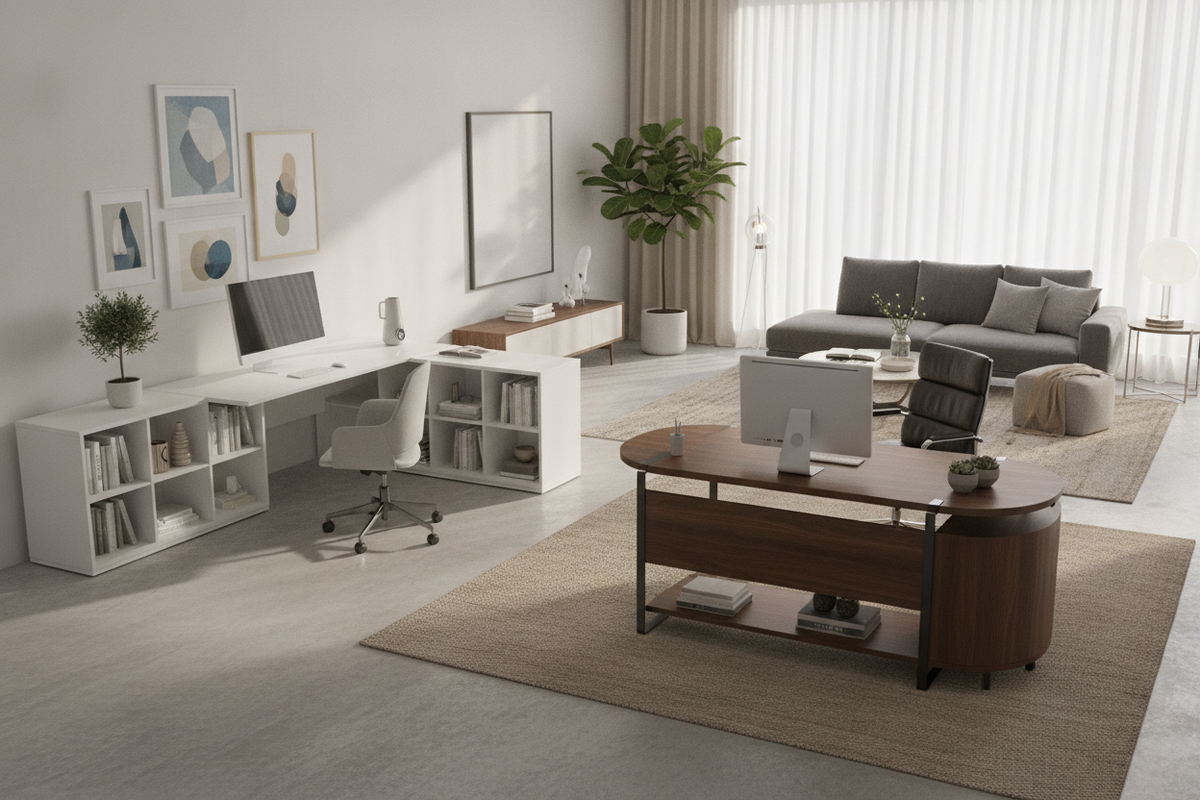
- Floating Peninsula Orientation: The main desk wing rests against a wall while the secondary return extends outward into the center of the room. This configuration creates an executive layout that defines a distinct functional barrier, separating the primary work zone from the rest of the room.
Material Composition, Frame Rigidity, and Assembly Logistics
Due to the two-piece joined construction of L-shaped tables, structural integrity and precision assembly are essential for long-term stability.
Substrate Quality, Surface Finishes, and Load-Bearing Frames
Modern corner desks typically pair engineered wood substrates with durable laminate veneers and powder-coated steel underframes. Heavy-gauge metal legs equipped with diagonal corner gussets reduce wobble along the joined seam, ensuring that equipment transitions smoothly across the junction between surfaces.
Reversible Return Assembly and Corner Leveling Techniques
Many modular L-shaped desks offer reversible configurations, allowing the return wing to mount on either the left or right side of the main desk. This flexibility allows the desk to adapt to varying room layouts, window placements, and power outlet locations. Furthermore, adjustable leveling feet are critical for corner installations, enabling users to compensate for uneven flooring along baseboards and ensure a completely flat, seamless desktop surface.
Strategic Decision Matrix: Selecting Your Ideal Corner or L-Shaped Table
To choose the right corner desk or L-shaped workstation, evaluate your primary spatial constraints and daily workflow needs:
- Assess Corner Geometry: Choose a compact pentagonal corner unit for tight single-user nooks, or select an L-shaped desk when multi-screen setups and broad surface area are necessary.
- Determine Orientation: Confirm whether your room requires a left-facing or right-facing return, or opt for a reversible frame for long-term versatility.
- Evaluate Storage Needs: Select open shelving or pedestal drawers mounted on the perimeter to preserve unrestricted leg movement at the corner junction.

Leave a comment
This site is protected by hCaptcha and the hCaptcha Privacy Policy and Terms of Service apply.