










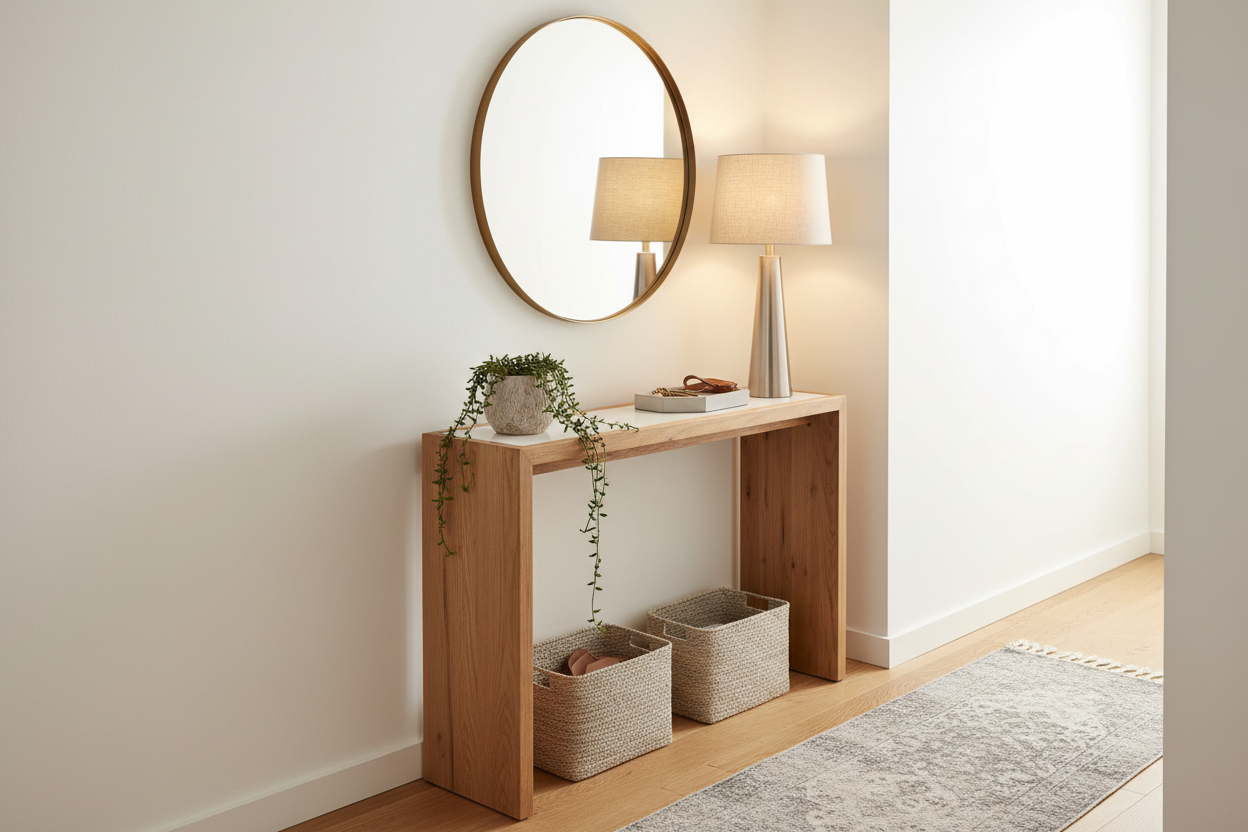
Your entryway is the handshake of your home. It creates that immediate impression for guests and serves as the psychological transition point for you after a long day. Yet, this space is often neglected, becoming a chaotic dumping ground for mail, keys, and discarded shoes. The solution usually isn't a massive renovation, but rather the strategic addition of a single piece of furniture: the console. Finding the right piece involves balancing strict spatial constraints with the need for a functional drop zone.
Defining the Purpose of Your Entryway
Before pulling out the measuring tape, look at how you currently use the space. Is your hallway purely a corridor, or does it function as a mudroom? If you find yourself constantly losing car keys or needing a place to set down groceries while you take off your coat, functionality needs to take precedence over pure ornamentation. A simple ledge won't cut it. You likely need a hallway table stand that incorporates drawers or a lower shelf. This verticality allows you to double your storage footprint without encroaching on the walkway.
Conversely, if your hallway is narrow and serves only to connect rooms, a bulky unit will make the walls feel like they are closing in. In this scenario, the goal is visual anchoring. You want a surface that breaks up the monotony of a long wall without obstructing traffic flow. This is where open-frame designs or glass tops shine, as they maintain an airy feel while providing a platform for a lamp or a piece of art.
My Battle with the "Shin-Bruiser"
I learned the importance of depth the hard way. In my second apartment, I fell in love with a gorgeous, heavy oak farmhouse console. It was sturdy, beautiful, and completely wrong for the space. I placed it in a hallway that was barely thirty-eight inches wide. The table was eighteen inches deep. Do the math, and you’re left with twenty inches of walking space.
For two years, I walked sideways past that table. Guests bumped their hips against the corners. Carrying laundry baskets past it became a tactical operation. I eventually replaced it with a slim, metal hall table stand that was only ten inches deep. The difference was immediate. The hallway felt twice as big, and the bruises on my shins finally healed. The lesson stuck: in a hallway, inches matter more than style. Always leave at least 36 inches of clearance for comfortable walking; if you can't, you need a slimmer table or a floating shelf.
Navigating Dimensions and Proportions
Getting the scale right prevents the furniture from looking like a mistake. Height is just as critical as depth. Standard console tables range from 30 to 36 inches high. This height is intentional; it allows you to drop keys without bending over and places table lamps at an appropriate level for casting light. If you place a low media unit in a hallway, it looks out of place, like it drifted away from the living room.
Length is more flexible, but visual balance is key. A tiny table on a long, expansive wall looks dinky and unintentional. A massive table on a short wall looks overwhelming. A good rule of thumb is to leave about 6 to 12 inches of wall space on either side of the table. This breathing room frames the piece and makes the arrangement look deliberate.
Material Selection and Durability
High-traffic areas demand durable materials. Your hallway sees purses being dropped, wet umbrellas leaning nearby, and people brushing past with zippers and bags. Delicate finishes often suffer here. A reclaimed wood surface is forgiving; scratches and dents tend to blend into the grain. Metal and glass offer resilience and are easy to wipe down, making them excellent choices for modern aesthetics.
If you have children or pets, consider stability. A lightweight, top-heavy hall table stand can be a tipping hazard. Look for pieces with weighted bases or secure the unit to the wall with a simple bracket. This is especially true for those ultra-slim designs that are popular in tight urban apartments.
Styling Your Console: The Rule of Three
Once you have the furniture in place, the challenge shifts to decoration. An empty table looks sad, but a cluttered one looks messy. Designers often rely on the "triangle" method or the rule of three to create a balanced vignette. This usually involves a tall item, a wide item, and a small decorative object.
Start with lighting. A tall, slender lamp adds height and provides a warm, welcoming glow that overhead lights can't match. If space is too tight for a lamp, a wall sconce above the table works beautifully. Next, add an anchor piece, usually a mirror or a large piece of art hung on the wall centered over the table. A mirror is particularly effective in a table hall setup because it reflects light and tricks the eye into perceiving the narrow corridor as wider than it actually is.
Finally, add the functional layer. A shallow bowl, a woven tray, or a decorative box is essential. This is the designated "catch-all" for keys, coins, and mail. By containing these small items, you keep the surface looking polished even when it's in use. Greenery, such as a tall vase with branches or a small potted succulent, adds the requisite life and texture to finish the look.
Creative Solutions for awkward Layouts
Sometimes a standard rectangular table just doesn't fit the architecture. If your door opens directly into the living room with no defined foyer, you can use a console table backed against a sofa to create a phantom hallway. This defines the circulation path and gives you a place to put down your things without walking all the way into the room.
For corners or odd nooks near the door, a demilune (half-moon) table is a smart alternative. The curved edges save space and prevent painful hip-checks in tight turns. If floor space is non-existent, a wall-mounted floating console provides the surface area you need without taking up any footprint, keeping the floor visible and the space feeling open.
Ultimately, the goal is to merge utility with personality. Whether you choose a sleek, modern hallway table stand or a vintage wooden piece, the right console transforms a pass-through space into a destination, setting the mood for the entire home the moment you walk through the door.
Frequently Asked Questions
What is the ideal depth for a hallway table in a narrow corridor?
For narrow corridors (around 36 to 42 inches wide), aim for a table depth of 10 to 12 inches. This ensures you maintain a comfortable walking path without having to turn sideways. If your hallway is wider, you can go up to 15 or 18 inches, but always prioritize walkway clearance over table surface area.
Can I use a console table behind a sofa instead of a wall?
Yes, placing a console table behind a floating sofa is an excellent way to define an entryway in an open-concept home. Ensure the table is slightly lower or the same height as the sofa back so it doesn't look awkward. This arrangement helps zone the room and provides a surface for lamps or decor that can be seen from the entryway.
How high should a mirror be hung above a hall table?
A mirror should generally be hung 6 to 8 inches above the highest point of the table surface. This connects the mirror to the furniture visually, creating a cohesive unit rather than two floating objects. Ensure the center of the mirror is roughly at eye level, usually about 57 to 60 inches from the floor.

Leave a comment
This site is protected by hCaptcha and the hCaptcha Privacy Policy and Terms of Service apply.