











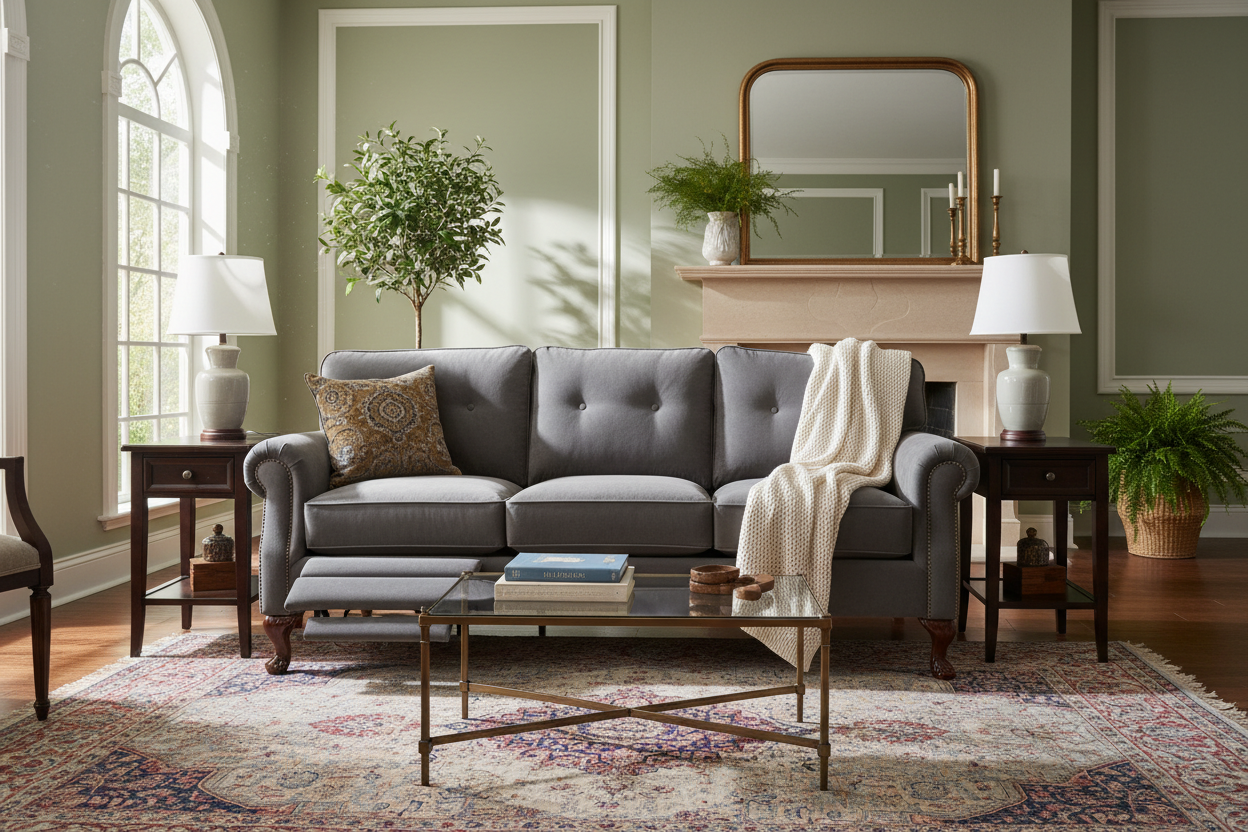
One of the most frequent requests I receive from clients involves a specific tug-of-war: one partner wants the unbridled comfort of a recliner, while the other fears it will turn their sophisticated living room into a casual media den. For years, the design community shied away from motion furniture for this very reason. However, the modern iteration of the traditional reclining sofa has evolved significantly. You no longer have to sacrifice a cohesive, elegant aesthetic for the sake of ergonomics. With the right silhouette and upholstery, these pieces can actually serve as a refined anchor for your formal sitting area.
Quick Decision Guide: Key Features to Look For
If you are rushing to make a purchase, prioritize these four elements to ensure longevity and style:
- Mechanism Type: Choose "Wall-Hugger" mechanisms for smaller rooms, or "High-Leg" push-backs to disguise the reclining function entirely.
- Frame Construction: Look for kiln-dried hardwood frames rather than plywood; this prevents warping over time.
- Suspension: Eight-way hand-tied springs offer superior support compared to simple sinuous springs.
- Upholstery Grade: Opt for top-grain leather (for patina) or high-performance wovens (for stain resistance) with a rub count over 30,000.
Mastering the Silhouette: Disguising the Motion
The hallmark of a poorly designed recliner is visual bulk. To maintain a traditional aesthetic, you must look for specific architectural details that mimic stationary furniture. I always steer clients toward "high-leg" models. These sofas sit on wooden legs—often turned or tapered—rather than a heavy, upholstered skirt or a black metal base that sits flush with the floor.
Look for classic design elements such as rolled arms, nailhead trim, or diamond tufting (reminiscent of a Chesterfield). These details draw the eye to the craftsmanship rather than the split in the footrest. When the sofa is in the upright position, it should be indistinguishable from a standard heritage piece.
Choosing the Right Material for Longevity
In traditional interiors, texture is paramount. While velvet is luxurious, it can be tricky with motion furniture because the friction of the moving parts can crush the pile unevenly over time. Instead, I recommend a buttery, aniline-dyed leather. Leather ages beautifully, developing a rich patina that suits traditional decor perfectly. If you prefer fabric, select a heavy-weight tweed or a tightly woven chenille. These materials have enough visual weight to balance the physical size of a reclining sofa without looking flimsy.
Space Planning and Traffic Flow
The most common error I see in floor plans is failing to account for the "pitch"—the distance the back of the sofa travels when reclined. Standard recliners require 12 to 18 inches of wall clearance. If you are floating the sofa in the center of a room, this isn't an issue, but against a wall, it can push your furniture footprint too far into the room.
Additionally, consider the coffee table gap. Because the footrest extends outward, you need at least 18 to 24 inches of clearance between the sofa edge and your coffee table. For traditional layouts, I often swap a heavy rectangular coffee table for two smaller, round ottomans or nesting tables that can be easily moved when it's time to kick back.
Lessons from My Own Projects: The "Floating Cord" Dilemma
I learned a hard lesson about power recliners during a renovation for a client in a historic brownstone. We selected a stunning, power-reclining traditional sofa to float in the center of the room, facing the fireplace. It was upholstered in a cognac leather and looked incredible.
However, on installation day, we realized a critical oversight: the power cord. Because the sofa was floating in the middle of the room, we had an ugly black cable snaking across a beautiful hand-knotted Persian rug to reach the nearest wall outlet. It completely ruined the high-end look. We ended up having to purchase a specialized, rechargeable battery pack that tucks underneath the frame to make it cordless. Now, I never specify a power recliner for a floating layout unless I know there is a floor outlet directly underneath, or we budget for a battery pack immediately. It’s a small logistical detail that saves a massive headache later.
Conclusion
Integrating motion furniture into a formal space is about deception. By prioritizing high-leg silhouettes, authentic materials, and mindful spacing, your traditional reclining sofa will offer the best of both worlds. Measure your clearances twice, check the mechanism's smoothness, and trust that comfort does not have to look cluttered.
Frequently Asked Questions
How do I style throw pillows on a reclining sofa?
Keep it minimal. Recliners often have angled backs or built-in lumbar support. Use two substantial 22-inch pillows in the corners for color, but avoid over-layering, as they will constantly fall off when the seat is engaged.
What is the difference between manual and power reclining for traditional styles?
Manual recliners (often push-back style) usually look more traditional because they lack buttons or control panels. However, power recliners offer infinite stopping positions and are better for individuals with limited mobility.
Can I use a slipcover on a traditional reclining sofa?
Generally, no. Custom slipcovers are difficult to fit onto motion furniture because the fabric can get caught in the scissor mechanisms. It is better to choose a performance fabric upholstery from the start.

Leave a comment
This site is protected by hCaptcha and the hCaptcha Privacy Policy and Terms of Service apply.